

Start with something most articles on this topic will not tell you: there is no credible current ranking of the best places to live in Canada. MoneySense stopped publishing its Best Places to Live list in 2018. Every 2026 ranking now circulating traces back to a residency consultancy, an immigration law firm, a mortgage lead-generation site or a moving company, none of which publish their weights, data sources or methodology.
We are a moving company too, which is exactly why this guide does the opposite. Below are the five things we scored, the source for each, and where each community lands. Disagree with the weighting and you can rebuild it yourself.
What this is built on
- Crime: Criminal Code offences per 1,000 residents, 2024, from the province’s Police Resources in British Columbia report.
- Jobs: unemployment rate by economic region, June 2026, from Statistics Canada via WorkBC.
- Healthcare: whether the community has a trauma-designated hospital, and its health authority’s family-doctor waiting list per 1,000 people.
- Climate: Environment and Climate Change Canada climate normals for the nearest station, on precipitation, wet days, summer highs and winter lows.
- Cost: the 2025 Living Wage BC rate, which prices a real household budget the same way in every community it covers.
Deliberately left out: Walk Score, Numbeo, “quality of life indexes” from insurance and real-estate sites, and any ranking whose methodology is not published. Those make up most of what ranks for this search.
The shortlist
| Community | Crime per 1,000 | Regional unemployment | Living wage | Trauma hospital |
|---|---|---|---|---|
| Saanich | 30 | 5.7% | $27.40 | Level 2 next door |
| North Vancouver District | 32 | 6.8% | $27.85 | Level 3, Lions Gate |
| Kimberley | 34 | 4.6% | — | Cranbrook, 30 min |
| Comox | 35 | 5.7% | $25.35 | No |
| Coquitlam | 43 | 6.8% | $27.85 | Level 1, 20 min |
| New Westminster | 61 | 6.8% | $27.85 | Level 1, Royal Columbian |
| Cranbrook | 127 | 4.6% | — | Tertiary referral |
| Nelson | 91 | 4.6% | $24.45 | No |
| Kamloops | 111 | 7.5% | $24.45 | Level 2, Royal Inland |
| Nanaimo | 101 | 5.7% | $24.40 | Level 3 |
| Kelowna | 104 | 7.5% | $25.95 | Level 2 |
| Prince George | 180 | 5.7% | $23.15 | Level 3, UHNBC |
Crime: Police Resources in BC, 2024. Unemployment: WorkBC, June 2026, by economic region rather than by town. Living wage: Living Wage BC 2025; a dash means the community is not costed. Small regional service centres like Cranbrook and Nelson carry inflated crime rates because the rate divides by residents only, a distortion we explain in our guide to the safest cities in BC.
Best for each thing
Best for weather, if you want sun and dry
Kamloops. It records 277.6 mm of precipitation a year across just 105.6 wet days, the driest of any major BC community, with July highs averaging 29.3°C and about 2,080 hours of sunshine. Osoyoos runs hotter still at 31.6°C in July, and Penticton has the mildest Okanagan winter at −3.2°C in January, a full 3.1°C warmer than Kelowna.
For mild rather than dry, Victoria: January lows averaging 3.8°C and 674.9 mm of precipitation at the Gonzales station, less than half what falls on downtown Vancouver.
A caution on the sunshine claims you will see. Cranbrook records 2,190.5 hours and Victoria Gonzales 2,193.3, a gap of under three hours in more than two thousand. Both cities claim to be BC’s sunniest and neither claim is supportable. Environment Canada also stopped measuring bright sunshine at most stations decades ago, so some of those figures come from a 1961 to 1990 period rather than the current one.
Best for jobs
The Kootenays. The region posted 4.6 per cent unemployment in June 2026, the lowest in British Columbia and nearly four points below the Northeast. Cranbrook, Nelson, Kimberley, Trail, Castlegar, Fernie and Rossland all sit inside it, and they combine that with housing well below the provincial average.
This is the finding that surprised us most, because it inverts the usual story. The cheapest housing in BC is in the Northeast, which has the province’s highest unemployment at 8.2 per cent. The Kootenays are cheap and busy at the same time.
Best for healthcare access
New Westminster. Royal Columbian is the only Level 1 trauma centre in British Columbia outside Vancouver, and New West sits in Fraser Health, which has a family-doctor waiting list of 49 people per 1,000, well under Island Health’s 133.
The regional picture matters more than most guides admit:
| Health authority | Waiting for a family doctor, per 1,000 |
|---|---|
| Island Health | 133 |
| Interior Health | 88 |
| Northern Health | 58 |
| Fraser Health | 49 |
| Vancouver Coastal | 41 |
Health Connect Registry figures, July 2025, obtained by freedom of information and published by BC Health Data, an independent analyst site. The Province reports that roughly 77 per cent of British Columbians had a primary care provider as of April 2026 but publishes no regional breakdown.
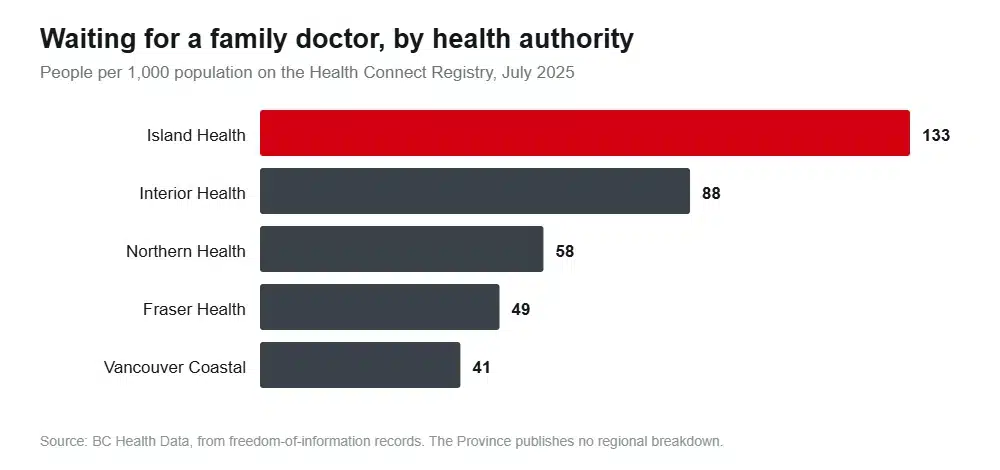
Island Health has roughly three times Vancouver Coastal’s waiting rate. That cuts against every Vancouver Island community on this list, and it is the strongest argument against the standard advice to retire to the Island.
Rural emergency departments are the other half of this. Northern Health recorded 628 hours of ER closures across 46 events in the northeast in 2025 alone, all attributed to staffing.
Best for keeping costs down
Trail, Port Alberni and Grand Forks, at living wages of $22.95, $22.60 and $21.55. At $23.15, Prince George is the cheapest place in BC with a university and a trauma hospital.
Best for safety
Greater Victoria’s residential municipalities and the North Shore. Oak Bay at 25 offences per 1,000, Central Saanich at 26, Saanich at 30 with over 125,000 residents, Port Moody at 29 and the District of North Vancouver at 32.
Best all-round, if you want one answer
Saanich is the closest thing BC has to a place that scores well on everything at once: 30 offences per 1,000 across a population of 125,444, a region with 5.7 per cent unemployment, mild coastal weather, and a Level 2 trauma centre and a university next door. The catch is Island Health’s doctor waiting list and a living wage of $27.40, third highest in the province.
North Vancouver District is the Lower Mainland equivalent: 32 offences per 1,000 across 102,285 people, Lions Gate Hospital, full SeaBus and bus access to downtown, and the region with BC’s highest concentration of professional and technical employment. North Van is also expensive, with detached homes benchmarked at $2,088,400 in August 2026.
Where the data does not support the reputation
Four places that appear on almost every list, with what the numbers say.
Whistler. No trauma hospital, no post-secondary institution, no airport. Its regional district, Squamish-Lillooet, was the fastest-shrinking in BC in 2024 to 2025, down 0.7 per cent. And it has the highest living wage in the province at $29.60, meaning a household needs more to get by there than in Metro Vancouver. It was ranked 20th in Canada by MoneySense, in 2018.
Oak Bay. The safest municipality in BC at 25 offences per 1,000, and it lost 0.6 per cent of its population between 2016 and 2021, one of only two candidate communities to shrink. No hospital, no post-secondary, no airport of its own. Its case rests entirely on climate and proximity to Victoria.
Port Moody. Excellent on crime at 29 per 1,000, with SkyTrain. Population growth 2016 to 2021: 0.0 per cent. Flat. If your question is where people are actually choosing to move, Port Moody’s own census answer is nowhere.
Squamish. Genuinely fast-growing, up 22.2 per cent from 2016 to 2021 and tied for BC’s fastest municipal growth in 2024 to 2025 at 3.6 per cent. But it has no trauma hospital, no post-secondary campus, no airport, and the second-highest living wage in the province at $28.00. A ninety-minute drive to Lions Gate is the reality for anything serious.
Where people are actually going
Migration is a better signal than any list. BC Stats’ figures for the year to July 2025:
- Fastest growing over 10,000 people: Langford and Squamish, both +3.6 per cent, then Parksville +2.7 and Courtenay +2.6
- Fastest growing at any size: Kitimat at +9.6 per cent, driven by LNG Canada
- Largest absolute gain: Surrey, +13,377 people
- Shrinking regional districts: Squamish-Lillooet −0.7 per cent, Thompson-Nicola −0.1, North Coast and Mount Waddington
Note that Vancouver Island takes three of the top four growth spots. Whatever the doctor waiting lists say, people are voting for the Island.
One ranking that is real
The Economist Intelligence Unit’s Global Liveability Index is the exception: a documented methodology, 30 indicators across stability, culture and environment, healthcare, infrastructure and education, with published weights. Its 2026 edition placed Vancouver 9th of 173 cities worldwide with a score of 96 out of 100, up from 10th, the only Canadian city in the global top ten.
The index also covers only that one BC place, so it settles nothing about Nelson versus Parksville.
Frequently asked questions
What is the best place to live in BC?
On the five indicators here, Saanich comes closest to scoring well on all of them, with North Vancouver District the Lower Mainland equivalent. If cost matters most, the Kootenays combine the province’s lowest unemployment with below-average housing. There is no single right answer, which is why we published the criteria rather than a number.
What is the best small town in BC?
Kimberley on the data: 34 offences per 1,000, a typical assessed house value of $517,000 in nearby Cranbrook, and the province’s lowest regional unemployment at 4.6 per cent, with East Kootenay Regional Hospital half an hour away. Comox at 35 offences per 1,000 is the Vancouver Island equivalent.
Where is the best weather in BC?
Kamloops for dry and sunny, at 277.6 mm of precipitation across 105.6 wet days a year. Osoyoos for heat, at July highs of 31.6°C. Victoria for mild, with January lows averaging 3.8°C. Prince George is the hardest of the major centres, with an annual mean of 4.3°C.
Is Vancouver Island a good place to live?
On jobs and safety, yes: Vancouver Island and Coast had 5.7 per cent unemployment in June 2026 and the region holds several of BC’s safest municipalities. The serious qualification is primary care. Island Health’s family-doctor waiting list runs at 133 per 1,000 people, roughly three times Vancouver Coastal’s. If you need a doctor, factor that in before you fall for the weather.
What are the fastest-growing places in BC?
Langford and Squamish tied at 3.6 per cent in the year to July 2025 among municipalities over 10,000, with Parksville at 2.7 and Courtenay at 2.6. Kitimat grew 9.6 per cent, the fastest in the province at any size.
How we put this together
Crime from Police Resources in British Columbia 2024, unemployment from WorkBC’s June 2026 update, population from BC Stats’ 2025 sub-provincial estimates, climate from Environment and Climate Change Canada normals, living wages from Living Wage BC 2025, and hospital designations from the Trauma Association of Canada and Interior Health.
Four honest limits. Unemployment is published by economic region rather than by municipality, so every town in the Kootenays carries the same 4.6 per cent. Living Wage BC covers 27 communities, not every place here. The family-doctor figures come from freedom-of-information data published by an independent analyst, because the Province publishes no regional breakdown. And several smaller BC communities have no Environment Canada climate station of their own, so any weather figure you see for them is modelled rather than measured.
Sources
- Police Resources in British Columbia, 2024
- BC Stats, sub-provincial population estimates 2025
- WorkBC, labour market monthly update
- Environment and Climate Change Canada, climate normals
- Living Wage BC, 2025 rates
- Province of BC, primary care attachment, April 2026
- BC Health Data, primary care attachment by region
- Interior Health, hospitals map
- MoneySense, Canada’s Best Places to Live 2018 (final edition)
For a closer look at one of them, our honest read on the North Shore weighs the parks and the hospital against the bridges and the rain.
At the eastern edge of Metro Vancouver, our read on Maple Ridge weighs a million park visits a year against the region’s longest commutes.
For the sub-region with four SkyTrain stations and the same commuter problem, we have weighed up the Tri-Cities the same way.
For the one Metro Vancouver city where nobody changes trains to reach downtown, we have weighed up New Westminster the same way.
At the expensive end of the region, we have weighed up West Vancouver the same way, including the parts of its reputation that the data does not support.
Shortlisted a couple of places? The affordability ranking and the running-cost breakdown are the two pages that usually settle a shortlist. We handle long-distance moves across British Columbia. Send us the two addresses.
