

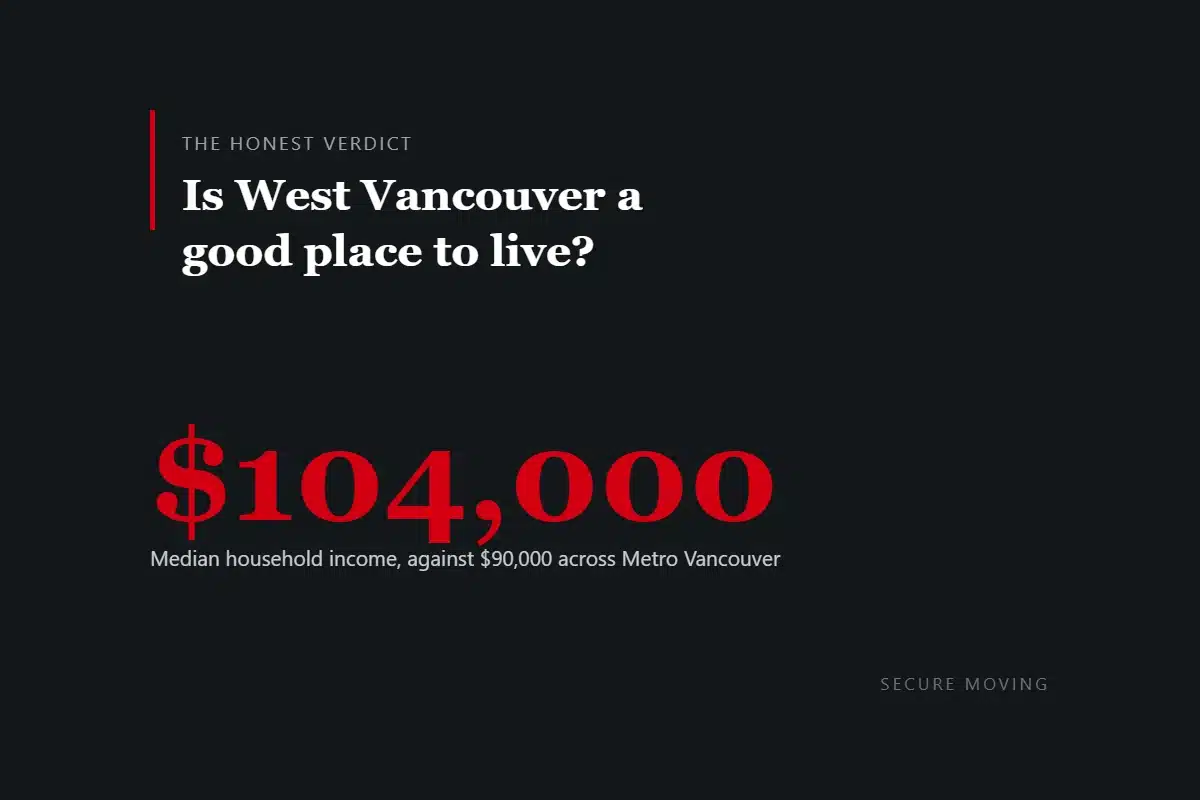
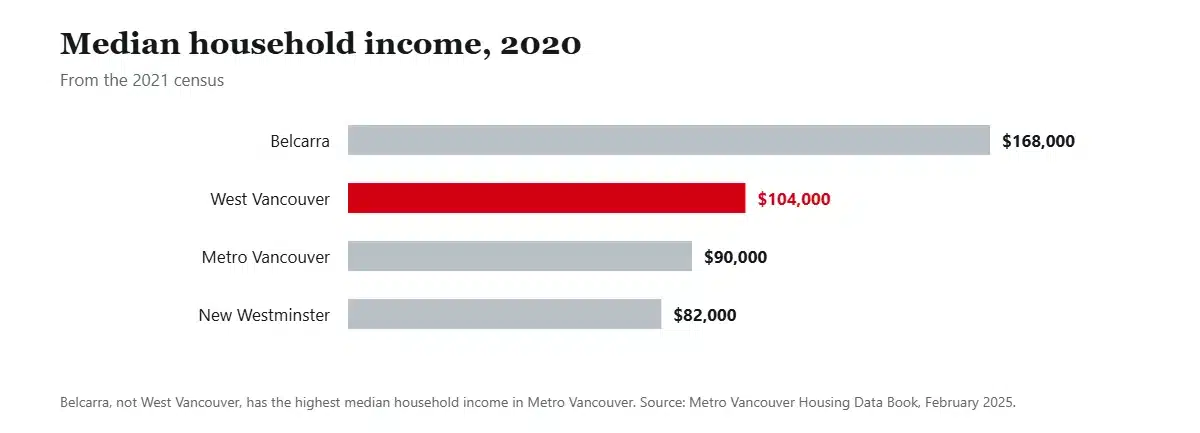
West Vancouver has a reputation as the richest place in Canada, and the income data does not support it. Median household income here was $104,000 in 2020 against $90,000 across Metro Vancouver. That is a 16 per cent premium, and it is lower than Belcarra.
What is extraordinary is not the income. It is the assets sitting underneath it. The median dwelling was worth $2.5 million against $1.1 million regionally, the ratio of home value to household income runs 24 against a regional 12, and 56 per cent of owners have no mortgage at all. Not a town of high earners, then, but a town of people who bought a long time ago and own outright.
Almost everything else about living here follows from that, including the fight the District is currently having with the Province.
The short version
- Median age 51 in 2021, a decade above the regional 41, with seniors approaching a third of residents.
- The population grew 7 per cent between 2001 and 2021 while Metro Vancouver grew 33.
- Six in ten working residents commute out of the District, and at least 80 per cent of daily trips are by car.
- The District delivered 172 net new homes against a cumulative provincial target of 462, and in April 2026 the Province imposed a local area plan on it by Order in Council.
- There is no hospital and no urgent care centre in West Vancouver. Both are in North Vancouver.
- Life expectancy in the local health area is 87 years, against 82 for British Columbia.
Who actually lives here
The age profile is the reputation that holds up. Median age reached 51 in 2021 against a regional 41, seniors are approaching a third of the population, up from a fifth in 2001, and the District’s own community profile uses the phrase “missing generation” for the younger adults who are not here. More than half of households have no children living at home, and 54 per cent of the residential building stock went up in 1980 or earlier.
The income distribution has an unusual shape too. Twenty-six per cent of households are above $200,000, against 13 per cent regionally, and 21 per cent are below $45,000. Those two facts sit together because a lot of the second group are retired owners drawing on assets rather than earning.
And the population barely moves. Seven per cent growth over twenty years against a region that grew a third, an average of 1.5 per cent every five years against the region’s 7.6. Its own forecast is about 54,000 residents by 2041, which would still be a rounding error at regional scale.
Work, and getting to it
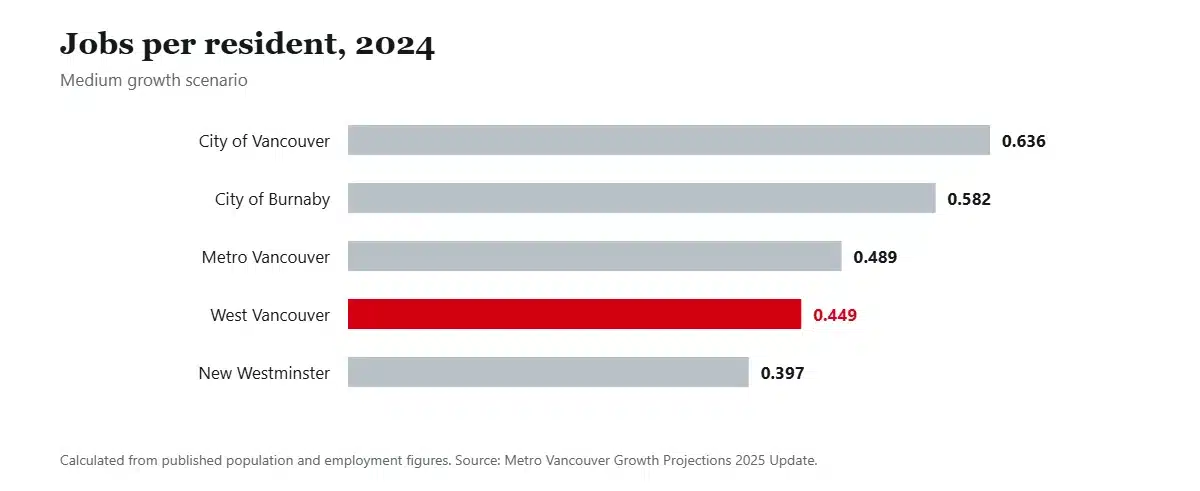
At 0.449 jobs per resident West Vancouver sits below the regional 0.489 but comfortably above New Westminster. That is not a jobs desert, and the projections have it drifting up to 0.479 by 2051 without ever catching the region.
The commute figures are more useful than the ratio. About 60 per cent of working residents leave the District every day, 20 per cent of them for the rest of the North Shore and 27 per cent for Vancouver. Cars account for at least 80 per cent of daily trips regardless of purpose, and unlike the rest of the region, transit ridership here has slightly declined.
Its planners explain why in one line: 80 per cent of residents live outside the commercial centres while 40 per cent of the jobs are inside them. The place is built to be driven around.
Getting off the North Shore
There is no SkyTrain to the North Shore and none is funded. Say that plainly, because a great deal of writing implies otherwise.
What exists is the Lions Gate Bridge, opened in 1938, three lanes wide since 1952, re-pointed twice every weekday by a counterflow system monitored around the clock. Two lanes run with the peak and one against it. The province puts it at roughly 60,000 trips a day against about 125,000 on the Ironworkers Memorial.
What is coming is a bus. TransLink fast-tracked the R2 RapidBus extension from the North Shore to Metrotown by more than three months, with construction starting in April 2026 and service launching in September 2026: sixty-foot buses, six to seven minute peak intervals, all day, seven days a week, with Park Royal as the western end of the corridor. A Metrotown to North Shore bus rapid transit project is in design with council check-ins planned for 2027. Anything fixed across Burrard Inlet is still being evaluated, which is not the same as being planned.
The local service is genuinely unusual. The Blue Bus is municipally owned and operated, running twelve routes, and it descends directly from the ferry company the new council bought in 1912, the year the District was incorporated. Its archives describe the service as the oldest continuously operated municipal transit system in North America. Service levels are set by TransLink, which reimburses the District’s full transit operating cost, currently about $27.3 million a year.
Then there is Horseshoe Bay, which is a ferry terminal serving Nanaimo, Langdale and Bowen Island sitting at the end of a residential municipality. The terminal is midway through a renewal programme BC Ferries costs at “in the hundreds of millions”, and during construction the work is reducing available vehicle space by 25 per cent. BC Ferries now requires advance bookings there expressly to prevent highway congestion. When the ferry operator itself names highway spillback as the risk it is managing, that is worth knowing before you buy in the west end of the District.
The growth fight
Growth is the defining story of West Vancouver right now and it is entirely on the public record.
West Vancouver’s own official community plan, adopted in 2018, anticipates about 5,000 net new homes over the twenty-three years to 2041, which it describes as around one per cent of all the growth expected in the region. Its heritage policy has produced one net new approved unit. Purpose-built rental completions in the most recent reporting year: none.
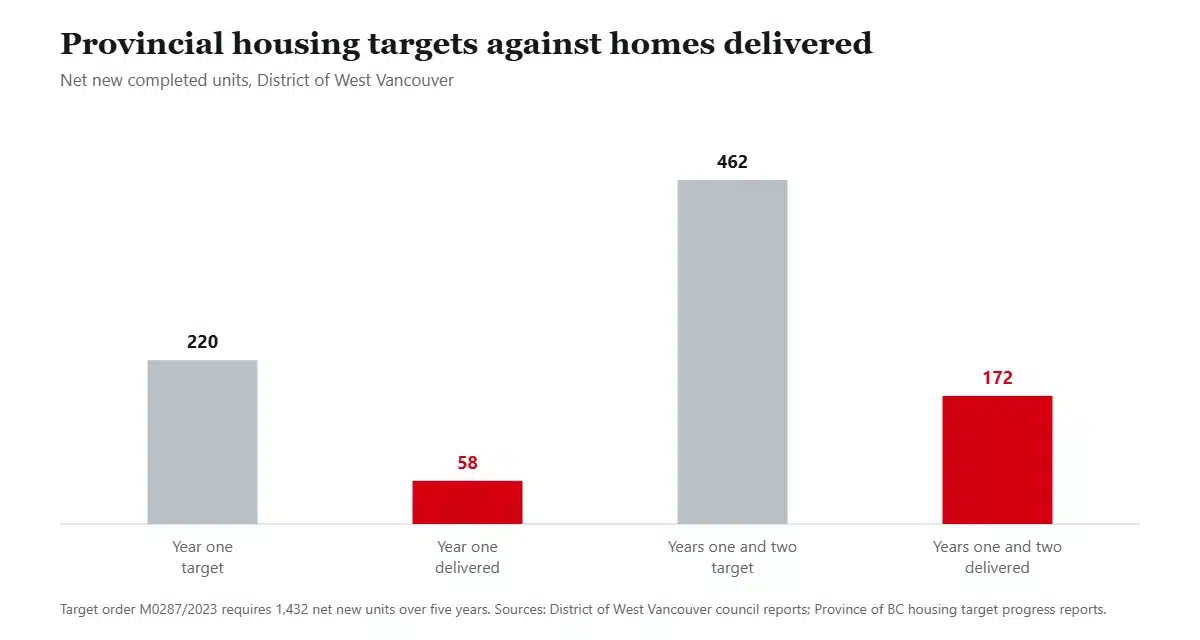
Against that, a ministerial order issued in September 2023 requires 1,432 net new completed units in five years. In other words the Province is asking for more than a quarter of the District’s twenty-three-year plan inside five.
Year one produced 99 completions minus 41 demolitions, so 58 net units against a target of 220. District staff wrote it up themselves as roughly a 75 per cent shortfall. Year two produced 146 completions minus 32 demolitions, so 114, bringing the cumulative total to 172 against a cumulative target of 462. Of those 146 completions, 101 were three-bedroom or larger.
What followed is a documented escalation. In December 2024 the minister raised the possibility of appointing an advisor. Advisors were appointed and intended directives issued in May 2025. Directives followed in July 2025. Council withdrew the Ambleside Centre Local Area Plan from its own October 2025 meeting agenda. On the last day of 2025 the minister found the District non-compliant with all three directives, and on 7 April 2026 an Order in Council imposed the Ambleside plan over the District. Two further directives, on Park Royal density and the Ambleside apartment area, remain open with reporting deadlines running to 2028.
The pattern repeats on the provincial small-scale housing rules. Council defeated the enabling bylaw at first reading in May 2024, missed the June deadline, took a ministerial notice of non-compliance and adopted it that August. The successor bylaw under the province’s 2025 legislation had readings scheduled for 21 September 2026, after the 30 June 2026 deadline had already passed. About 630 parcels here qualify for exemption anyway, on heritage grounds, or for exceeding roughly an acre, or for having no municipal water or sewer, which describes the upper slopes precisely.
None of that is an argument for or against living here. But it is the thing to understand if you are buying a house on a large lot and assuming the rules around it will hold.
Schools
School District 45 covers West Vancouver plus Bowen Island and Lions Bay, running 19 public schools. Four independent schools operate in the District as well, which is a high density for a municipality of 44,000.
The enrolment fact worth knowing is the District’s own: about 7,500 students attend those 19 schools and roughly 70 per cent of them live in West Vancouver. The other 30 per cent, some 2,250 children, commute in from outside. A decade ago the Ministry’s non-resident share was running between seven and nine per cent, so this has grown considerably.
That is not a scandal, and it does not mean schools are closing. Provincial listings show 17 schools here in 2015 and 19 today. What it does mean is that a school system in a municipality with a missing generation of young families is partly sustained by children who live somewhere else.
We would like to tell you how the district performs against provincial averages, and we cannot. The Ministry publishes completion rates, assessment results and post-secondary transitions for every district, but it renders them through charts that return no numbers, and the district’s own reporting is behind files that would not open. Rather than guess, we have left it out.
Healthcare
There is no hospital in West Vancouver, and no urgent and primary care centre. The only Vancouver Coastal Health facility in the municipality is a community health centre offering public health programmes such as vaccinations. For an emergency you are going to Lions Gate Hospital in the City of North Vancouver.
Lions Gate is a real hospital: general medicine, emergency and critical care, general surgery, orthopedics, maternity, paediatrics, psychiatry, chemotherapy, cardiac care, diagnostics, palliative care and neurosurgery. It opened the Paul Myers Tower on 9 March 2025, a roughly $325 million building with 108 private patient rooms and eight operating rooms, serving the North Shore plus the Sea to Sky corridor, the Sunshine Coast and communities up the central coast.
And then the number that makes the case for the whole municipality better than any other single statistic. Life expectancy in the local health area was 87 years in 2022, against 85 across Vancouver Coastal Health and 82 for British Columbia. West Vancouver also reports up to four per cent more of its residents attached to a primary care clinic than the health authority or provincial average.
The outdoors, which is the point
The parks department maintains more than 140 parks and over 100 kilometres of urban and wilderness trails, along with two golf courses, a cemetery and public beaches.
Lighthouse Park runs to about 75 hectares and holds an example of remaining old growth coastal forest in the Lower Mainland, with a functioning lighthouse at Point Atkinson since the 1870s on a national historic site. Whytecliff Park is a 15-hectare park the District bought from Union Steamships for $75,000 and dedicated by bylaw in 1953, with a diving ramp built for divers with disabilities. The District’s archives record that in 1993 the waters off it were designated Canada’s first saltwater marine protected area; federally, that water today sits inside Fisheries and Oceans Canada’s Rockfish Conservation Area 28 rather than being an Oceans Act marine protected area.
The Centennial Seawalk runs 1.7 kilometres from 18th Street to Dundarave Park, and unlike Vancouver’s seawall it bans bikes, boards and rollerblades outright. A walking path, and it stays one.
Above the town, Cypress Provincial Park was established in 1975 and climbs from 425 metres at the access road to over 1,454 metres at Mount Strachan. Cypress Mountain Resort operates 53 downhill runs inside it, with 19 kilometres of nordic trails and 11 kilometres of self-guided snowshoe routes. The Howe Sound Crest Trail runs 29 kilometres one way. And the Baden-Powell Trail crosses the whole North Shore for 48 kilometres from Horseshoe Bay to Deep Cove, opening with a 1,040 metre climb out of Horseshoe Bay over 8.5 kilometres, which tells you what kind of terrain this is.
The usage figures back it up. Nearly 1.5 million visits were recorded across its ice arena, aquatic centre and seniors’ activity centre in 2024, with almost 700 programmes offered, in a municipality of 44,000 people.
The weather, and a gap worth admitting
Environment and Climate Change Canada has no climate station in West Vancouver, and none in North Vancouver, at Cypress, Grouse, Capilano or Hollyburn either. Only 57 stations in the whole province have current normals, and the nearest are across Burrard Inlet at Vancouver Harbour and the airport.
So any figure you see labelled as West Vancouver’s rainfall has been borrowed from a station somewhere else, usually at sea level and usually across the water. The pattern is not in doubt: this is a steep, forested, north-shore municipality rising from the inlet into the Coast Mountains, and rainfall climbs with the ground. We are not going to put a number on it, because nobody has published one.
The honest downsides
Wildfire is the big one, and it is measurable. A wildfire hazard development permit area covers every property within about 100 metres of undisturbed forest interface, which is roughly half its land. If you want to build or substantially alter a house on that half, you need a wildfire hazard assessment report from a qualified professional, often an arborist report and a survey, and typically four to six weeks for the permit.
Its own community wildfire resiliency plan, published in October 2025, rates the municipal threat as low to moderate based on fuels, terrain and fire weather. It also notes that about 40 per cent of the area, privately owned and containing most of the community’s infrastructure and highest-value assets, was not included in that detailed analysis. Both sentences belong together. The plan names Whytecliff, Horseshoe Bay, Eagleridge and Pasco Road as priority neighbourhoods, which are the western, forested, single-access ones.
The bridge is the second. Three lanes, one of them running against the peak, carrying about 60,000 trips a day, with no rail alternative and none funded. We are not going to tell you how often it closes or what happens when it does, because no published source gives closure frequency or diversion volumes. The province runs a live traveller information system for the bridge, which tells you something on its own.
Then cost, which the numbers make obvious. BC Assessment’s 2026 roll puts the typical single-family home at $2,910,000 and the typical strata at $1,354,000, both down slightly on the year. Council approved a 2.43 per cent operating levy increase plus a one per cent asset levy for 2026.
One downside that turns out not to be one. The 2025 point-in-time homeless count found 168 people across the North Shore, unchanged from 2023, while the region rose nine per cent to 5,232. No West Vancouver breakout exists in that count, so nobody can give you a municipal figure, but the sub-region held flat while the region did not.
So who is it for
It suits people who want mountains, ocean and old forest within ten minutes of a front door, and who will actually use them. On that measure there is nothing else like it in Metro Vancouver.
It suits retirees and people approaching retirement, which the demographics already show, and the healthcare outcomes support. Most of the houses here sit on slopes with long driveways and steep front steps, which is the main thing that shapes a downsizing move on the North Shore: the crew size and the hours come from the stairs, not the distance.
It suits households who can absorb a three-million-dollar house and a car-dependent life, and whose work is on the North Shore or who can cross the bridge against the peak.
It suits you less if you are young and buying your first place, if you need transit rather than a car, if you want an urgent care centre in your own municipality, or if you want to be somewhere that is growing and changing. On that last one the District plans for one per cent of the region’s growth, and the Province has started overruling it.
Frequently asked questions
Is West Vancouver the richest place in Canada?
Not on income. Median household income was $104,000 in 2020 against $90,000 for Metro Vancouver, and Belcarra was higher at $168,000. On assets it is a different story: a median dwelling value of $2.5 million against $1.1 million regionally, and 56 per cent of owners mortgage-free.
Is there a hospital in West Vancouver?
No. There is no hospital and no urgent and primary care centre in the municipality. Both are in the City of North Vancouver, where Lions Gate Hospital opened a $325 million, 108-bed patient tower in March 2025.
Is SkyTrain coming to the North Shore?
No project is funded. What is funded and dated is the R2 RapidBus extension from the North Shore to Metrotown, launching September 2026, plus a bus rapid transit project in design with council check-ins in 2027. Fixed rapid transit across Burrard Inlet is still under evaluation.
Is West Vancouver good for families?
It has 19 public schools, four independent ones and an unusual amount of parkland, and about 30 per cent of the students in its schools commute in from outside the District. The trade-offs are the price of entry, the car dependence and a community with a median age of 51.
Why is the Province overriding West Vancouver’s council?
Because the District delivered 172 net new homes against a cumulative provincial target of 462 over two years, and did not implement three directives by the end of 2025. In April 2026 an Order in Council imposed the Ambleside Centre Local Area Plan on the District.
How we put this together
Figures come from the District of West Vancouver’s own community profile, bylaws, plans and council reports, Metro Vancouver, Statistics Canada via Metro Vancouver’s housing data book, TransLink, BC Ferries, BC Assessment, BC Parks, Vancouver Coastal Health, the Province of British Columbia and the 2025 point-in-time homeless count.
Four things we left out on purpose. There is no rainfall figure here, because Environment and Climate Change Canada has no station in West Vancouver. Nor is there a school performance comparison, because the province’s figures render as charts that return no numbers and the district’s own report would not open. We have not described Whytecliff as a federal marine protected area, because it is a rockfish conservation area. And we have not said the bridge closes often, because nobody publishes how often it closes.
Sources
- District of West Vancouver, population and demographics
- District of West Vancouver, households and housing
- District of West Vancouver, mobility
- District of West Vancouver, social infrastructure
- Metro Vancouver, Growth Projections 2025 Update
- Metro Vancouver Housing Data Book, February 2025
- District of West Vancouver, provincial housing targets
- Province of British Columbia, Order in Council on the Ambleside Centre plan
- District of West Vancouver, small-scale multi-unit housing
- District of West Vancouver, Blue Bus
- BC Ferries, Horseshoe Bay terminal renewal
- District of West Vancouver, wildfire hazard development permit area
- Vancouver Coastal Health, Lions Gate Hospital
- BC Parks, Cypress Provincial Park
- District of West Vancouver, parks and trails
- BC Assessment, Lower Mainland 2026 property assessments
- 2025 point-in-time homeless count for Greater Vancouver
Weighing it up properly? The cost breakdown prices out what living here actually takes, the crime numbers deal with the other common question, and if you are comparing across the bridge, we have weighed up North Vancouver the same way. We move people into West Vancouver most weeks of the year, on the same hourly rates we charge anywhere else on the North Shore. When you have an address, tell us where you are moving from.
