

Most packing goes wrong in the last 48 hours. Boxes get filled with whatever is on the counter, the tape runs out, and the wine glasses end up rolled in a hoodie at 1 a.m. None of that is a skill problem. It is an order problem.
Below is the system our crews use on packing jobs around Metro Vancouver and the Fraser Valley, written for people doing it themselves. It covers what to buy, which rooms to start with, how to fill a box so it survives a truck, and the item-by-item methods for dishes, glasses, electronics and clothes.
The short version
- Get rid of what you are not taking before you buy a single box.
- Buy fewer box sizes than you think: small, medium and large cover almost everything.
- Pack in reverse order of use. Storage and seasonal things first, the kitchen and bathroom last.
- Heavy items go in small boxes, light items in big ones. No exceptions for books.
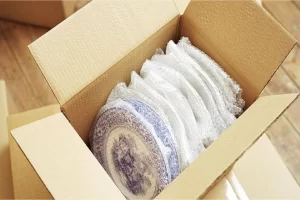
- Wrap every breakable piece on its own and stand plates and glasses on edge.
- Seal one box of first-night essentials and keep it with you, not on the truck.
Start with what you are not taking
Every item you donate is one you do not have to wrap, carry or unpack. A week of sorting before packing usually saves more time than it costs.
Go room by room with three piles: keep, give away, recycle. Do the storage spaces first, since that is where most of the forgotten stuff lives. Old phones, cables, chargers and dead printers can go to a Return-It Electronics drop-off, and the same depots take small appliances and power tools, from toasters to countertop microwaves. Paint, propane and solvents need their own depots, and movers will not load them anyway; our residential moving checklist covers where those go.
Use up the freezer and pantry over the last two or three weeks. Half-empty bottles of oil and open bags of flour are the things most likely to leak through a box.
Supplies: what to buy and how much
Three box sizes do most of the work. Standard retail moving boxes come in roughly these sizes (U-Haul’s are typical):
| Box | Approx. size (inches) | Volume | What goes in it |
|---|---|---|---|
| Small | 16 x 12.5 x 12.5 | 1.5 cu ft | Books, records, canned food, tools, paperwork |
| Medium | 18 x 18 x 16 | 3.0 cu ft | Pots, small appliances, toys, shoes, electronics accessories |
| Large | 18 x 18 x 24 | 4.5 cu ft | Bedding, towels, cushions, lampshades, light bulky things |
| Extra-large | 24 x 18 x 24 | 6.0 cu ft | Duvets, pillows, coats |
Add a few specialty boxes only where they earn their place: wardrobe boxes for hanging clothes, a dish pack with cell dividers for glasses, and a mirror or picture carton for anything framed.
You will also need:
- Packing tape, more than you expect, and a tape gun
- Plain packing paper (newsprint ink rubs off on dishes)
- Bubble wrap or foam pouches for the truly fragile pieces
- Thick markers and coloured stickers for labels
- Zip-top bags for screws and small hardware
- Stretch wrap for drawers, doors and bundles of curtain rods
- One box cutter, a screwdriver set and a hex key set, kept out of the boxes
Counting boxes is easier than guessing. Pack a single full room, count what it took, and use it as your yardstick for rooms of a similar size. Kitchens break the rule: they almost always need more than you think, mostly small and medium boxes.
Cardboard does not have to cost anything if you start a couple of weeks out; here is where to get boxes without paying for them. If you book a move of two bedrooms or more with us, we drop off reusable plastic moving boxes before the move and collect them afterwards, free.
What to pack first, and what to leave for last
Work backwards from how often you use something. The things you have not touched in a month go first. Everyday things go last.
| When | What to pack |
|---|---|
| 4+ weeks out | Garage, storage locker, crawl space, seasonal clothes, holiday decor, sports gear, spare linens |
| 3 weeks out | Books, framed art, ornaments, guest room, most of the office, good china you rarely use |
| 2 weeks out | Living room extras, most of the kitchen except a basic set, toys the kids can live without, out-of-season shoes |
| Last week | Most clothes, the rest of the kitchen, bathroom extras, take apart furniture you can do without |
| Last day | Bedding, toiletries, the kettle and one pan, chargers, the first-night box |
Finish one room before starting the next. Half-packed rooms are how a TV remote ends up in a box of saucepans.
Stack finished boxes in one spot near the door, heaviest at the bottom, with labels facing out. On moving day, that pile is the first thing the crew sees, and a tidy stack loads faster than boxes scattered through five rooms.
How to pack a box so it survives the truck
A box fails in one of three ways: the bottom gives out, the sides crush under the boxes stacked on top, or the contents shift and break. Each has a simple fix.
Tape the bottom properly. Run one strip along the centre seam and one across each edge seam, an H pattern. Once it is full, seal the top the same way. Heavy boxes get a second layer on the bottom.
Match weight to size. Books, files and canned food go in small boxes even when a bigger one is handy. A large box full of books is too heavy to carry safely and tends to split. U-Haul rates its standard boxes to hold up to 65 lb, but that is the box’s limit, not a sensible load for your back. Can you carry it comfortably down a flight of stairs? If not, take something out.
Fill the box to the top. A half-full box crushes when another is stacked on it. Heaviest things go at the bottom, lighter ones above, and fill any gap with crumpled paper, towels or socks until the lid closes flat. Shake it gently. If anything moves, add more filler.
Never overfill. Bulging lids will not stack and the tape will lift. The lid should close flat with no pressure.
How to label each box (room, number, contents, handling notes on the top and two sides) has its own guide: how to label boxes for moving.
Packing fragile items: dishes, glasses, bowls and breakables
Breakables are where most moving damage starts, and almost all of it comes from three mistakes: pieces packed touching each other, plates laid flat, and too little padding underneath. Fix those and you can move a full kitchen without a chip.
Start every fragile box the same way. Put a layer of crumpled paper, two or three inches deep, in the bottom. Use small or medium boxes only. Double-tape the bottom.
Plates and platters
Wrap each plate on its own in two or three sheets of packing paper. Then bundle three or four wrapped plates together with another sheet. Stand the bundles on edge in the box, like records in a crate, never stacked flat. A plate on its edge spreads a bump across its rim; a stack of flat plates puts the whole load on the bottom one.
Glasses and stemware
Stuff each glass with a loose ball of paper, then roll it in two or three sheets, tucking the ends inside. Wine glasses need extra paper wrapped around the stem first. Pack glasses upright, rims up, and add a layer of crumpled paper or a piece of cardboard between layers. A dish pack with cell dividers is worth the few dollars if you own good stemware.
Bowls, mugs and odd shapes
Bowls can be wrapped one by one and nested in small stacks of three, with paper between each. Mugs go rim down with the handles pointing the same way. Teapots and gravy boats get the lid wrapped separately and taped to the body so they travel together.
No bubble wrap? Use what you own
You can pack a whole kitchen without buying bubble wrap. Dish towels, tea towels and hand towels wrap plates well. Clean socks fit over glasses and mugs. Sweaters and fleece fill the gaps. Packing paper is the one thing worth buying anyway, because it is cheap, clean and goes around odd shapes without slipping.
Lamps, mirrors and framed art
Take the shade off and the bulb out before wrapping a lamp. Pack shades on their own in a large box with soft things around them, never with anything heavy inside. Mirrors and framed pictures travel on edge, never flat, with an X of painter’s tape across the glass and cardboard corners on the frame. Large mirrors need more care than that; see our guide on moving large mirrors safely.
Mark every fragile box on the top and two sides, and tell the crew which ones they are. Writing “fragile” helps people handle a box with care, but it does not change who is responsible if something breaks. Our post on whether movers are responsible for damage explains what is and is not covered.
Electronics
Take a photo of the back of the TV, the router and the computer before unplugging anything. Those photos will save you an hour of guessing which cable went where.
- Back up laptops and phones, and carry them with you.
- Pull batteries out of remotes, cameras and toys so they cannot leak.
- Put each device’s cables in a labelled bag and tape the bag to the device or its box.
- Use the original box when you still have it. Failing that, wrap the device in an anti-static bag or a towel, then bubble wrap, and pack it snugly in a box with padding on every side.
- Keep printers and game consoles upright and remove ink cartridges or discs.
Flat-screen TVs are their own job. They should travel upright and never lie flat on the screen; here is our full guide to moving a large flat-screen TV.
The kitchen, beyond the dishes
Pack the kitchen in two passes. The first, about two weeks out, takes everything you will not cook with before the move: the stand mixer, baking dishes, spare glasses, the cupboard above the fridge. The second, in the last two or three days, takes the basic set you kept back.
- Nest pots and pans with paper between them, and wrap glass lids on their own.
- Roll each knife blade in paper or cardboard, tape it shut, and mark the bundle “sharp”.
- Small appliances fit best in their original boxes. Tape cords to the appliance so they do not tangle.
- Spices, oils and sauces go in zip-top bags, upright, in a small box lined with a towel.
- The fridge needs to be emptied, defrosted and dried a day ahead. How long to wait before plugging it back in is covered in our fridge guide.
Clothes, bedding and shoes
Clothes are the easiest thing in the house to pack, which is why they so often get packed badly.
Hanging clothes can go straight from the rail into a wardrobe box and back onto a rail at the other end. Without wardrobe boxes, gather ten or so hangers at a time and pull a large garbage bag up over them from the bottom, tying the drawstring around the hooks. Folded clothes can be rolled into medium boxes or suitcases. Suitcases are free boxes with wheels, so fill them with something heavy.
Some movers will carry a dresser with light clothing left in the drawers, as long as the drawers are wrapped shut. Others prefer them emptied. Ask before moving day.
Shoes go in medium boxes with paper stuffed in the toes, heavier pairs at the bottom. Bedding, pillows and towels go in large boxes, and they double as padding for everything else. Mattresses should go in a mattress bag; in a wet Vancouver winter this matters more than anywhere else.
Books, papers and everything in between
Pack books flat or spine-down in small boxes, alternating directions so they sit tight. Close the last gap with a paperback rather than paper. Files and paperwork go in small boxes too.
Passports, birth certificates, the lease or sale documents, insurance papers and anything you cannot replace should never go on the truck. Put them in a folder that travels in your car or bag.
Toys sort easily into clear bins or medium boxes. Keep a small box of favourites out for the kids until the last day and pack it last so it comes off the truck first.
Furniture and the heavy pieces
Take apart anything that comes apart easily: bed frames, table legs, shelves, desk hutches. Put every screw and bolt in a zip-top bag, label it with the piece it belongs to, and tape the bag to the underside of that piece. A phone photo before you start takes the guessing out of reassembly.
Empty bookcases, cabinets and desks completely. Wrap drawers and doors shut with stretch wrap rather than tape, which can pull off finishes. For the big pieces, these guides go step by step: moving a heavy bookcase, moving a king-size bed, and getting heavy furniture up stairs.
Plants are the one thing that should not be boxed and sealed. Our guide to moving plants covers pots, watering and the drive.
Packing for a Lower Mainland move: rain and strata rules
Two things change how you pack around here.
Rain is one. From October to March, boxes spend a few minutes between the door and the truck in whatever the sky is doing. Plastic bins for anything that cannot get damp, mattress bags, and stretch wrap over upholstered furniture all pay off. A roll of garbage bags is handy for the last few boxes on a wet day. There is more in our post on moving in a Vancouver winter.
Strata buildings are the other. Many limit moves to a booked elevator window and a single entrance. Every box should be packed, taped and stacked before that window starts, because loading time is the part you are paying for and the building is counting.
Moving out of province adds a few more steps. See our long-distance moving tips for packing for a long haul.
The first-night box, and what rides with you
Pack one or two boxes, or a suitcase, with everything you need for the first 24 hours. Keep it in your car, not the truck.
- Medication, glasses and contact lens supplies
- Phone and laptop chargers, a power bar
- Documents, keys, jewellery and anything irreplaceable
- Toothbrushes, toiletries, toilet paper, a towel each
- Sheets and pillows for every bed
- A kettle, mugs, coffee or tea, snacks, a few plates and cutlery
- Dish soap, a cloth, garbage bags, paper towels
- Box cutter, scissors, a screwdriver and a hex key set
- A change of clothes for everyone, plus pet food and bowls if you have pets
When to hand some of it over
DIY packing is cheaper. It also takes far longer than most people plan for, and the kitchen alone can eat a weekend.
Partial packing is the middle ground. Plenty of our customers pack their clothes, books and personal things, then have a crew pack the kitchen and anything fragile on moving day or the day before. Our packing services cover full or partial jobs, with the boxes, paper, dish packs and wardrobe boxes coming with the crew.
To get a price, request a free quote and tell us which rooms you would rather not pack yourself.
FAQs
What should I pack first when moving?
Start with things you will not need before moving day: storage areas, the garage, seasonal clothes, holiday decor, books and framed art. Leave the kitchen basics, bathroom and bedding for the last few days.
How far ahead should I start packing?
For a one-bedroom apartment, start about two weeks out. A family house needs four to six weeks, starting with storage spaces. Decluttering can start as soon as you know the date.
How do I pack fragile items without bubble wrap?
Give each piece its own wrap of packing paper, dish towels or clothing, stuff glasses and mugs with paper or socks, and fill every gap in the box so nothing can shift. Small boxes with a thick layer of padding on the bottom work best.
Should plates be packed flat or on their side?
On their side. Plates stood on edge, like records in a crate, are much less likely to break than plates stacked flat, because a bump spreads across the rim instead of pressing down on the bottom plate.
What should not go in the moving truck?
Flammables and hazardous goods such as propane, gasoline, paint thinner and aerosols, plus perishable food, medication, important documents, cash and jewellery. Movers will not carry the first group; the rest should travel with you.
How heavy can a moving box be?
BC sets no legal weight limit for a household moving box, and standard retail boxes are rated to about 65 lb. A practical limit is whatever you can lift and carry down stairs without straining. Keep book and file boxes small so they stay manageable.
