

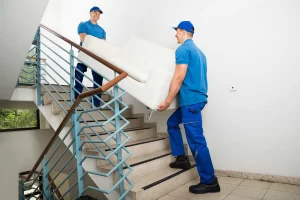
Two things that will surprise you, and both change how you plan this.
There is no legal maximum lifting weight in British Columbia. Not 23 kg, not 50 lb, not anything. Part 4 of the Occupational Health and Safety Regulation contains no weight threshold and no numeric trigger anywhere in it. Any page citing “the WorkSafeBC limit” has invented a number.
There is also no stair-specific safety guidance from WorkSafeBC or from the Canadian Centre for Occupational Health and Safety. We looked for it specifically. There is no published procedure for carrying loads on stairs and none for stair-climbing dollies.
What that does not mean is that there is no guidance. It means the guidance is a framework and a set of team-handling rules rather than a number, and those turn out to be more useful than a weight limit would be. Here they are, along with the dimensions that decide whether the job is possible at all.
Measure the headroom at the turn
Everybody measures the furniture. Most people measure the doorway. Almost nobody measures the headroom at the turn, which is the number that actually stops the job.
The BC Building Code figures, and Vancouver’s own by-law matches them on stairs:
| Minimum | |
|---|---|
| Required exit and public stairs, residential buildings | 900 mm wide, 2,050 mm headroom |
| Stairs serving a single dwelling unit | 860 mm wide, 1,950 mm headroom |
| Required entrance doorway to a dwelling | 810 mm |
| Most interior rooms | 760 mm |
| Bathrooms, walk-in closets, rooms off a 710 mm hallway | 610 mm |
Headroom is measured vertically over the clear width of the stair, from a line tangent to the tread and landing nosings. In a house that is 1,950 mm, about 6 feet 5 inches.
Now hold a tall item against that. A 202 cm bookcase is 6 feet 7 inches. A 60-inch file cabinet tilted to 45 degrees needs more vertical space than it does standing up. Anything you have to tilt to get around a turn is taller diagonally than it is upright, and the diagonal is what has to clear the ceiling.
Measure in this order, and write the numbers down rather than eyeballing them:
- The item: height, width, depth, and the diagonal across its largest face (the square root of height squared plus width squared, or just run a tape corner to corner).
- Every doorway on the route, at its narrowest point, including the door stop.
- The stair width between handrails, not between walls.
- The headroom at the turn and at the top of the flight.
- The landing depth, because a turn needs somewhere to pivot.
If the item’s diagonal exceeds the headroom at the turn, it does not go up that stair, and no technique fixes that. That is worth knowing before a crew arrives.
No weight limit in BC, and why that helps
BC’s ergonomics regime, sections 4.46 to 4.53 of the Occupational Health and Safety Regulation, requires an employer to:
- Identify the factors in the workplace that may expose workers to a risk of musculoskeletal injury.
- Assess the risk once those factors are identified.
- Eliminate or minimise it, using personal protective equipment only where engineering or administrative controls are not practicable, and implementing interim measures where permanent controls will be delayed.
- Educate and train workers in risk identification and in the specific control measures.
- Monitor and review the measures at least annually.
- Consult the joint health and safety committee or worker representative, and workers with signs or symptoms.
The assessment must consider, where applicable: the force required, repetition, duration, work postures and local contact stresses; working reaches, working heights, seating and floor surfaces; the size, shape, load condition and weight distribution of the object, and its handles; environmental conditions including cold; and work-recovery cycles, task variability and work rate.
Read that list against a staircase and it is all there. Floor surfaces, working heights, weight distribution, postures. A weight limit could not express the difference between a 90 lb cabinet down a tight turn and a 150 lb one across a flat floor. The framework can, which is why BC uses one.
Team handling, the documented version
This is the most useful material on the subject and it comes from the Canadian Centre for Occupational Health and Safety. Hardly anyone follows it.
- Select team members of similar height and strength. A height mismatch tilts the load toward the shorter person and puts them under it.
- Assign a leader to the team. One voice.
- Agree the commands before you start: lift, walk, stop, down.
- Practise team lifting and carrying together before attempting the task.
- “Remember that the combined strength of the team is less than the sum of individual strength.”
- Walk in step.
- For long objects, use shoulder pads, carry on the same shoulder.
- For furniture, use straps with webbing to prevent slipping, dollies or platform trucks, secure the load, and have assistance when loading.
CCOHS’s general manual-handling guidance adds the things people skip: “Be sure that the path to the planned location of the load is clear. Grease, oil, water, litter, and debris can cause slips and falls.” And “Avoid twisting and side bending while lifting.” Check for mechanical assistance before lifting at all, assess the load’s weight and stability, and clear the destination area first.
The one that matters most on a stair
The combined-strength point. Two people who can each manage 60 kg cannot reliably manage 120 kg between them, and on a staircase the person below is carrying substantially more than half the load because the item is above them.
Which produces the practical rule: the heavier end goes downhill, and the stronger person goes below. Going up, the person at the bottom is taking the weight and the person at the top is steering. Going down, that reverses and the person below becomes the brake. Decide which of you is which before anyone lifts.
Equipment, and the ratings that are published
Hand trucks. Magliner publishes that all its hand trucks have a 500 lb capacity unless otherwise noted. That covers almost all household furniture and does not cover a pool table or a vending machine.
Stair-climbing dollies. These exist as distinct products. Magliner lists appliance trucks with stair-climber and stair-crawler wheel configurations, and powered stair-climbing hand trucks in its powered range. Worth knowing that it publishes no per-model load capacities for those and no stated limits on stair use, and we found no manufacturer or occupational-health guidance on their correct use. So if someone quotes you a stair-climber capacity, ask where it came from.
Lifting straps. Forearm Forklift publishes up to 800 lb; Shoulder Dolly’s heavy-duty Pro Lift straps up to 1,000 lb. Straps transfer the load from your hands and arms to your shoulders and legs, which is the point of them, and CCOHS specifically recommends webbing that prevents slipping.
Furniture sliders. We could not find a published load rating from any named manufacturer. They are for flat floors regardless; a slider on a stair is not a thing.
Blankets and jamb protectors. Not load-bearing equipment, but on a stairwell they are what stops the drywall damage that costs more than the furniture.
Going up: the sequence
- Clear the whole route first, including the destination room. CCOHS’s point about grease, oil, water, litter and debris is about factories and applies exactly to a rain-wet doorstep in Vancouver.
- Protect the stairwell. Runner or blankets on the treads, jamb protectors at the top and bottom, and something over the handrail if the item will touch it.
- Empty and disassemble whatever will come apart. Every kilogram removed is a kilogram nobody carries.
- Agree the plan out loud. Who leads, who is below, what the commands are, where you will rest.
- Plan the rest. On a long flight, a landing is a rest point. Nobody should be improvising a pause halfway up.
- Lift with the load close to the body, and avoid twisting and side bending, which is CCOHS’s instruction and the one thing everybody does anyway.
- Take the turn by walking it round rather than pivoting it, and tilt only as much as the headroom allows.
- Set it down fully before anyone lets go.
Going down is harder, and here is why
- Gravity is working with the load rather than against it. The person below is braking, not carrying.
- You cannot see your feet if the item is in front of you. The person below faces forward and calls the steps.
- The handrail is the safety feature, and if both your hands are full you have given it up. This is the argument for straps: they free a hand.
- Momentum is the failure mode. A controlled descent is slow, in step, with a stop at every landing.
Where the item is heavy enough that one person is taking most of it downhill, that is the point at which the honest answer is equipment or more skill rather than more effort.
When it is worth handing over
- The diagonal is close to the headroom at the turn. That is a judgment call about what can be tilted and how far, and getting it wrong means damage to the item, the wall, or a person.
- Anything over about 150 lb with a turn in the flight.
- A narrow stair with an open side, where a slip has nowhere to end.
- Anything you cannot disassemble that is close to the width of the stair.
- You are the only person available. Nothing on this page works alone.
How Secure Moving handles stairs
We measure the diagonal and the headroom at the turn before quoting, which is the measurement that decides whether the item goes up at all. We protect the treads and the jambs before anything moves. We carry as a planned two-person job with an assigned leader, agreed commands and the stronger person downhill, and we use straps and the right dolly rather than more people. One sofa or dresser can also be booked by itself as a single-item move.
Secure Moving carries $5 million in liability coverage and active WorkSafeBC registration. Our team works across the region as a moving company in Vancouver and a moving company in Coquitlam.
The items that most often raise this question have their own guides: moving a heavy bookcase, moving a treadmill, moving a king size bed and moving a pool table.
Frequently asked questions
Is there a legal limit on how much you can lift in BC?
No. Part 4 of BC’s Occupational Health and Safety Regulation, sections 4.46 to 4.53, contains no weight threshold and no numeric trigger anywhere in it. The duty is to identify, assess and control the risk of musculoskeletal injury, considering force, repetition, duration, work postures, floor surfaces, working heights, and the object’s size, shape and weight distribution, with controls reviewed at least annually. Any page citing a WorkSafeBC weight limit has invented it.
What does WorkSafeBC say about carrying furniture on stairs?
Nothing stair-specific that we could find, and the same is true of the Canadian Centre for Occupational Health and Safety. Stairs sit inside the risk assessment, in the regulation’s references to floor surfaces and work postures. What CCOHS does publish is team-handling guidance: similar height and strength, an assigned leader, agreed commands, practise together, walk in step, and the point that a team’s combined strength is less than the sum of the individuals’.
How do I know if furniture will fit up my stairs?
Measure the diagonal across the item’s largest face, then the headroom at the turn. Code-minimum stair headroom in a BC dwelling is 1,950 mm, about 6 feet 5 inches, and 2,050 mm for required exit and public stairs. Tilting makes an item taller diagonally than it is upright, and the diagonal is what must clear the ceiling. A diagonal that exceeds the headroom at the turn cannot be fixed by technique.
Who should go at the bottom when carrying furniture downstairs?
The stronger person, with the heavier end downhill. Gravity works with the load going down, so the person below is braking rather than carrying and is taking substantially more than half. They also face forward and call the steps, because whoever is behind the item cannot see their feet. Decide this before anyone lifts.
Are stair-climbing dollies safe to use?
They exist as purpose-built products, including powered versions, and they are what a professional crew uses on a long flight. Worth knowing that the main manufacturer publishes no per-model load capacities for them and no stated limits on stair use, and we found no manufacturer or occupational-health guidance on their correct use. So anyone quoting you a stair-climber capacity should say where they got it.
Should I use lifting straps on stairs?
They help, for a specific reason: they move the load from your hands and arms to your shoulders and legs and free a hand for the handrail, which on a staircase is the safety feature you otherwise give up. Forearm Forklift publishes strap capacities up to 800 lb and Shoulder Dolly’s heavy-duty straps up to 1,000 lb, and CCOHS recommends webbing that prevents slipping. Moving a hot tub rather than furniture? That job has its own rules, from draining to electrical permits, covered in our guide to how to move a hot tub.
