

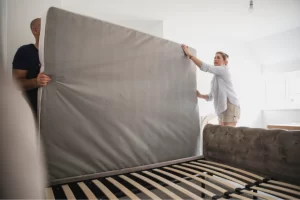
A king bed is four separate moving problems wearing one name: a mattress that is large and floppy, a box spring or foundation that is large and rigid, a frame that comes apart, and a headboard that does not fit anywhere.
There is also a fifth problem that no moving guide mentions and that public health authorities do, which is that a mattress is the single most likely object in your move to carry a pest problem into a home you have just paid for. That section is the most useful thing on this page, and it comes first.
Check the mattress before it goes in the vehicle
Health Canada’s bed bug guidance contains one instruction written for exactly this day:
“Check items before you put them in your vehicle and check your vehicle after helping a friend move.”
And a second, blunter one: “Never take a mattress or sofa from a curb.”
Bed bugs travel in seams, in the piping around a mattress edge, in a box spring’s frame and fabric, and in the joints of a wooden bed frame. A move is the moment they change address, and a new home with no history is the worst place to find out.
What to actually do, from BC’s own public health file
HealthLinkBC’s bed bug file, updated September 2024, gives a protocol. Adapted to a moving day, in order:
- Vacuum the mattress, the box spring and the frame, including under and behind. HealthLinkBC’s specific instruction: “Use a scrub brush to remove bed bugs and eggs from mattress seams.” The seams and piping are where they are, not the surface.
- Dispose of the vacuum bag properly: in a sealed plastic bag, then into a garbage can with a tight lid.
- Wash the bedding, meaning sheets, covers, protectors and pillows, in hot water with detergent, and dry on the hottest dryer setting.
- Anything that cannot be washed goes in a hot dryer for 30 minutes or more, which is HealthLinkBC’s figure. Items that will not take a dryer can be steam cleaned.
- Bag the clean, dry items in “light-coloured, sealed, heavy-duty plastic bags or plastic storage bins with secure lids”. Light-coloured, because you can see through it.
- Look at the frame joints before it comes apart, particularly a wooden frame with slats sitting in pockets.
If you find something
Health Canada’s position on the bed itself: “You should throw your bed out if you find bedbugs inside the box spring or where holes or worn spots in the fabric of the mattress are.”
And on disposal, which is a civic point as much as a personal one: wrap it in plastic and tape the edges “to prevent spreading bedbugs on your way to the trash”, and “Put a sign on the item saying it has a bedbug infestation, so that no one else takes the problem home with them.”
On encasements
If you are keeping a mattress you are unsure about, Health Canada’s guidance is to enclose the mattress and box spring completely in zippered bed encasements, put duct tape over the zipper because zippers have a gap bugs can pass through, and keep it enclosed for a full year. Plastic film, wrapped and sealed, is the alternative it gives.
For a move, a mattress bag does a lesser version of the same job and is worth it regardless: it keeps the mattress clean, dry and off truck decking and door frames.
A note on the dates of these sources. HealthLinkBC’s bed bug file was last updated 3 September 2024 and is current. Health Canada’s bed bug pages were last modified in February 2015, which is over eleven years ago. They remain the official federal position and are still published on canada.ca, and we have flagged the age rather than hiding it.
No manufacturer publishes a mattress weight
You will find pages giving exact dimensions and weights for a king and a California king. We went looking for those figures from a manufacturer or a recognised authority and could not source them. We also could not source mattress weights by construction type, or any manufacturer statement about transporting a mattress on its side, or any warranty language about it.
That last one matters because “never bend or fold a mattress, it voids the warranty” appears on every page about this and we found no manufacturer saying it.
So rather than repeat numbers with nothing behind them:
- Your mattress’s dimensions are on its law label, the tag you were told never to remove. It is on there along with the manufacturer and the construction.
- The warranty terms are in your own paperwork or on the maker’s site. If bending is restricted, that is where it will say so.
- The practical guidance holds without a citation: a pocket-coil or hybrid mattress has internal structure that folding can damage, a foam mattress tolerates flexing better, and either way a king mattress carried on its side by two people is manageable and the same mattress folded into a doorway is not.
Getting it apart
The order matters, and the headboard is the awkward one:
- Strip the bed and bag the bedding.
- Mattress off, into a bag, and stood on its long edge against a wall while you work. Not flat on the floor where it will be walked on.
- Box spring or foundation out. A split king has two, which makes the whole job easier; a single-piece king foundation is the item most likely not to fit up a stairwell.
- Slats out and bundled, banded or taped together and labelled.
- Headboard and footboard off, with the bolts bagged and taped to the headboard itself rather than put in a toolbox. Bed hardware is proprietary and the most commonly lost item in a move.
- Side rails apart, kept as a set.
- Photograph the frame assembled, and photograph each connection before you undo it.
On adjustable bases, which are increasingly common: unplug it, let it return to flat before disconnecting power, and look for a transport bracket or a shipping lock. Those exist on some models and the manual names them.
Will it fit? The single-piece foundation problem
The narrowest doorway the BC Building Code permits inside a dwelling is 610 mm, about 24 inches, which covers bathrooms, walk-in closets and rooms off a 710 mm hallway. Other rooms are 760 mm and required entrances 810 mm. Stairs within a dwelling are 860 mm minimum with 1,950 mm headroom, and required exit and public stairs are 900 mm with 2,050 mm.
A king mattress is roughly 76 by 80 inches, depending on the maker, and it is flexible, which is what saves you. A single-piece king box spring or foundation is rigid and approximately the same footprint, and that is the item that does not go up a turned stairwell or into a small elevator.
Two things to check before moving day:
- Is your foundation split? Two halves of a king foundation are a completely different job from one. If you are buying, this is the question to ask.
- Measure the diagonal of the foundation against the headroom at the stair turn. A rigid rectangle tilted to get around a corner needs its diagonal to clear the ceiling, and that is the measurement that fails.
If a single-piece foundation genuinely will not fit, the options are a split foundation, a bunkie board, or a platform frame, all of which are cheaper than the wall repair from forcing it.
In the truck: bagged, on edge, strapped
- Mattress bagged, on edge, against a wall, strapped. Flat on the deck it becomes a shelf and something heavy ends up on it.
- Foundation the same, alongside rather than on top.
- Nothing sharp anywhere near either. A mattress bag punctured by a chair leg has done nothing for you.
- Frame parts bundled together so no rail travels alone.
- Headboard wrapped in blankets, because it is usually the only finished, visible piece of the set.
At the new place: look at the room first
- Look at the room before the bed goes in it. If you are moving into a building with neighbours, a quick look at the baseboards and the floor edges is five minutes well spent.
- Frame first, on a level floor, from your photographs.
- Foundation, then mattress, and leave the mattress bag on until the room is otherwise finished.
- Check the mattress orientation. Many are one-sided now, and the label tells you.
- Fresh bedding, from the bags you sealed.
When to hand it over
- A single-piece king foundation and a turned stairwell. This is the most common reason a king bed job goes wrong.
- An adjustable base, which is heavy, electrically connected and often has a transport lock that a generic guide cannot tell you about.
- A bed with a proprietary connection system you did not assemble yourself.
- Any suspicion of bed bugs, where the right call is a pest professional before a moving company.
How Secure Moving handles a bed
We bag the mattress, keep the bedding separate and sealed, bag the bed hardware and tape it to the headboard, bundle the slats and photograph the frame before it comes apart. We will ask whether your king foundation is single-piece or split before quoting, because that one answer changes the job.
What we will not do is move a mattress we have been told has bed bugs into a building with other units, because the problem stops being yours at that point. If that is the situation, the sequence is a pest professional first.
Our team works across the region as a moving company in Vancouver and a moving company in Surrey. For the stairwell part, our guide to moving heavy furniture up stairs covers the measuring and the technique, and if the bed is going into a tight unit our guide to moving furniture into a small apartment covers the access.
Frequently asked questions
How do I check a mattress for bed bugs before a move?
Vacuum the mattress, box spring and frame including underneath and behind, and use a scrub brush on the mattress seams, which is HealthLinkBC’s specific instruction because the seams and piping are where they hide. Dispose of the vacuum bag sealed inside a plastic bag in a lidded bin. The federal guidance for moving day is direct: check items before you put them in your vehicle, and check your vehicle after helping a friend move.
Can you fold or bend a king mattress to move it?
We found no manufacturer statement either way, and the warranty claim that appears on every page about this could not be sourced to any maker. The practical position: a pocket-coil or hybrid mattress has internal structure that folding can damage and a foam one tolerates flexing better, but a king mattress carried on its long edge by two people is manageable and the same mattress forced into a doorway is not. Your own warranty paperwork is the authority.
What size is a king mattress?
It is on the law label, the tag you were told never to remove, along with the manufacturer and construction. We could not verify standard Canadian king and California king dimensions from a manufacturer or recognised authority, so we are not publishing figures we cannot attribute. What matters more for the move is whether your foundation is single-piece or split.
Will a king box spring fit up my stairs?
A single-piece king foundation is the item most likely to fail. Rigid, roughly the same footprint as the mattress, and it cannot flex. Measure its diagonal against the headroom at the stair turn, which in a BC dwelling is 1,950 mm, about 6 feet 5 inches, at minimum. A split foundation is two manageable halves and solves the problem outright.
Should I get a mattress bag?
Yes, regardless of any pest concern. It keeps the mattress clean and dry and off truck decking and door frames, which is most of what damages a mattress in transit. If you are actively concerned, Health Canada’s guidance goes further: zippered encasements on the mattress and box spring with duct tape over the zipper, kept enclosed for a full year.
What do I do if I find bed bugs when packing the bed?
Stop and call a pest professional before a mover. Health Canada says you should discard the bed if you find bed bugs inside the box spring or in holes or worn spots in the mattress fabric, and that a discarded mattress should be wrapped in plastic with the edges taped and carry a sign saying it has an infestation so nobody else takes it home. Moving an infested mattress into a building with other units makes it other people’s problem too.
