

A long-distance move is a different animal from a move across town. The price is based on weight instead of hours, your things arrive inside a delivery window rather than at a set time, and the truck has to cross some of the most avalanche-prone highway in North America to get out of BC. Most of the stress people describe afterwards comes from not knowing those three things going in.
This guide is about the move itself: how pricing and delivery work, what to cut before you pay to ship it, what is not allowed on the truck, and how to plan around the mountains. The paperwork side (health coverage, driver’s licence, taxes) has its own guide, our moving out of BC checklist.
Heading to Alberta, Ontario or further?
Secure Moving runs long-distance moves out of Metro Vancouver and the Fraser Valley, with route pages for BC to Alberta, Edmonton and Toronto. Our long-distance moving page covers how we price and schedule them.
Weight, not hours, sets the price
Local moves in BC are billed by the hour. Long-distance moves in North America are usually priced on the weight (or volume) of your shipment and the distance it travels, plus a fuel surcharge. Extra charges tend to show up for the same few reasons: a long carry from the truck to your door, stairs, a shuttle when a full-size truck cannot reach your street, crating for fragile pieces, and very heavy items.
That changes how you should think about packing. On a local move, an extra box costs you a few seconds of carrying. Cross the country and it costs you its weight times the rate, every time. Two practical consequences:
- Get your estimate after you declutter, not before. A survey of a house still full of things you plan to sell is a survey of the wrong shipment.
- Ask how weight is measured. Reputable long-distance movers weigh the truck empty and full on a certified scale, or price on a volume inventory they can show you. The Canadian Association of Movers lists a missing empty-truck weigh ticket among its warning signs.
You will also be asked to choose between a dedicated truck, where your things are the only load, and a shared load, where your shipment travels with other households. Shared loads cost less. They also take longer, because the truck makes several pickups and drops along the way.
How the delivery window works
This is the part that catches people out. On most long-distance moves you cannot choose the exact day your furniture arrives. Movers’ own trade body explains that carriers set transit times from guides that factor in shipment size, distance, driver hours, weather and the number of stops, and your bill of lading should show a range of delivery dates rather than one date. Expect a call about 48 hours and again about 24 hours before the truck arrives.
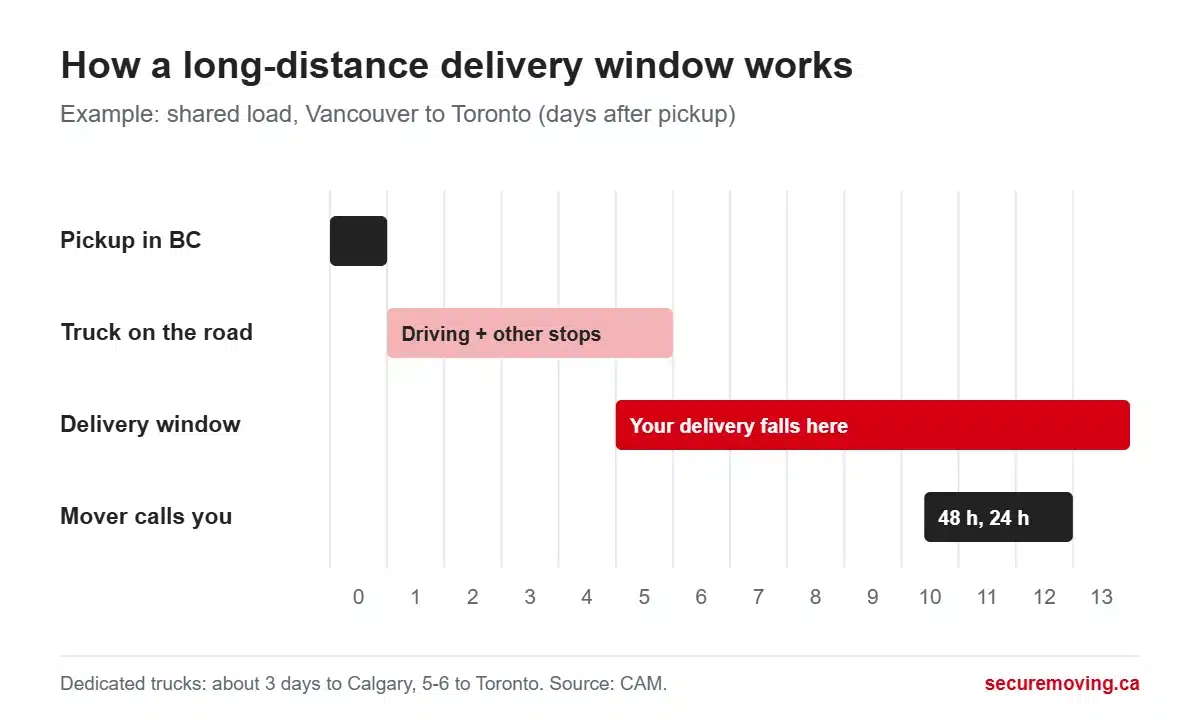
Federal hours-of-service rules cap a commercial driver at 13 hours of driving a day, with at least eight hours off in a row. A driver cannot simply push through the night to make up time, which is why a dedicated truck from Vancouver to Calgary still takes around three days door to door, and Vancouver to Toronto about five or six. The same trips on a shared load can take one to two weeks.
Plan for the gap. If you are flying ahead, assume a few nights with no furniture. Air mattresses, a kettle, two plates and a phone charger make an empty apartment liveable for a week. If your new place is not ready when the truck arrives, ask about storage-in-transit, which the moving association describes as short-term storage of up to 60 days along the way.
Planning a move to Alberta, Ontario or beyond?
Call 604-500-3003 or get a free quote for your long-distance move, and we will walk you through timing for your route.
Sell it, ship it or replace it
The easiest way to save money on a long-distance move is to not ship things you would not miss. A simple test works for most furniture: ask your mover for their per-pound or per-cubic-foot figure on your route, estimate what the item weighs, and compare the cost of shipping it against what it would cost to replace.
- Usually worth shipping: good solid-wood furniture, anything with sentimental value, quality mattresses under a few years old, tools, and anything expensive and light.
- Often not worth shipping: flat-pack furniture (it rarely survives a second assembly well anyway), old sofas, cheap bookcases, pantry food, cleaning supplies and garden soil.
- Check before you pack: appliances. Many rentals in other provinces come with them, and older fridges and washers can cost more to move than they are worth.
Start selling early. Marketplace listings take longer to move as moving day approaches and buyers can smell urgency. For the packing itself, see our guide to getting free moving boxes.
The rules follow the province you leave from
When a truck crosses a provincial border, whose rules apply if something breaks? Federal regulations answer that: the conditions of carriage and limits of liability are those of the province where the transport starts. A move that begins in BC runs under BC’s household goods rules all the way to Halifax.
Under those rules, the default maximum a mover owes is $4.41 per kilogram ($2 per pound), calculated on the shipment’s weight, unless you declare a higher value. Many movers also offer a “released value” of 60 cents per pound per article if you sign for it, which pays very little on light, expensive things. Our guide to choosing a moving company in BC explains both in detail, including a tribunal case where a release was not enforced because it was not explained properly.
Two habits protect you on a long move:
- Read the inventory before you sign it. The crew will tag each item and note its condition. Make sure “scratched” is not written next to a table that has no scratches, and photograph anything valuable before it is wrapped.
- Note damage on delivery paperwork. Open the boxes that matter most before the crew leaves, and write any damage on the delivery receipt rather than signing it clean.
What cannot go on the truck
Movers will not carry anything flammable, corrosive or explosive. The usual list: propane cylinders, gasoline, paint thinner, aerosols, fireworks, matches, oxygen bottles, pool chemicals and car batteries. Ammunition and firearms come under federal rules, so ask your mover before packing them. Our BC moving checklist lists the free depots that take paint, propane and solvents before you go.
Plants and wood are the restrictions most people moving out of Metro Vancouver have never heard of:
- Japanese beetle. The federal food inspection agency (CFIA) has regulated areas in Vancouver, Burnaby, Coquitlam and Port Coquitlam, among others. Moving plants with soil or growing media out of a regulated area needs a CFIA movement certificate, all year round. Bare-root cuttings and plants without soil are treated differently; call the CFIA before you pack the garden.
- Emerald ash borer. Vancouver, Burnaby, Surrey, New Westminster and UBC are regulated areas, and moving ash firewood out of one is prohibited.
- Firewood in general. The CFIA’s advice is to buy it where you will burn it, from wood cut less than 80 km away. Leave the woodpile behind.
Getting through the mountains in winter
Every road out of the Lower Mainland climbs. From 1 October to 30 April, most BC highways outside the Lower Mainland require winter tires (the M+S or three-peak mountain snowflake symbol, with at least 3.5 mm of tread), and commercial trucks over 11,794 kg must carry chains. Summer tires with chains on them do not count.
Weather is the reason delivery windows widen in winter. The Coquihalla summit sits at 1,244 metres. On the Trans-Canada, Rogers Pass crosses about 130 avalanche paths, and Parks Canada runs what it calls the largest mobile avalanche control program in the world there, with the Canadian Armed Forces firing artillery to bring slopes down safely. When the road closes for control work or a slide, every truck waits. Building a day or two of slack into a winter move is not pessimism, it is how these routes work. More on that in our guide to moving in winter.
Driving your own car? Check DriveBC before each leg, carry a winter kit, and do not plan your days to the limit of your daylight.
Your car, your pets and the bag that rides with you
Drive it or ship it
Rough driving distances from Vancouver: Calgary about 970 km (11 hours of driving), Edmonton about 1,160 km (13 hours), Winnipeg about 2,290 km (25 hours), and Toronto about 4,400 km on Canadian highways. Calgary is a long day or an easy two. Toronto is five or six days for most people.
Car carriers listed on uShip quote roughly $450 to $1,900 for distances between 300 and 2,000 km, with open transport cheaper than enclosed. Weigh that against fuel, hotels, meals and the days off work, and remember that your car can carry the essentials that should not go on the moving truck.
Pets
Driving is usually easier on animals than flying, but if you fly, check the airline’s rules early. Air Canada, for example, does not accept pets as checked baggage between 18 December and 4 January, restricts small pets in the hold through the winter months, and does not carry snub-nosed breeds in cargo. WestJet asks for checked pets to be booked at least 48 hours ahead. Rules change, so confirm with the airline when you book.
The bag that rides with you
Pack one bag or tote that never goes near the truck:
- Passports, ID, birth certificates, your lease or purchase documents
- The bill of lading, inventory and your mover’s contact number
- Prescription medication and a week of anything you take daily
- Laptops, chargers, hard drives and jewellery
- A week of clothes for everyone, plus bedding for the first nights
- Basic tools for reassembling beds, and a box cutter
- Kids’ favourite things and pet food, bowls and leashes
A timeline that works
Eight weeks out: get two or three in-home or video estimates, decide what to sell, book your mover. Summer dates go first.
Six weeks out: start selling and donating. Book the car carrier or plan the drive. Check CFIA rules if you are taking plants.
Four weeks out: start packing the rooms you use least. Confirm the delivery window and whether you need storage-in-transit. Arrange pet travel.
Two weeks out: drop off paint, propane and other dangerous goods at a depot. Use up the freezer. Confirm elevator bookings at both ends.
Moving week: pack your ride-along bag, photograph valuables, defrost the fridge, and walk through the inventory with the crew before you sign.
Delivery day: be reachable by phone, check the most important boxes before the crew leaves, and note any damage on the paperwork.
Frequently asked questions
How far in advance should I book a long-distance move?
Six to eight weeks is comfortable, and more for June to August or a month-end date. Long-distance crews and trucks are committed for days at a time, so availability tightens faster than for local moves.
How long does a move from Vancouver to Calgary or Toronto take?
With a dedicated truck, roughly three days to Calgary or Edmonton and five or six days to Toronto, door to door. A shared load needs a window of one to two weeks.
What is the cheapest way to move long distance?
Ship less. After that, a shared load costs less than a dedicated truck, and flexible dates help. For very small moves, shipping boxes by courier can beat a truck; Canada Post accepts parcels up to 30 kg.
Can I choose the exact day my things arrive?
Usually not on a shared load. You get a delivery window and calls 48 and 24 hours ahead. A dedicated truck gives you much more control over timing, at a higher price.
What if my new home is not ready when the truck arrives?
Ask for storage-in-transit when you book. Your shipment is held in a warehouse along the route and delivered when you are ready, usually for up to 60 days.
How we put this together
Pricing and scheduling practices come from the Canadian Association of Movers and published guidance from Canadian van lines. Liability rules come from the federal Conditions of Carriage Regulations and BC’s household goods conditions of carriage, as described by the Canadian Association of Movers and applied by the Civil Resolution Tribunal. Driver hours are from the federal Commercial Vehicle Drivers Hours of Service Regulations. Plant and firewood rules are from the Canadian Food Inspection Agency, highway rules from the Province of BC and TranBC, and Rogers Pass facts from Parks Canada. Driving distances are rounded and approximate. Pet rules are from Air Canada and WestJet as of October 2026.
Sources
- Canadian Association of Movers, handling and delivery FAQs
- Canadian Association of Movers, moving terms
- Government of Canada, Conditions of Carriage Regulations (SOR/2005-404)
- Government of Canada, Commercial Vehicle Drivers Hours of Service Regulations
- Atlas Van Lines Canada, how long-distance moving works
- Canadian Food Inspection Agency, Japanese beetle in BC
- Canadian Food Inspection Agency, areas regulated for emerald ash borer
- Canadian Food Inspection Agency, hazards of moving firewood
- Province of BC, winter tire and chain-up routes
- Province of BC, winter driving for commercial vehicles
- TranBC, the Coquihalla
- Parks Canada, avalanche control on highways
- uShip Canada, car transport costs
- Canada Post, size and weight restrictions
- Air Canada, travelling with pets
- WestJet, travelling with pets
Deciding where to go? Our Toronto vs Vancouver cost of living comparison runs the numbers on rent, tax and transit. When you are ready for a price, our long-distance movers page has the details and a quote form.
