

There is no such thing as a licensed mover in British Columbia. The province does not issue moving licences, and Consumer Protection BC says plainly that the moving industry is not regulated in Canada the way, say, home inspectors are. So when a company’s website says “fully licensed,” it is worth asking: licensed by whom?
That does not mean you are on your own. A handful of real checks exist, most of them free and online, and together they take about ten minutes. This guide walks through each one, explains what your mover actually owes you if something breaks (it is less than most people assume), and uses real BC tribunal decisions to show where moves tend to go wrong. It finishes with the questions to ask on the phone and what good answers sound like.
Want to run these checks on us?
Go ahead, and run them on every mover on your list. Ask for the WorkSafeBC account number, a copy of the bill of lading and how time is billed. Secure Moving’s Vancouver moving crews work across Metro Vancouver and the Fraser Valley, and the quote form takes about a minute.
The ten-minute background check
Before you compare prices, make sure every company on your shortlist passes these. A mover that will not give you the information needed to run them has already answered the question. For the full list of what a BC mover is required to have, see our guide to moving company rules in BC.
1. WorkSafeBC clearance letter
Any BC business with workers must register with WorkSafeBC and pay premiums. You can pull a clearance letter yourself, free, any time, at WorkSafeBC’s online clearance search, using the company’s account number or its exact legal or trade name. No login is needed.
This matters more than it sounds. WorkSafeBC warns that a homeowner who hires an unregistered business could be liable for premiums owing on the work done on their behalf. Picture a mover getting hurt carrying your sofa down the stairs while their employer is not covered: that problem lands at your door. A clearance letter confirms premiums are paid. It does not rate the company’s work, so it is a minimum, not a recommendation.
2. National Safety Code certificate, for big trucks
Commercial vehicles licensed over 5,000 kg gross vehicle weight need a National Safety Code (NSC) safety certificate, and BC’s Commercial Vehicle Safety and Enforcement branch has a public carrier profile lookup. Any company running full-size moving trucks should have an NSC number and should give it to you.
One fairness note: a small crew with a cube van under 5,000 kg does not legally need one. A missing NSC number is only a red flag if the truck is big.
3. A real business address and legal name
The Canadian Association of Movers lists a missing physical address, and a phone answered with a generic “Movers,” among its warning signs. Search the legal name, not just the brand. The name on your paperwork should match the name on the truck and on the clearance letter.
4. Reviews and complaint history
Check the Better Business Bureau profile and complaint history, then read Google reviews from the bottom up. One bad review means little. What you are looking for is a pattern: the same complaint about surprise charges or slow damage claims repeated across months, and how the company replied.
What your mover owes you if something breaks
This is the single most misunderstood part of hiring a mover in BC, and almost no moving guide explains it.
BC’s Motor Vehicle Act Regulations set standard conditions of carriage for household goods, and every mover carrying them must issue a bill of lading that includes those conditions. Two parts of them matter most to you:
- The mover has to prove it was not negligent. Under the standard conditions, the carrier is liable for damage it causes through negligence, and the burden is on the carrier to show it was not negligent. You do not have to prove they dropped it.
- Liability is capped by weight, not value. The default maximum is $4.41 per kilogram ($2 per pound), calculated on the total weight of the shipment, unless you declare a higher value on the bill of lading.
Then there is the release. Many movers offer a lower “released value” of 60 cents per pound per article, sometimes in exchange for a small discount, and the customer agrees to it by signing. Once signed, BC’s Civil Resolution Tribunal has enforced it. One 2022 decision found a customer’s TV had likely been damaged in the move, then limited the payout to the signed 60-cents-a-pound rate, about $60. Our explainer on whether movers are responsible for damage walks through how a claim works.
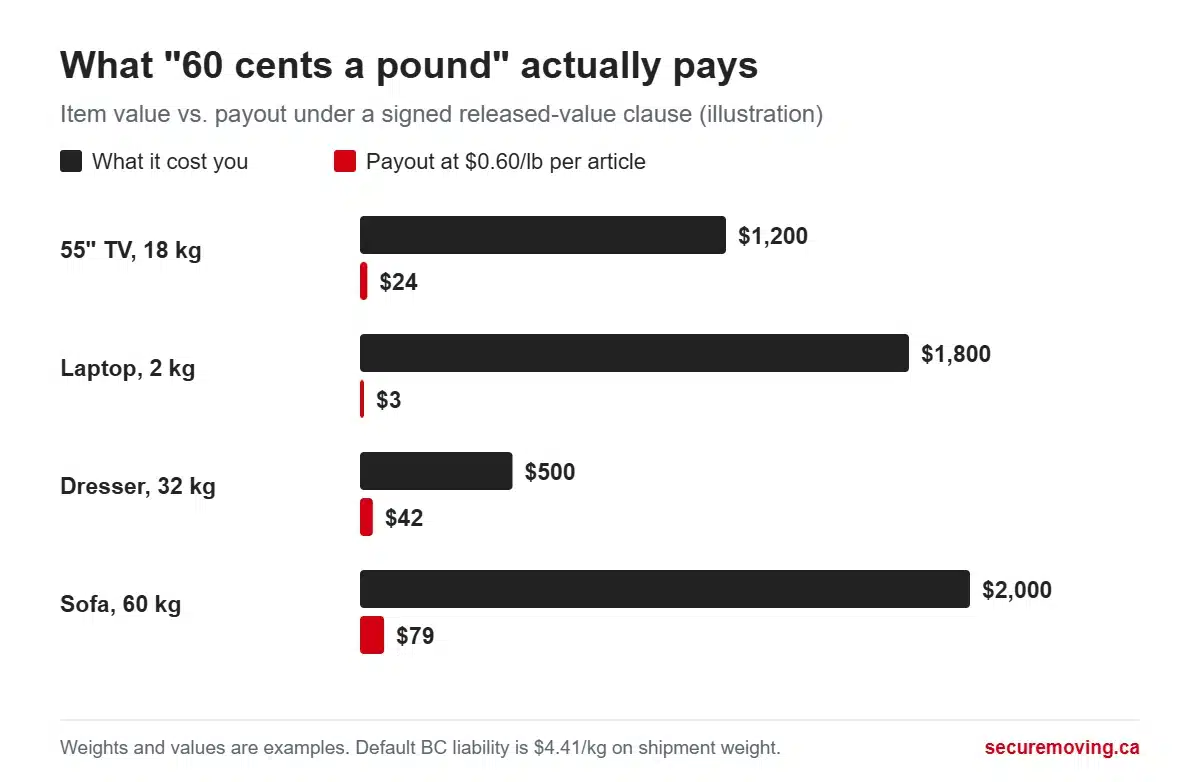
Light, expensive things are where this hurts. A laptop weighs about 2 kg. At 60 cents a pound it is worth roughly $3 to the mover’s liability, whatever it cost you. Practical takeaways:
- Read the liability section of the bill of lading before moving day, not at 8 a.m. on the doorstep.
- Do not sign a released-value clause unless you understand what you are giving up and the saving is worth it.
- For anything valuable, ask what declaring a higher value costs, or check whether your home or tenant insurance covers belongings in transit.
- Carry laptops, jewellery, documents and medication yourself.
Caps are not automatic, either. A 2024 decision refused to apply a 60-cents-a-pound limit because it had not been clearly brought to the customer’s attention near her signature. Our guide to moving insurance in Canada covers the coverage options in more detail.
How hourly quotes really work
Local moves in BC are almost always billed by the hour. That is fair for both sides, because nobody knows exactly how long a move will take until it is done, but it means the hourly rate on its own tells you very little. BC’s Civil Resolution Tribunal has heard a steady run of disputes about hourly bills, and they show what to ask about.
- Estimates are estimates. In one case, an estimate of about five hours turned into nine and a half. The estimate said in bold that billing was by actual time, so the mover was paid. In another, the tribunal said it is unreasonable to expect a binding price from a mover that has not seen your home or your belongings.
- Travel time is often billed. Several decisions involve driving time charged at the crew rate. Ask whether the clock starts at the depot or at your door, and whether there is a charge for the return trip.
- Rates can step up. One bill went up $15 per mover after the ninth hour. Find out whether the rate changes after a certain number of hours, on weekends, or at month-end.
- Fuel and truck fees may be separate. Get every line that could appear on the final invoice listed upfront.
- Verbal promises can bind them too. In a 2022 case, a mover gave a verbal range and then billed far more. With no evidence offered to contradict the customer’s account, the tribunal capped the charge at the top of the quoted range. Get the estimate in writing, by text or email at least.
To compare two hourly quotes honestly, put them on the same footing:
| Example only | Mover A | Mover B |
|---|---|---|
| Rate for 2 movers and a truck | $150/hr | $130/hr |
| Their estimate of hours on site | 5 | 5 |
| Travel time billed | None | 1.5 hours |
| Truck or fuel fee | $0 | $75 |
| Likely total before tax | $750 | $920 |
The cheaper hourly rate is the more expensive move. Crew size matters as much as the rate: three movers at a higher rate often finish a house well before two movers at a lower one. Ask each company how many people they would send, and why.
Red flags worth walking away from
The Competition Bureau and the Canadian Association of Movers describe the same scam pattern: a very low quote, often from an online classified ad, promises that “everything is included” and insists a verbal agreement is enough. On moving day a different contract appears with new fees, and the belongings are held until the customer pays more. Most reported cases have been in Ontario, where police laid hundreds of charges against one group in 2022, but the pattern travels. The BBB serving Mainland BC has logged moving complaints through its Scam Tracker too.
Signs to take seriously:
- A price well below everyone else’s, offered without seeing your home or a list of your things.
- A large cash deposit up front. The moving association suggests being wary of deposits above about 10 per cent.
- No bill of lading, or reluctance to show you one before the move.
- No WorkSafeBC account number, no physical address, an unmarked truck.
- Pressure to pay in cash only.
- A different company name on the paperwork than on the website you found.
Already had a move go wrong? The companion guide to dealing with a bad moving company in BC covers complaints, the Civil Resolution Tribunal and getting your things back.
Strata buildings: sort it out before you book
Moving in or out of a strata building adds three things to organise, and a good mover will ask about them before you do. Most buildings require an elevator booking with padding, many ask the mover for a certificate of insurance naming the strata corporation, and many charge a move-in or move-out fee.
On fees, there is a myth worth clearing up. No BC rule caps strata moving fees at a dollar figure. The Strata Property Regulation allows user fees for common property only if they are reasonable and set out in a bylaw or rule, and the Civil Resolution Tribunal has cut or cancelled fees it found unreasonable, including a $200 fee reduced to $25. Ask your strata manager for the rules in writing, then pass the certificate requirement to your mover early, since some buildings want it a week ahead.
Questions to ask on the phone
A trustworthy mover will answer all of these without hesitation. Vague answers are your signal.
- What is your WorkSafeBC account number? Good answer: they give it to you on the spot.
- How many movers would you send, and how long do you expect it to take? Good answer: a specific crew size and a range, based on questions about your home, stairs, parking and elevator.
- When does the clock start and stop? Good answer: a clear rule, in writing, including any travel time.
- Is there a minimum, and does the rate change after a certain number of hours or on weekends?
- Are there any fees on top of the hourly rate? Fuel, truck, stairs, heavy items, mattress bags, shrink wrap.
- Can I see your bill of lading before moving day? What liability does it set? Good answer: yes, and an explanation of the $2-a-pound default and how to declare a higher value.
- How much is the deposit and how is it refunded if I cancel?
- Can you give me your legal company name and office address?
Put these questions to us
Call 604-500-3003 and ask any of the questions above, or get a free quote online. Our crews cover Metro Vancouver and the Fraser Valley.
Paying safely
Consumer Protection BC’s advice is to avoid paying cash, because a credit card leaves you with a chargeback route if a service is not delivered. That route has limits: BC’s consumer law only builds in specific chargeback rights for contracts not made in person, and otherwise you rely on your card issuer’s rules. A chargeback on a move that did happen can also be reversed. A 2025 tribunal decision shows it: a customer who disputed a bill by charging it back was ordered to pay the mover anyway. A card is protection against a no-show, not a way out of an hourly bill you disagree with.
Frequently asked questions
Do movers need a licence in BC?
No. BC does not license moving companies, and no provincial body approves them. The checks that do exist are a WorkSafeBC clearance letter, a National Safety Code certificate for trucks over 5,000 kg, a bill of lading that meets the provincial conditions of carriage, and the company’s review and complaint history.
Who regulates movers in BC?
Nobody licenses them, but general consumer law still applies. The province’s consumer watchdog has taken enforcement action against a moving company under the Business Practices and Consumer Protection Act, and disputes of up to $5,000 go to the Civil Resolution Tribunal.
How much is a mover liable for if they break something?
By default in BC, up to $4.41 per kilogram ($2 per pound), calculated on the shipment’s total weight, unless you declare a higher value. If you sign a released-value clause, it can drop to 60 cents per pound per article. The mover has to prove it was not negligent.
Should I get an in-home estimate?
Yes for anything bigger than a small apartment, or at least a video walk-through. A BC tribunal has said it is unreasonable to expect a binding price from a mover who has not seen the job, and a better-informed estimate means fewer surprises on the invoice.
How far ahead should I book?
Two to four weeks is usually enough outside summer. For a month-end date between May and September, book as early as you can, since the last and first days of the month fill first.
How we put this together
The regulatory points come from Consumer Protection BC, WorkSafeBC and the Commercial Vehicle Safety and Enforcement branch. Liability rules are taken from the BC Motor Vehicle Act Regulations as quoted in Civil Resolution Tribunal decisions, and every dispute described above is a published tribunal decision listed below. Scam patterns come from the Competition Bureau, the Canadian Association of Movers and the BBB. Strata fee rules come from the Strata Property Regulation and tribunal decisions. The hourly comparison table is an illustration, not real quotes.
Sources
- Consumer Protection BC, avoiding moving scams
- WorkSafeBC, get a clearance letter
- WorkSafeBC, homeowners urged to check contractors’ coverage
- CVSE, National Safety Code
- Davies v. James Movers Inc., 2024 BCCRT 693
- 2 Burley Men Moving Ltd. v. Fraser, 2022 BCCRT 468
- Monteith Moving and Storage v. McKay, 2022 BCCRT 150
- Civil Resolution Tribunal, 2024 BCCRT 459 (release not enforced)
- Daily Hive, tribunal decision on a moving chargeback, June 2025
- Competition Bureau, rogue movers
- Canadian Association of Movers, buyer beware
- Consumer Protection BC, moving company fined, December 2016
- Huang v. Strata Plan BCS4348, 2024 BCCRT 993
- AHBL, strata moving fees, July 2026
- Consumer Protection BC, distance sales credit card reversal
Picked your mover? The BC moving checklist covers the tenancy and building deadlines, and our guide to tipping movers settles the last question of the day. For a quote from us, use the quote form or see our residential moving page.
