

Moving a hot tub comes down to four jobs: drain it, have the power safely disconnected, roll it out on its side on a spa cart with four to six people, and set it up properly on a level pad at the other end. Where there is no clear path from the backyard to the street, add a fifth job: a crane. A typical 7-by-7-foot tub weighs roughly 300 to 420 kg empty, and well over a tonne when full, which is why none of those steps can be skipped.
Most guides to this are written for American backyards. In BC, the electrical work needs a permit, Metro Vancouver cities have rules about where the water can go, and the new site may need a fence or a locking cover. This guide covers all of it, using the weights and instructions the manufacturers actually publish.
Taking the hot tub along with the rest of the house?
Tell us the make and model, send a few photos of the route from the tub to the street, and Secure Moving can tell you whether it is a crew-and-cart job or one for a crane. Heavy and awkward pieces are a regular part of our work across Metro Vancouver and the Fraser Valley. Start with the quote form.
What a hot tub actually weighs
“Five hundred to a thousand pounds” is the figure you will see everywhere. The manufacturers’ own spec sheets are more useful, because they show how much of the weight is water.
| Model (size) | Footprint and height | Empty | Full |
|---|---|---|---|
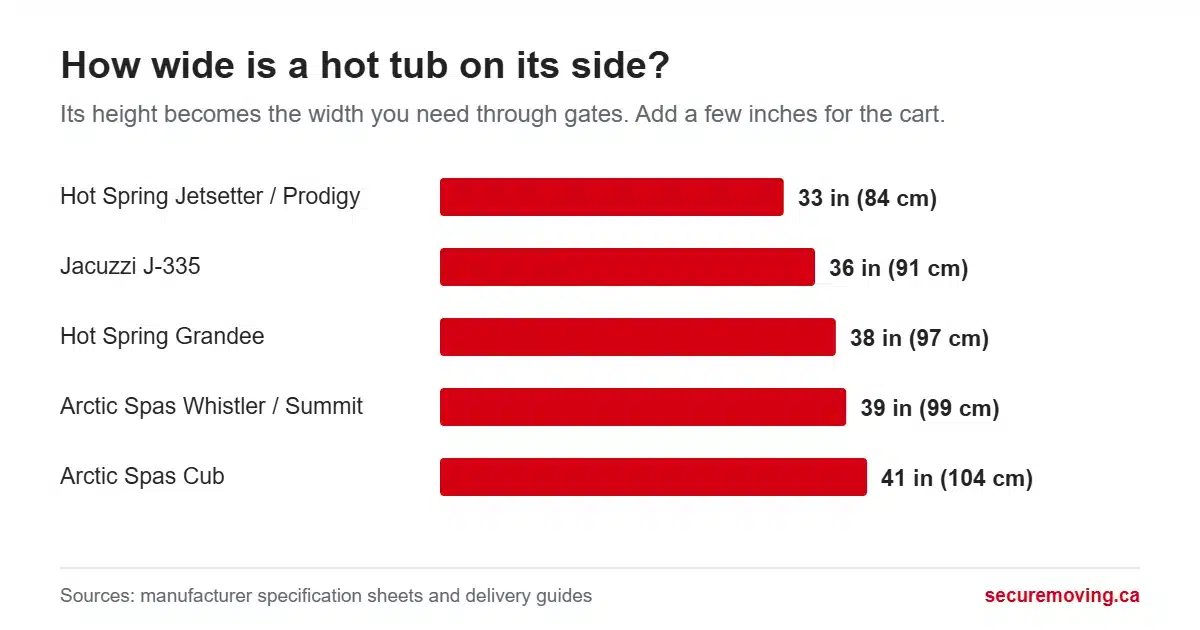
| Hot Spring Jetsetter (3 seats) | 7′ x 5’8″, 33″ high | 225 kg | 1,390 kg |
| Arctic Spas Whistler (7′ x 6′) | 85″ x 69″, 39″ high | 277 kg | 1,277 kg |
| Arctic Spas Cub (7′ x 7′) | 85″ x 85″, 41″ high | 336 kg | 1,377 kg |
| Hot Spring Grandee (7 seats) | 8’4″ x 7’7″, 38″ high | 360 kg | 2,645 kg |
| Arctic Spas Summit (8′ x 8′) | 93″ x 93″, 39″ high | 424 kg | 1,787 kg |
| Sundance AQ14 swim spa | 172″ x 89″, 54″ high | 1,043 kg | 6,721 kg |
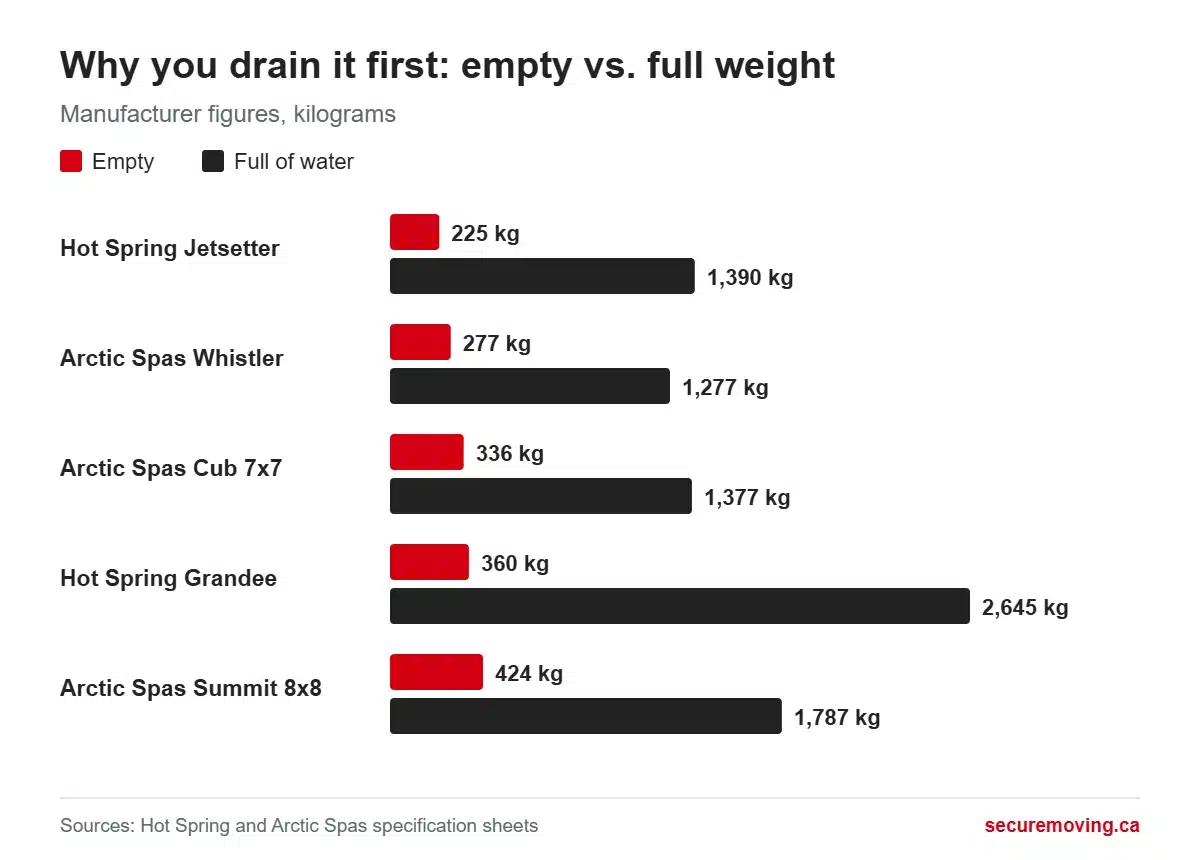
The rule of thumb is simple: a litre of water weighs about a kilogram, and a 7-by-7 tub holds somewhere between 1,000 and 1,400 litres. Draining it takes more than a tonne off the job. What is left is still heavier than a piano and far more awkward, because the shell and skirt are not built to be lifted from the edges.
Measure the route before anything else
Hot tubs travel on their side, on a spa cart, so the width that matters is not the footprint. It is the tub’s height, plus a few inches for the cart. Hot Spring’s delivery guide tells customers to take the cart width or the tub’s on-its-side width, whichever is greater, as the minimum clearance along the whole route.
Walk the path from the tub to where the truck will park and check:
- The narrowest point. Side gates, the gap between a house and a fence, a heat pump or gas meter sticking out from the wall. Most standard tubs need a clear 40 to 48 inches (about 1 to 1.2 m).
- Height clearance under eaves, branches and gutters. On its side, the tub is as tall as it is wide, often 7 or 8 feet.
- Stairs. Hot Spring and Jacuzzi both set a limit of six steps in a row without a landing for a cart delivery.
- Turns. A 90-degree corner in a narrow side yard is often the real problem, because the tub’s length has to swing through it.
- Ground. Lawn, gravel and soft beds need a plywood track. A wet Lower Mainland lawn in November will swallow cart wheels.
If the tub cannot fit through on its side, or it sits on a raised deck or behind a wall, it is a crane job. One manufacturer’s installers once put that at about one delivery in ten. The guide to moving in winter has more on working around rain and short days if your move falls between November and March.
The electrical side: a BC permit, even for an electrician
A hot tub is hard-wired on a dedicated circuit, usually 240 volts and 40 to 50 amps, with a disconnect nearby. That makes the electrical part the one step you should not improvise.
Technical Safety BC is clear that installing a hot tub requires an electrical permit, even when an electrician does the work. In the City of Vancouver the permit comes from the City rather than Technical Safety BC, and Burnaby and Surrey run their own homeowner permit forms too. Homeowner permits are not available to owners in strata buildings or non-strata duplexes, who must hire a licensed electrical contractor.
In practice:
- At the old house: switch the tub off at its disconnect and breaker before draining. Have an electrician disconnect the wiring and make the old circuit safe, especially if the new owners are not keeping a tub.
- At the new house: the tub needs a correctly sized circuit, ground-fault protection, and a disconnect in the right place. BC adopted the 2024 Canadian Electrical Code in March 2025. Under its hot tub section, the disconnect has to be outdoors, easy to reach, and at least 1.5 m from the water. Your electrician will handle the details and the permit.
Budget for this. Canadian cost guides put a hot tub electrical hookup at roughly $600 to $2,200, depending mostly on the distance to your panel.
Draining it without breaking a bylaw
Even a mid-size tub holds well over 1,000 litres of chlorinated or brominated water, and in Metro Vancouver it cannot simply go down the street drain. Storm drains run straight to creeks and the ocean.
- Vancouver: drained hot tub water goes to the sanitary sewer. Draining onto the ground is only acceptable where there are no storm drains, yard drains, perimeter drains, ditches or creeks nearby. Fines under the City’s sewer bylaw run up to $10,000 per offence.
- Burnaby: the drain must go to a sump or standpipe connected to the sanitary or combined sewer.
- West Vancouver: chlorinated water goes to the sanitary sewer, and draining into the watercourse system is prohibited.
The usual method is a submersible pump or the tub’s own drain spigot and a hose run to a basement floor drain, laundry sink or cleanout. Before you start, Sundance suggests running the jets with the air valves open to push water out of the lines. Expect a few litres to stay in the footwell and the plumbing; a wet-dry vac takes care of it. In winter, that leftover water can freeze and crack lines if the tub sits outside before being moved, so blow the lines out. Arctic Spas recommends having a dealer winterize the tub, since a botched winterizing can void the warranty.
Moving day, step by step
- Take the cover off and move it separately. Hot tub covers weigh about 23 to 45 kg (50 to 100 lb) and tear easily at the hinge.
- Check that the power is off and the tub is empty and dry inside. Remove the filters and anything loose.
- Lay the plywood track over grass and soft ground, all the way to the truck.
- Tip the tub onto its side onto the spa cart, with padding underneath. Sundance advises resting it on the side opposite the equipment compartment, so the pump and heater are not carrying the load. Lift from the base, not from the acrylic lip or the skirt panels.
- Strap it to the cart with ratchet straps before it moves an inch.
- Roll it out with enough people. Sundance suggests at least four for a standard 7-by-7 tub, and six to be safe. Someone walks ahead to check the path and someone watches the corners.
- Load it into the truck or onto a trailer using a ramp or liftgate, keep it on its side, and strap it to the truck wall at several points. Blankets go between straps and the skirt.
- Reverse the process at the new house, setting it down gently on the prepared pad.
Pipes and rollers under a tub on its base, a common DIY trick, work for shifting it a few feet on a flat patio. For other awkward single pieces, our single-item movers handle the heavy lifting. They are not a way to move it across a yard, up a slope or into a truck.
When you need a crane
A crane, or a boom truck, lifts the tub from the backyard over the house or fence and sets it on the truck or straight onto the new pad. That is the right call when the side yard is too narrow, the tub sits on an elevated deck, there are steps without landings, or the new spot is just as hard to reach. Swim spas almost always need one: Bullfrog’s manual says they are not intended to be moved after installation and that a crane will be required in most cases.
Crane rates are quoted per job with minimum hours, and nobody publishes a reliable Metro Vancouver price list, so get a quote with photos. Should the crane truck need to park on the street, the City may require a permit, and the crane company usually arranges it. Time the crane and the moving crew for the same slot; paying a crew to wait for a crane is the most expensive way to do this.
Not sure whether yours needs a crane?
Send us photos of the route from the tub to the street with your quote request, or call 604-500-3003. You can also get a free quote for the hot tub and the rest of the move together.
Setting it up at the new place
The base
A full tub puts roughly 115 to 130 pounds on every square foot, according to Hot Spring. The manufacturers ask for a flat, level, reinforced concrete pad at least 4 inches thick, extending 6 to 12 inches beyond the tub on each side. Never level a tub with shims; Bullfrog warns there should be no voids beneath it. A raised deck is a different matter: have a contractor or structural engineer confirm it can take the load before the tub goes anywhere near it.
Permits and fencing
Check with the new municipality before installation day. Burnaby, for example, requires a building permit with engineer-sealed drawings if the tub is not on the ground or its own concrete foundation, along with electrical and plumbing permits, and requires the tub to sit inside a non-climbable fence 1.5 to 1.8 m high with self-latching gates. Delta accepts a locking cover instead of a fence. Rules vary from city to city, so ask at the permit counter.
Refilling and start-up
- Fill it through the filter compartment with a garden hose, which helps prevent airlocks in the pump.
- Do not turn the power on until the tub is full. The Arctic Spas manual warns that powering an empty tub can damage it immediately and void the warranty.
- Check every fitting for leaks during the first few hours, since joints can loosen on a move.
- Expect it to take most of a day to reach temperature. Balance the water chemistry once it is warm; Arctic Spas cites Health Canada’s 3 to 5 ppm sanitizer level for residential tubs.
- Give it 24 to 48 hours before the first soak.
What it costs
Few Canadian sources publish prices, so treat these as ranges to sanity-check quotes against rather than as prices:
| Part of the job | Typical range | Source |
|---|---|---|
| Moving the tub itself, local | US$300 to US$1,200; around US$200 to US$400 on the same property | Angi, Hot Spring (US data) |
| Electrical disconnect and new hookup | CA$600 to CA$2,200 | HomeStars |
| New concrete pad or foundation | CA$2,000 to CA$5,000 | HomeStars |
| Crane or boom truck | Quoted per job, with minimum hours | Get a local quote |
| Removal instead of moving | CA$300 to CA$1,000 | HomeStars |
Notice that the move itself is often the cheaper part. The electrician, the pad and any permits at the new house can easily cost more than the moving crew.
Is your hot tub worth moving?
Add up the move, the electrical work and the new pad, then compare it with what the tub is worth. A tub under ten years old in good condition usually justifies it. An older one with a tired heater, a cracked shell or a cover that needs replacing often does not, especially if the new home needs a full electrical run.
Getting rid of one costs less than people expect. Metro Vancouver’s small-load tipping fee is capped at $167 per load from July 2026, and an empty tub is well under a tonne, so the cost is mostly the labour of getting it there. Removal services typically charge $300 to $1,000.
Selling your house? Decide early whether the tub stays. BC’s standard contract of purchase and sale includes fixtures, and a tub that only sits on a pad under its own weight is usually treated as personal property rather than a fixture. Write it into the contract either way, so nobody is surprised on possession day.
Frequently asked questions
Can you move a hot tub on its side?
Yes, and that is how most are moved. It goes onto a padded spa cart, resting on the side opposite the equipment compartment, and stays strapped to the cart the whole way.
How many people does it take to move a hot tub?
At least four for a standard 7-by-7 tub, and six is safer. Smaller two- and three-seat tubs are lighter, but the shape still makes them awkward for fewer than four.
Do I need an electrician to disconnect a hot tub in BC?
Turning it off at the breaker and disconnect is something any owner can do. Disconnecting and reconnecting the wiring is electrical work that needs a permit in BC, and owners in strata buildings or duplexes must use a licensed electrical contractor.
How long after moving can I use my hot tub?
Once it is full, heated and the chemistry is balanced. That usually means 24 to 48 hours after the refill starts.
Can a regular moving company move a hot tub?
Many can, with a spa cart, enough crew and a clear route. Ask whether they have moved hot tubs before, what equipment they bring and how they handle the electrical side, and book the electrician and any crane yourself or through them. Our guide to choosing a moving company in BC covers the questions to ask.
Can you move a swim spa?
Yes, but it is a specialist job. A swim spa weighs around a tonne empty and almost always needs a crane.
How we put this together
Weights, dimensions, delivery rules and start-up steps come from the manufacturers’ own spec sheets, delivery guides and owner’s manuals (Hot Spring, Arctic Spas, Jacuzzi, Sundance and Bullfrog). Electrical rules come from Technical Safety BC and the 2024 Canadian Electrical Code as summarised by provincial regulators. Drainage, permit and fencing rules come from the cities of Vancouver, Burnaby, West Vancouver and Delta. Cost ranges come from HomeStars and US sources, labelled as such, and disposal fees from Metro Vancouver.
Sources
- Hot Spring, Jetsetter specifications
- Hot Spring, Grandee specifications
- Hot Spring, HighLife pre-delivery instructions (2026)
- Arctic Spas, Cub specifications
- Arctic Spas, Whistler specifications
- Arctic Spas, Summit specifications
- Arctic Spas, owner’s manual: care and maintenance
- Arctic Spas, owner’s manual: start-up procedures
- Sundance Spas, how to move a hot tub safely
- Sundance Spas, swim spa weight
- Bullfrog Spas, swim spa owner’s manual
- Technical Safety BC, does installing a hot tub require a permit?
- Technical Safety BC, electrical homeowner permits
- Technical Safety BC, adoption of the 2024 electrical code
- City of Vancouver, swimming pools, hot tubs and spas bulletin
- District of West Vancouver, responsible pool and hot tub drainage
- City of Burnaby, spas and hot tubs guide
- City of Delta, hot tubs
- HomeStars, hot tub cost guide
- Angi, hot tub moving cost (US)
- Metro Vancouver, tipping fees
- Smith v. McGillis, 2024 BCCRT 443 (fixtures and personal property)
Moving other heavy pieces too? Our piano movers and gym equipment movers handle the other awkward items, and the BC moving checklist keeps the rest of the move on track. For a quote that includes the hot tub, use the quote form.
