

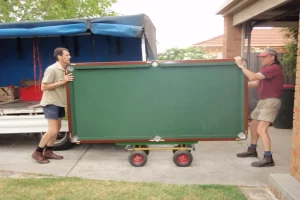
Before anything about dollies, straps or slate, there is a sentence you need to read, and it comes from a manufacturer rather than from us.
Olhausen’s published warranty says: “Use of a moving company or a non-Olhausen affiliated agent will result in your Lifetime Warranty being null and void.”
Brunswick’s says the warranty “becomes null and void if the Product is not installed and serviced by Brunswick or an Authorized Brunswick Dealer”, and its exclusions reach any table “installed, moved or repaired by parties other than Brunswick or an authorized Brunswick dealer or agent.”
We are a moving company, and we are telling you this on our own page, because finding it out a year later when the slate cracks is worse for you than reading it now.
So the first step in moving a pool table is not physical. It is finding out who made yours and what its warranty says. This page then covers what the manufacturers publish, why disassembly is usually the right answer, and what happens if you decide to proceed anyway.
Check the warranty before you book anyone
- Find the maker. Usually on a plate under a rail, on the frame inside, or on the original invoice.
- Read the warranty page for that brand, specifically the sections on installation, service and exclusions. The language you are looking for is about who is permitted to move or service it.
- Call the dealer before you call a mover if the table is still in warranty and the warranty matters to you. An authorised installer costs more than a crew and preserves coverage that can be worth far more than the difference.
- If the table is out of warranty, or the coverage is not something you intend to rely on, then the rest of this page applies and the decision is yours to make on the merits.
Worth being precise about what those warranty terms do and do not say. No published instruction from either maker says a table must not be moved assembled. Their terms are about who handles it. We looked specifically for a manufacturer statement about frame or slate damage caused by moving a table in one piece and could not find one from any maker. So anyone telling you the manufacturer forbids it is going further than the manufacturers do.
One more piece of Brunswick’s fine print, which catches people even on an authorised move: the “warranty does not include re-leveling of the table after a successful initial installation.” Levelling after a move is a separate service and a separate bill.
One manufacturer publishes weights, and it is 800 lb
Only one manufacturer we could find publishes weights. Diamond Billiard Products, on its own product pages:
| Table size | Assembled dimensions | Published weight | Playing area |
|---|---|---|---|
| 7 foot | 94 × 54 × 32 in | 800 lb | 40 × 80 in |
| 8 foot | 104 × 59 × 32 in | 1,000 lb | 45 × 90 in |
| 9 foot | 114 × 64 × 32 in | 1,200 lb | 50 × 100 in |
Diamond’s Pro-Am and Professional lines publish identical figures, so treat these as indicative of a slate table of that size rather than line-specific.
No weights from Brunswick, Olhausen or Connelly could be located. And nobody publishes slate weight by thickness, which is the number quoted on every pool-table page online. We are not going to add another unsourced one. Your dealer has the figure for your table.
For scale: at 1,000 lb, an eight-foot table is heavier than a grand piano and about twice the rated capacity of a standard hand truck. Magliner publishes a blanket 500 lb capacity for its hand trucks unless otherwise noted. Lifting straps go to 800 lb with Forearm Forklift, and 1,000 lb for Shoulder Dolly’s heavy-duty Pro Lift straps. An assembled eight-footer is at or over the top of every piece of general moving equipment on the market, which is the practical reason it comes apart.
It comes apart for the tolerance, not the weight
The Billiard Congress of America publishes equipment specifications for recreational tables, and the numbers are tighter than people expect:
| Specification | Tolerance |
|---|---|
| Playing surface flatness, lengthwise | ± .020 inch |
| Playing surface flatness, across the width | ± .010 inch |
| Maximum deflection under a 200 lb centre load | .030 inch |
| Slate joint alignment after levelling | within .005 inch |
| Bed height | 29¼ to 31 inches |
| Tournament slate | three-piece, minimum 1 inch thick |
Five thousandths of an inch is roughly two sheets of paper. That is the tolerance the slate joints are set to when the table is installed properly, and it is achieved by shimming and levelling a three-piece slate on an assembled frame, in position, with the table where it will live.
Nothing about carrying a one-piece assembly through a doorway, down a step and across a driveway re-establishes that. Even if nothing visibly breaks, the table you set down is not levelled and the joints are not aligned, and you will be paying someone to correct it. Which is the point: the choice is not “disassemble or don’t”, it is “disassemble now or re-level later”.
There is a narrow case where moving a table assembled makes sense: a short, flat, same-floor move of a small table with wide openings and enough hands, on a table whose warranty is not a concern. That is a real case and we will do it. It is just much narrower than a page titled “without taking it apart” implies.
Will it even fit?
Measure before you decide anything, because the geometry often makes the decision for you.
The narrowest doorway the BC Building Code permits inside a dwelling is 610 mm, about 24 inches, covering bathrooms, walk-in closets and rooms off a 710 mm hallway. Other rooms are 760 mm and required entrances and stair openings are 810 mm, about 31.9 inches.
An eight-foot table is 59 inches across the rails. Assembled, it does not pass any of those openings on its side without being tipped, and tipping a 1,000 lb assembly with unsupported slate is the specific thing you are trying to avoid. Disassembled, the largest single piece is a slate section, and a one-inch slate section of an eight-foot table is a two- or three-person carry that fits through a normal door flat.
On stairs, the code figures are 900 mm minimum width for required exit and public stairs in residential buildings, 860 mm for stairs serving a single dwelling unit, and headroom of 2,050 mm, or 1,950 mm within a dwelling unit. Vancouver’s own by-law matches those stair numbers. A slate section on an 860 mm stair with a turn is a planned carry with a spotter.
Room size at the far end. Brunswick publishes room-size requirements by table size and cue length. Worth noting honestly: the table as published on its page appears to have the minimum length and width columns transposed, showing a greater minimum width than length for a table that is longer than it is wide. We have not reprinted the figures for that reason. Check the live page, and if you are laying out a room, measure the playing area plus twice your cue length in each direction and treat that as the floor.
If you are taking it apart, the order matters
This is the sequence an installer follows, and the reason for each step:
- Pockets and rails off first. Note which rail came from which side; they are not always interchangeable and the bolt patterns can differ.
- Cloth off the rails carefully if it is being reused. Rail cloth is usually stapled. Slate cloth is often glued, and removing glued cloth intact is a skill rather than a step.
- Slate unbolted, lifted, and carried flat. Three-piece slate comes up in three pieces, each with its beeswax joint seam broken. Slate carried on edge is slate that chips at the edge, which is the edge the joint depends on.
- Frame and legs. Label everything and bag the hardware by assembly.
- Photograph each stage before you undo it. This is the single highest-value five minutes in the whole job.
On the reassembly side, the levelling is the job. Shim the frame, set the slate, align the joints, wax the seams, re-cloth, re-rail, then level again with the table in position. If that sequence reads like a trade rather than a task, that is because it is one, and it is the reason the manufacturers tie their warranties to authorised installers.
Common mistakes
- Tipping an assembled table to get it through an opening. Unsupported slate on a tipped frame is the failure mode that cracks slate.
- Lifting by the rails. Rails are fastened to the frame, not structural to it, and they will pull.
- Sliding it across a floor. A pool table has feet designed to sit still, and the floor loses.
- Reusing glued slate cloth. Budget for new cloth if the table is being disassembled; it is a small cost next to the labour around it.
- Skipping the final level. A table that plays with a roll is a table you will call someone about anyway.
- Not checking the warranty. Covered at the top, and it is the one that costs the most.
How we handle a pool table
We will move a pool table, disassembled, with the hardware labelled and the slate carried flat. We will tell you at the quote stage what your manufacturer’s warranty says if you can tell us the brand, and we will recommend an authorised installer instead of us where the coverage is worth more than the saving. For the levelling and re-clothing at the far end, a billiards installer is the right trade and we are happy to work alongside one.
If the table is out of warranty and you want it moved as one piece on a short flat route, we will assess whether that is sensible and tell you honestly if it is not.
Our guide to moving heavy furniture up stairs covers the lifting technique in more detail, and for the rest of the move our team works as a moving company in Vancouver. If you want us to handle the whole job, our residential moving service is the place to start.
Frequently asked questions
Does moving a pool table void the warranty?
It can, and at two major manufacturers it does. The Olhausen warranty states that use of a moving company or a non-Olhausen affiliated agent “will result in your Lifetime Warranty being null and void”. Brunswick’s becomes null and void if the product is not installed and serviced by Brunswick or an authorised dealer, and its exclusions cover tables moved by other parties. Check your own manufacturer’s warranty page before booking anyone.
Can you move a pool table without taking it apart?
Physically, on a short flat same-floor route with a small table, wide openings and enough people, yes. Two reasons it is usually the wrong call: an eight-foot table is around 1,000 lb, which is at or above the rated capacity of every piece of general moving equipment, and the table will need re-levelling afterwards regardless, because slate joints are set to within .005 inch and nothing survives being carried. Neither Olhausen nor Brunswick publishes an instruction forbidding it, so this is a judgment rather than a rule.
How much does a pool table weigh?
Published figures from Diamond Billiard Products are 800 lb for a 7 foot, 1,000 lb for an 8 foot and 1,200 lb for a 9 foot table. Brunswick, Olhausen and Connelly publish no weights we could find, and no manufacturer publishes slate weight by thickness, so we are not quoting one. The dealer will have the figure for your specific table.
How flat does a pool table have to be?
The equipment specification published by the Billiard Congress of America gives ± .020 inch lengthwise and ± .010 inch across the width, with a maximum deflection of .030 inch under a 200 lb centre load, and slate joints aligned within .005 inch after levelling. That last figure is about two sheets of paper, and it is the reason levelling is a trade rather than a step.
Do I need to re-level a pool table after moving it?
Yes, in effect always. Worth knowing too that Brunswick states its warranty “does not include re-leveling of the table after a successful initial installation”, so even on an authorised move the levelling may be a separate service and a separate bill.
Will a pool table fit through a standard door?
Not assembled: an eight-foot table is 59 inches across the rails, against a code-minimum entrance opening of 810 mm, about 31.9 inches, and interior doorways as narrow as 610 mm. Taken apart, the largest single piece is a slate section, which is a two- or three-person carry that goes through a normal door flat. Hot tubs are the other backyard heavyweight people ask us about, and they come with their own rules; see our guide to how to move a hot tub.
