

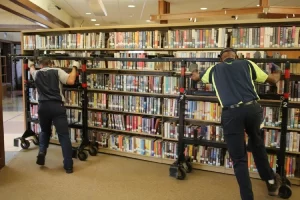
The lifting is the easy part of this job. The part people get wrong is the anchor, and a move is the one moment in a bookcase’s life when the anchor definitely comes off the wall.
So this page covers the tip-over question first, because it is the only part with real consequences, and then the mechanics.
Canada regulates dressers, and not bookcases
Furniture tip-over is a regulated hazard in Canada, and bookcases fall through the gap.
What is regulated. Health Canada has determined that free-standing clothing storage units, meaning dressers, chests and the like, that do not conform to the applicable criteria in ASTM F2057-23 “pose a danger to human health or safety”, and are therefore prohibited from being manufactured, imported, advertised or sold in Canada under paragraphs 7(a) and 8(a) of the Canada Consumer Product Safety Act. Enforcement can include seizure, orders to take corrective measures, product recalls, administrative monetary penalties or criminal prosecution.
What is not. That standard is scoped to units with at least 3.2 cubic feet of enclosed storage, along with a height of at least 686 mm, about 27 inches, and a mass of at least 13.5 kg, about 30 lb. An open-shelf bookcase has no enclosed storage and does not qualify.
We looked for a mandatory tip-over standard covering open bookcases, in Canada or the United States, and found none.
Which leads somewhere useful rather than alarming. The only thing standing between a tall bookcase and a tip-over is the wall anchor, and nobody is required to check that you refitted it. IKEA’s BILLY page carries the manufacturer’s own warning: “WARNING! Tipping hazard – this product must be securely anchored. Use suitable screws and plugs for your home.” That is a product warning rather than a regulation, and on moving day it is the whole of your protection.
90 Canadian reports, 12 of them deaths
Two sets of numbers get quoted together and they are not comparable, so here they are separately.
Canada. Health Canada is aware of 90 reports of furniture tip-over incidents between 20 June 2011 and 30 September 2024, of which 12 reported a death and 42 reported an injury. These are voluntary incident reports.
United States (labelled, because it is a different country and a different measure). US emergency departments treated an estimated annual average of 17,800 people for product instability or tip-over injuries related to televisions, furniture and appliances across 2020 to 2022, including an estimated annual average of 1,800 child injuries involving a chest, bureau or dresser, with 100 reported fatalities. These are estimates of hospital visits.
The US figures are far larger because they measure something different. Anyone presenting them side by side without saying so is misleading you.
Find the anchor before you move the bookcase
- Locate it first. It is usually a strap or an L-bracket at the top rear, screwed into a stud. Photograph how it was fitted.
- Keep the anchor hardware with the bookcase, in a labelled bag taped to the unit. This is the single most-lost item in a move because it is small, metal and looks like nothing.
- Refit it at the new address, into a stud or with a proper wall plug. Drywall alone does not hold a bookcase.
- If the anchor is missing or was never fitted, buy an anti-tip kit. They cost a few dollars and they are the only safeguard that exists for this product category.
- If children live in the house, do it before anything goes on the shelves, not at the end of the week.
Empty it, and weigh what you are dealing with
Every shelf, every book. A partly loaded bookcase has a shifting centre of gravity and a top-heavy one is the specific condition in which a unit goes over on a dolly or in a truck.
Books are the densest thing you will pack. IKEA rates a BILLY shelf at a maximum of 30 kg, about 66 lb, per shelf. A six-shelf unit loaded to that rating is carrying 180 kg of books on a carcass whose flat-packed weight is about 40 kg. The books are four and a half times the furniture.
That ratio is why the rule is boxes, not shelves, and why the boxes should be small. A book box that a person can comfortably lift is a small box two-thirds full, and a large box full of hardbacks is a back injury with a set of stairs attached.
Label by shelf. Reloading in order takes minutes if you numbered the boxes and an afternoon if you did not.
Take it apart if it comes apart
Flat-pack units are the case where the answer is usually no. Cam-lock and dowel construction is designed to be assembled once; taking it down and putting it back up can leave a looser joint than it started with, and particleboard cam holes do not improve with a second pass. A solid-wood bookcase with screwed joints takes disassembly better than a flat-pack one.
What to do instead, for flat-pack: if the unit will go through the openings assembled, move it assembled, empty, wrapped and strapped upright on a dolly. That is usually gentler on the joints than a full teardown.
Two things to remove even on an assembled move:
- Adjustable shelves. They lift out, they rattle, and a loose shelf inside a wrapped unit is what breaks the back panel.
- Glass doors or glass shelves. Out, wrapped separately, transported upright, for the reasons in our mirrors guide.
The back panel is the structural weakness. On most flat-pack units the thin hardboard back is what holds the carcass square. Carry the unit by its sides rather than its top, do not let it rack, and do not lay it face down on an uneven surface.
Will it fit? Measure the narrow point
The narrowest doorway the BC Building Code permits inside a dwelling is 610 mm, about 24 inches, which covers bathrooms, walk-in closets and rooms off a 710 mm hallway. Other rooms are 760 mm and required entrances and stair openings are 810 mm.
Height is the sleeper problem with a bookcase. A BILLY unit at 202 cm is 6 feet 7 inches tall, against a code-minimum stair headroom of 1,950 mm, about 6 feet 5 inches, within a dwelling unit. A tall bookcase carried upright on a staircase does not clear the ceiling at the turn, which is why it goes up tilted, which is why the back panel racks.
Measure: unit height, width and depth; every doorway at its narrowest; the stair width, which is 860 mm minimum within a dwelling and 900 mm for required exit and public stairs; and the headroom at the turn, which is the number that catches people.
Wrap it, then protect the route
- Blankets first, then stretch wrap. Wrap against a finished surface in warm weather can mark it, and wrap alone provides no impact protection.
- Corners take the damage. Cardboard corner protectors, or folded blanket taped at the four upper corners, which are what hit door frames.
- Protect the door jambs too, not just the furniture.
- Upright on a dolly, strapped to it, rather than carried. A bookcase is tall, light for its size and easy to control on a dolly and hard to control in arms.
- In the truck, against a wall, upright, strapped at two heights. Never flat with anything on top; the shelves are not designed to carry load from above.
Two people, in step, with agreed commands
The Canadian Centre for Occupational Health and Safety publishes team-handling guidance that is worth following on anything tall:
- Similar height and strength, because a height mismatch tilts the load.
- An assigned leader.
- Commands agreed before you start: lift, walk, stop, down.
- Practise together before the real carry.
- Walk in step.
- And the point people miss: “the combined strength of the team is less than the sum of individual strength.”
There is no legal lifting limit in BC. Part 4 of the Occupational Health and Safety Regulation, sections 4.46 to 4.53, sets out a duty to identify, assess and control the risk of musculoskeletal injury, considering the force required, the work postures, the size and weight distribution of the object, the floor surfaces and the working heights, with controls reviewed at least annually. No kilogram figure appears anywhere in it.
When to hand it over
- A tall unit and a staircase with a turn, where the headroom problem and the racking problem meet.
- An antique or solid-wood case, where the joints are worth more than the labour, and a white glove move wraps it in paper before the blankets.
- Glass doors or integral glass shelving.
- A unit you intend to keep assembled that is close to the dimensions of your narrowest opening.
How Secure Moving handles a bookcase
We move bookcases empty, wrapped, upright and strapped to a dolly, and we keep the anchor hardware with the unit in a labelled bag. We will refit the anchor at the new address if you want us to, and we will mention it at the quote stage if there are children in the house, because it is the step that gets forgotten and the only one with a real consequence.
Our team works across the region as a moving company in Vancouver and a moving company in North Vancouver. For the stairway part of the job, our guide to moving heavy furniture up stairs goes into the technique, and if the bookcase has glass in it our guide to moving large mirrors covers the glass.
Frequently asked questions
Do bookcases need to be anchored to the wall?
The manufacturer says so, and no regulation covers it. IKEA’s BILLY page carries the warning “Tipping hazard – this product must be securely anchored.” Health Canada’s tip-over determination applies to free-standing clothing storage units with at least 3.2 cubic feet of enclosed storage, which an open bookcase does not have, and we could find no mandatory tip-over standard in Canada or the US that covers open bookcases. So the anchor is the whole safeguard, and a move is when it comes off the wall.
How much does a bookcase weigh?
Less than its contents, by a wide margin. IKEA rates the BILLY at 80 by 28 by 202 cm with a package weight of about 40 kg and a maximum rated load of 30 kg per shelf, so a six-shelf unit loaded to rating carries 180 kg of books on 40 kg of furniture. Empty it completely and pack the books into small boxes two-thirds full.
Should I take a flat-pack bookcase apart to move it?
Not if it will fit through the openings assembled. Cam-lock and dowel construction is designed to be assembled once, and particleboard cam holes do not improve with a second pass, so an empty, wrapped, upright move on a dolly is usually gentler on the joints than a full teardown. Do remove adjustable shelves and any glass either way.
Will a tall bookcase fit up my stairs?
Measure the headroom at the turn, not the stair width. A 202 cm bookcase is 6 feet 7 inches tall against a code-minimum stair headroom of 1,950 mm, about 6 feet 5 inches, within a dwelling unit. So it has to go up tilted, which is what racks the thin back panel that holds the carcass square.
How many furniture tip-over incidents happen in Canada?
Health Canada is aware of 90 reports between 20 June 2011 and 30 September 2024, of which 12 reported a death and 42 an injury. The much larger figures you may have seen, around 17,800 emergency department visits a year and 100 fatalities, are United States data from the Consumer Product Safety Commission for 2020 to 2022, and they estimate hospital visits rather than count voluntary reports. The two are not comparable.
