

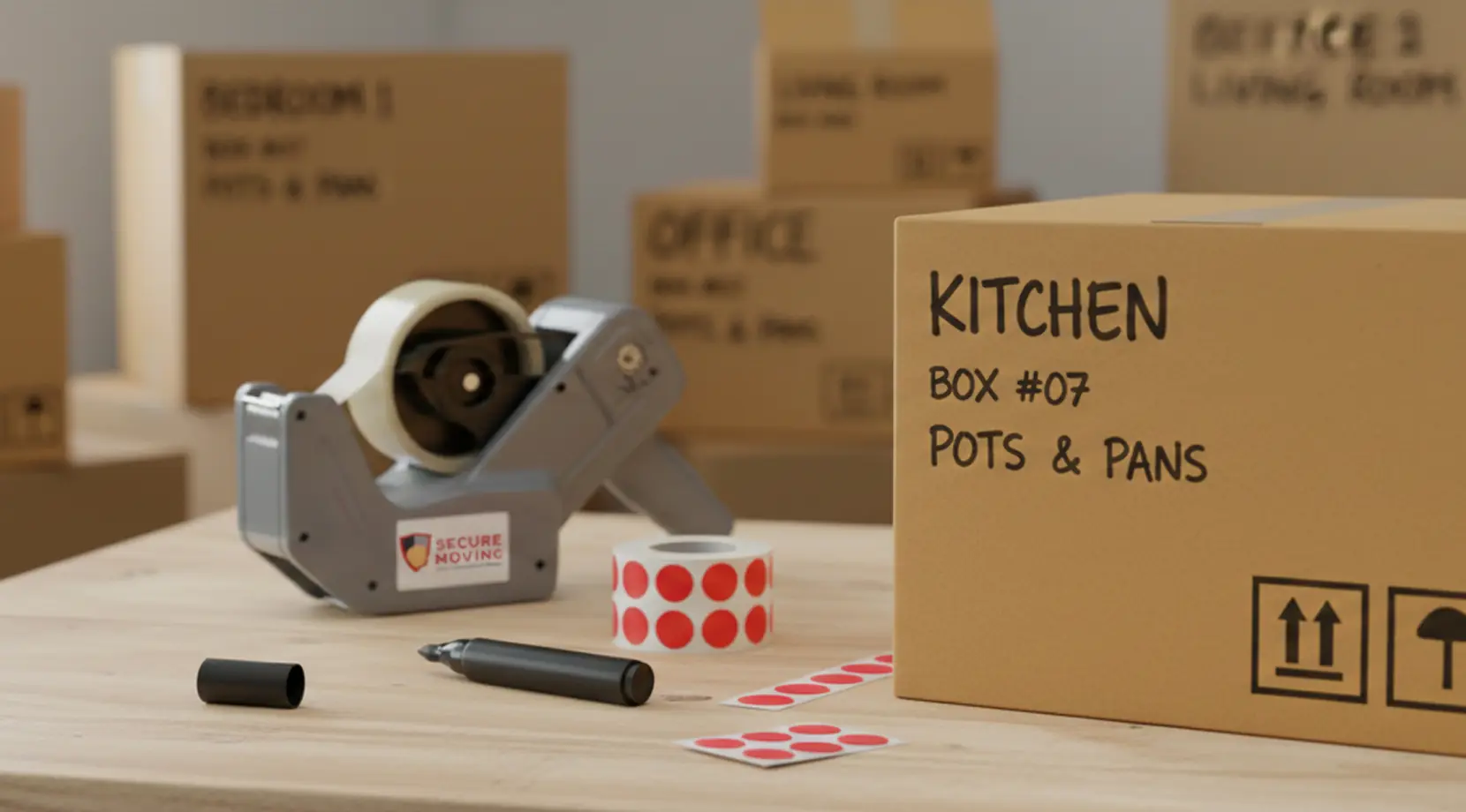
Packing goes faster than unpacking, and that is why learning how to label boxes for moving pays off. A clear label system helps helpers place boxes correctly and stops you from opening random boxes late at night just to find basics. This guide covers the label; for what goes inside the box, start with our guide to how to pack for a move.
The four-part label: room, number, contents, handling
The best system is one you can repeat on every box. Use the same four parts each time: Room + Box Number + Contents Summary + Priority/Handling.
A working example looks like this: “KITCHEN | 07 | Plates + Mugs | OPEN FIRST | FRAGILE.” Once you commit to that format, helpers can follow it without questions.
What to write, and what to leave off
People get stuck by writing too much. Keep the outside readable from a few steps away. Start with the destination room in big letters, then add a contents line that uses categories or 2 to 5 items, like “BATHROOM | Towels + Toiletries.”
Next, add one priority tag so you unpack in layers: “OPEN FIRST,” “WEEK ONE,” or “STORAGE.” Finish with handling notes like “FRAGILE,” “HEAVY,” or “THIS SIDE UP.”
For privacy, avoid labels that advertise high-theft items. “Personal Items” beats “Jewelry,” and “Desk Accessories” beats “Laptop.”
Label three surfaces: the top and two sides
A label is only useful if someone can see it. Use the “three-surface rule.” Put one label on the top, then add labels on two adjacent sides.
Keep placement consistent, too. Pick one spot, like the upper-right corner on side panels, and use it every time. If you use paper labels, tape over them so the ink does not smear in Vancouver rain.
Stickers or marker? Use both
To label quickly, combine both tools. Stickers are tidy and fast for room and priority, and marker text is flexible for contents and box numbers.
A simple routine is a sticker for room and priority, a marker for contents and number, then tape over the label. That keeps stickers readable while still letting you customise each box in seconds.
Colour on the box, colour on the door
If you want a system that does not need babysitting, add two layers: colour for speed, and a short code for clarity. Codes like “K” (kitchen), “BR1” (primary bedroom), “BR2” (kid’s room), and “OFF” (office) help even when people are tired or lighting is bad.
Then label the doors. Tape a matching colour strip plus the room code on each door frame in the new place. Helpers walk in, see “BR2,” and drop those boxes there.
Door tags earn their keep most in a condo with a booked elevator window, where the person directing traffic cannot be in two places at once. The same logic drives our guide to moving furniture into a small apartment, where access is the constraint rather than volume.
Number boxes per room, starting at 01
Room labels get boxes to the right area. Numbers help you find things inside those areas later. For less guesswork, number boxes per room starting at 01: KITCHEN 01, KITCHEN 02, LIVING 01, and so on.
Then keep a quick list in your phone, like “KITCHEN 07: plates, mugs, kettle.” It takes a minute and it is often the difference between calm unpacking and chaos.
ISO 17451: the standard for moving inventories
The numbered inventory you just built has a formal counterpart. ISO 17451-1:2016, “Packaging — Codification of contents for inventories for shipments of household goods and personal effects — Part 1: Numeric codification of inventories,” is an international standard for exactly what a mover’s inventory sheet does. There is a companion, ISO/TS 17451-2:2017, covering the XML messaging structure for transmitting that inventory data electronically.
An international standard exists for numbering the contents of a household move. Which is a decent argument for doing it properly on your own move: the room-coded, numbered, phone-listed inventory above is the consumer version of something the industry standardised.
It matters most on a cross-border move, where a detailed itemised inventory is not a convenience but part of your customs declaration.
Special labels for fragile, heavy, electronics, and liquids
This is where labelling saves your things. For fragile boxes, write “FRAGILE” big, add “THIS SIDE UP” arrows, and keep the contents line specific enough to help you unpack safely.
For heavy boxes, write “HEAVY” and keep box size smaller, so it is liftable without strain. A short “HEAVY: TEAM LIFT” note can prevent someone from trying to carry it alone.
For electronics, label the device category (Monitor, Router, Console), then bag cables and label the bag. For liquids, add “UPRIGHT” arrows and keep them bagged so leaks do not spread.
ISO 780: the standard handling symbols
The graphical handling symbols for fragile, this way up, keep away from rain, and the rest are specified in a single international standard: ISO 780:2015, Packaging — Distribution packaging — Graphical symbols for handling and storage of packages. It sits with ISO technical committee TC 122 and appears in the ISO catalogue as the current confirmed edition, replacing earlier versions from 1984, 1985, and 1997.
The practical value is that the pictorial symbols are internationally understood in a way that English words are not. Someone who does not read English fluently still knows the umbrella and the wine-glass symbols. On a box that may be handled by several people, the symbol plus the word beats the word alone.
FRAGILE creates no obligation on a carrier
Worth saying plainly, because it changes what you do. Writing FRAGILE on a box creates no obligation on any carrier we checked, and one of them says so in terms.
UPS Canada, in its terms of service effective 1 May 2026, states: “UPS does not provide special handling for Shipments bearing ‘Fragile,’ Package orientation markings (e.g., ‘UP’ arrows or ‘This End Up’ marking), or any other similar markings.” It also makes packaging the shipper’s responsibility and excludes liability for damage caused by inadequate packaging.
FedEx Canada’s service guide, effective 11 September 2026, excludes liability for damage arising from its own failure to comply with packaging orientation graphics, FRAGILE labels, or any sender instructions on a shipment.
Canada Post goes further than a disclaimer. Ceramics, glass, porcelain, mirrors, crystal, pottery, and china appear on its list of contents for which it has no liability for loss or damage at all. Buying extra coverage does not change that.
Purolator does not mention FRAGILE markings anywhere in its terms. What it does say is that adequate packaging is the customer’s own warranty, that it may refuse a shipment “which is improperly prepared, packed or wrapped for transport,” and that paying for Special Handling “does not affect Purolator’s maximum liability.”
Four carriers, and not one promises anything in exchange for the word. Which actually makes the advice above more valuable rather than less: the label is for the person carrying the box, so write it for them. Padding is what protects the contents. And on a move handled by a crew rather than a parcel network, the label genuinely does work, because a person reads it and changes how they carry the box. That is the whole point of putting it on three surfaces.
If you are shipping rather than moving, the carrier limits and the fragile-goods exclusions are covered properly in our guide to shipping boxes across Canada.
How heavy is too heavy? BC sets no limit
People ask for a number. British Columbia does not set one.
The Occupational Health and Safety Regulation’s ergonomics provisions, sections 4.46 through 4.53, impose a duty to identify factors that may expose workers to musculoskeletal injury, assess the risk, and eliminate or minimise it. The risk factors listed include force, repetition, duration, work postures, local contact stresses, workplace layout, object characteristics, environmental conditions, and work organisation. No weight limit is prescribed anywhere in them.
So the answer to “what is the legal limit for a box” is that there isn’t one, and the regulation asks a better question instead: can the load be made smaller? WorkSafeBC’s lifting and handling guidance poses exactly that, asking whether the size of the load can be reduced and noting that options include ordering smaller containers, or making two trips with smaller loads rather than one trip with a heavy load.
Which is a direct endorsement of the advice above: pack heavy things in small boxes. WorkSafeBC also publishes a lift and lower calculator and a push, pull, and carry calculator, though both produce risk ratings and suggested maximum forces rather than legal ceilings.
Writing the weight on a heavy box is good practice rather than a requirement. No BC rule asks for it, but the person picking it up will thank you.
For the items that are too heavy to solve with smaller boxes, see moving heavy furniture up stairs.
Labelling for storage or long-distance moves
Storage and long-distance moves add one extra risk: boxes can get mixed into the wrong phase. For a move across multiple stops, add a phase line like “STORAGE,” “FINAL HOME,” or “PHASE 2.” For storage, add a month and year, like “STORAGE | 02/2026.”
If boxes might be transferred, add your last name and destination city in small text on two sides as a backup.
Copy-paste label templates
- STANDARD: ROOM | ## | Category or 2 to 5 items
- OPEN FIRST: ROOM | ## | Key items | OPEN FIRST
- FRAGILE: ROOM | ## | Item type | FRAGILE | THIS SIDE UP
- STORAGE: STORAGE | ## | Category | 02/2026
Label six weeks out, not moving week
Labelling is a six-weeks-out job, not a moving-week job. Our BC residential moving checklist sets out the whole sequence with the deadlines that actually bind, and if you are sourcing cartons, where to get boxes without paying for them covers that. If you are also changing your address, who to tell and when covers mail forwarding properly, including the fact that it does not forward parcels. Canada Post’s own moving and mail page covers its side of it.
Get a free quote
A good label system works best with a crew that follows it. Secure Moving runs full-time trained teams across Greater Vancouver, with clean trucks and careful handling that keeps boxes and furniture protected, transparent quotes with no surprise add-ons for stairs, elevators, or basic equipment, and licensed and insured service for home, office, local, long-distance, and cross-border moves.
Get a free quote from Secure Moving today, or use our moving cost calculator for an instant estimate.
Frequently asked questions
How many sides should I label on a moving box?
Label three surfaces: the top and two adjacent sides. That keeps at least one label readable after stacking.
Should labels go on the top or the sides?
Both. The top helps stacking, and side labels are the ones movers read while carrying and placing boxes.
Are moving box labels better than writing directly on boxes?
Many people use both. Printed labels look cleaner and speed sorting, and marker text helps with contents and numbering.
What is the easiest numbering system for moving boxes?
Number boxes per room starting at 01, then keep a short list in your phone. That is how to label boxes for moving so you can find things fast.
How do I label boxes for a long-distance move?
Use the same room and number format, add a phase line if there is storage, and add your last name and destination city in small text.
What should I avoid writing on labels?
Avoid anything that advertises high-theft items. Use general terms like “Personal Items” instead.
How do I stop labels from smudging or falling off?
Use a thick marker, stick labels to clean cardboard, and tape over paper labels with clear packing tape.
Is there an official standard for FRAGILE and THIS WAY UP symbols?
Yes, ISO 780:2015 specifies them internationally. Its full title is Packaging, distribution packaging, graphical symbols for handling and storage of packages. The advantage of the symbols over the words is that they do not depend on the reader’s language.
Does writing FRAGILE on a box make a carrier handle it carefully?
It creates no obligation. UPS Canada states in its terms that it “does not provide special handling for Shipments bearing ‘Fragile,'” orientation arrows, or similar markings. FedEx excludes liability for its own failure to comply with such labels. Canada Post excludes glass, ceramics, mirrors, and china from damage liability entirely. Purolator says paid Special Handling does not increase its liability. Write the label for the person carrying the box, and let padding do the protecting.
Is there a legal weight limit for a moving box in BC?
No. British Columbia’s occupational health and safety regulation takes a risk-assessment approach rather than setting a number, requiring employers to identify, assess, and control musculoskeletal injury risk. WorkSafeBC’s guidance instead asks whether the load can be made smaller, which is the practical answer: pack heavy things in small boxes.
