

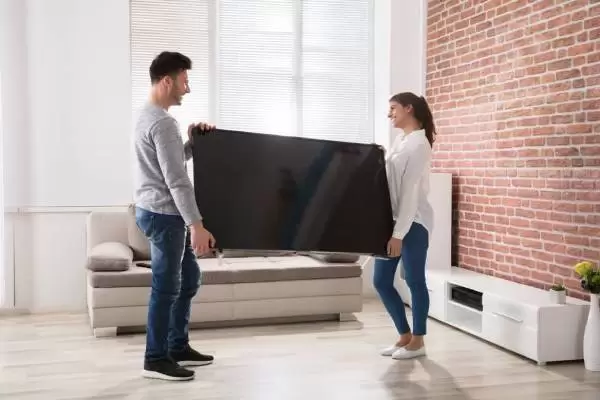
Let us start by retiring a claim, because this page used to make it and we could not stand it up.
“Never lay a flat-screen flat, it will void the warranty” is not something we can find any manufacturer saying. We read a full Samsung flagship television manual end to end. It contains nothing about transport orientation, nothing prohibiting laying a panel flat, and nothing about the warranty on either point. We found no such statement from LG, Sony, TCL or Hisense either.
We still carry televisions upright, and we will explain why in a moment, with the actual physics and the actual published numbers. What we will not do is dress up our own practice as a manufacturer instruction. If you have the manual for your set and it says otherwise, the manual wins.
Here is what is genuinely documented, and it turns out to be more useful than the myth.
The weight, from the manufacturer’s own manual
People underestimate this badly, because a flat panel looks like it weighs nothing.
From Samsung’s own published user manual for its Q9FN series:
| Model | Panel size | Weight without stand | Weight with stand |
|---|---|---|---|
| QN65Q9FNAF | 65 inch | 58.9 lb (26.7 kg) | 62.8 lb |
| QN75Q9FNAF | 75 inch | 86.6 lb (39.3 kg) | 90.4 lb |
Body dimensions for the 75 inch are 66.0 by 37.9 inches, and 1.6 inches deep.
Sit with that for a second. Eighty-seven pounds, five and a half feet wide, an inch and a half thick. That is a shape with almost no structural depth carrying the better part of a hundredweight, and the load path through it changes completely depending on how you hold it. That, not a warranty clause, is the reason for everything below.
We could not source weights for 55 inch or 85 inch panels, or any figures from LG, Sony, TCL or Hisense, so we are not printing estimates. Your model’s weight is in your manual and on the box.
Samsung’s one explicit handling instruction in that manual is “Always have two people mount the TV onto a wall.” Two people is also the right answer for carrying it, for the same reason.
Temperature and condensation, where there is a real published limit
This is the part that almost never appears in a moving guide and is the most likely thing to actually damage a set in a Vancouver winter.
Samsung publishes environmental limits for that series:
| Range | |
|---|---|
| Operating temperature | 10°C to 40°C (50°F to 104°F) |
| Operating humidity | 10% to 80%, non-condensing |
| Storage temperature | −20°C to 45°C (−4°F to 113°F) |
| Storage humidity | 5% to 95%, non-condensing |
Two things follow directly from the manufacturer’s own numbers.
A television that spent the morning in an unheated truck box is below its stated operating range. Metro Vancouver mornings sit under 10°C for a large part of the year. The set is fine in storage down to −20°C, but it is out of spec for use.
Both humidity specs say non-condensing. Carry a cold panel into a warm, humid room and moisture condenses on and inside it, which is exactly the condition the spec excludes. Powering it up then is the risk.
So: bring the television indoors, leave it boxed or wrapped, and let it reach room temperature before you plug it in. No waiting time is published, so we will not invent one, though a large panel takes longer than you would think and an hour or two is a small price against the alternative. If the set is cold to the touch, it is not ready.
Why we still carry them upright
Not a warranty rule. Three physical reasons, and you can judge them yourself:
The glass is unsupported across its area. A panel laid flat is a large, thin sheet carrying its own weight across the middle with support only at the edges. Stand it up and the weight runs down through the frame, which is what the frame is for. The National Glass Association’s guidance for flat glass mirrors reaches the same conclusion for the same reason, instructing that mirrors be stored vertically and not laid flat, because glass “exhibits more strength, fewer strains when stored vertically”. A television panel is not a mirror, but the mechanics of a thin sheet of glass are the mechanics of a thin sheet of glass.
Anything placed on top becomes a point load. In a loaded truck, a flat panel is a shelf, and someone will use it as one. Upright and strapped against a wall, it cannot be.
The original carton is designed for upright. The foam inserts, the printed orientation arrows and the handhold positions are all built around the panel standing up. Outside the original packaging that engineering is gone, which is the real argument for keeping the box.
No original box? Rigid faces and corner protection
If you still have the original box, use it. It is the only container designed for that specific panel, and the foam locates the corners, which are what break.
If you do not, what you are trying to reproduce is: rigid faces on both sides of the panel, soft material against the screen itself, and corner protection. In practice that means a purpose-made flat-panel box or a picture crate, blankets or foam against the screen, cardboard or thin plywood on the outer faces, and the whole thing strapped so nothing shifts. Bubble wrap directly against a screen is not ideal, because the dimples can press into a soft coating over hours in a warm truck. Put a smooth layer against the glass first.
Photograph the cable layout before you unplug anything. It costs ten seconds and saves twenty minutes at the far end. Then bag and label the cables, the stand hardware and the wall-mount bolts separately, because the wall-mount bolts are the ones you will not find at a hardware store on a Sunday.
Remove the stand or the wall bracket, and keep the screws with it. A stand left on makes the package longer, heavier and more likely to catch a door frame.
Getting it out of the building
Two published figures make this easier to plan than guessing.
Doorways. The narrowest doorway the BC Building Code permits inside a dwelling is 610 mm, about 24 inches, which covers bathrooms, walk-in closets and rooms off a 710 mm hallway. Other rooms are 760 mm and required entrances 810 mm. A boxed 75 inch panel is roughly 40 inches deep on its side including packaging, so the constraint is usually the turn rather than the width. A straight run through a 760 mm door is fine; a right-angle turn at the top of a stairwell may not be.
Stairs. Required exit and public stairs in residential buildings are not less than 900 mm wide; stairs serving a single dwelling unit not less than 860 mm; headroom not less than 2,050 mm, or 1,950 mm within a dwelling unit. A 66 inch wide box on an 860 mm stair with a turn needs two people who have agreed on the plan before they start.
Samsung’s own delivery service publishes its limits, which is a useful sanity check on what is reasonable to attempt. For sets 55 inch and larger its teams will not lift or hoist televisions over objects or through windows, will not alter property beyond simple door removal, and will not carry above three flights of stairs where there is no elevator. If the manufacturer’s own delivery service declines a route, that is a route worth thinking about. Samsung’s US page also states a ten-foot width clearance requirement, which reads like an error on the page rather than a real residential requirement. We mention it only because we are quoting the source and would rather flag the oddity than tidy it away.
In the truck: upright, against a flat wall
- Upright, against a wall, strapped. Not leaning on furniture, not freestanding.
- On a blanket, not on the deck. Road vibration through a bare floor goes straight into the panel.
- Nothing on top, and nothing that can slide into it. A television is the one item in the load that has no tolerance for a knock.
- Last on, first off. It should spend the least time on the truck of anything you own.
At the new place: let it reach room temperature
- Bring it in and leave it alone. Boxed or wrapped, at room temperature, until it is no longer cold to the touch. See the temperature section.
- Unpack it upright, with two people.
- Reattach the stand or mount before standing it anywhere unsupported. A panel propped against a wall is a panel about to slide.
- Reconnect from your photograph.
- Power it on and look at a bright, uniform image. A plain white or light grey screen is what shows cracks, pressure marks and dead zones. Do that before the crew leaves, not next week.
65 inches is where it becomes a two-person job
- 65 inch and up, which is where the weight and the unsupported span both cross into two-person territory with real consequences.
- No original box, where the packing is the whole job.
- Stairs, a turn, or a small elevator on the route.
- An OLED or a very large panel you are not prepared to replace. We found nothing published comparing OLED and LED transport risk, so we are not going to claim one is more fragile. The replacement cost is the argument on its own.
How Secure Moving handles televisions
Two people, upright, blanketed and strapped, last on and first off. We will use your original carton if you have it and bring a flat-panel container if you do not, and we will tell you before we start that the set needs to come up to room temperature before anyone plugs it in.
Would you rather we did the packing? Our packing service covers televisions and other fragile electronics, and our guide to packing fragile items covers the same principles for everything else breakable. For the rest of the move, our team works as a moving company in Vancouver.
Frequently asked questions
Can you lay a flat-screen TV flat when moving it?
No manufacturer statement was found either way, and the Samsung flagship manual we read says nothing about transport orientation and nothing about the warranty. We carry televisions upright anyway, because a panel laid flat is a thin sheet of glass carrying its own weight across an unsupported span, anything placed on top becomes a point load, and the original carton is engineered for upright. If your own manual gives an instruction, follow it.
How much does a 75-inch TV weigh?
Samsung’s published figure for its 75-inch Q9FN is 86.6 lb without the stand and 90.4 lb with it; the 65-inch model is 58.9 lb without the stand. Manufacturer weights for 55-inch and 85-inch panels could not be sourced, and nor could figures from other brands, so check your own manual or the box rather than relying on an average.
How long should I wait before turning on a TV after moving it?
Until it is no longer cold to the touch. The published operating range for the series we checked is 10°C to 40°C with humidity specified as non-condensing, so a set that travelled in an unheated truck is below its operating range and condensation is the risk. Samsung gives no waiting time, so we will not invent one, though on a cold day an hour or two indoors is a reasonable minimum.
Do I need the original box to move a TV?
No, but it is the best container that exists for your specific panel because the foam locates the corners, which are what break. Without it you need rigid faces on both sides, a smooth soft layer against the screen rather than bubble wrap directly on it, corner protection, and straps so nothing shifts.
Will my TV fit through the door?
Measure the narrowest doorway on the route and the turns, not the front door. The BC Building Code permits interior doorways as narrow as 610 mm, about 24 inches; other rooms are 760 mm and required entrances 810 mm. A boxed 75-inch panel is about 40 inches deep on its side, so a straight run through a standard door is usually fine and a right-angle turn at the top of a stairwell often is not.
Is it safe to move an OLED TV?
Handled the same way as any large panel, yes. We found nothing published comparing OLED and LED transport risk, so we will not claim one is more fragile than the other. The argument for professional handling on an OLED is the replacement cost, not a documented difference in durability.
