

You can still buy a detached house in British Columbia for under $300,000. Three communities sit below that line on the 2026 assessment roll, and about a dozen more come in under $450,000.
The catch is not the one most people expect. It is not that every cheap BC town has no work; the region with the province’s lowest house prices and the region with its lowest unemployment are different places, and one of them is cheap and busy at the same time. The real trade-offs are healthcare access, internet, and how far you are from a hospital that can handle something serious.
Here is what the numbers actually say, community by community.
Where houses cost least
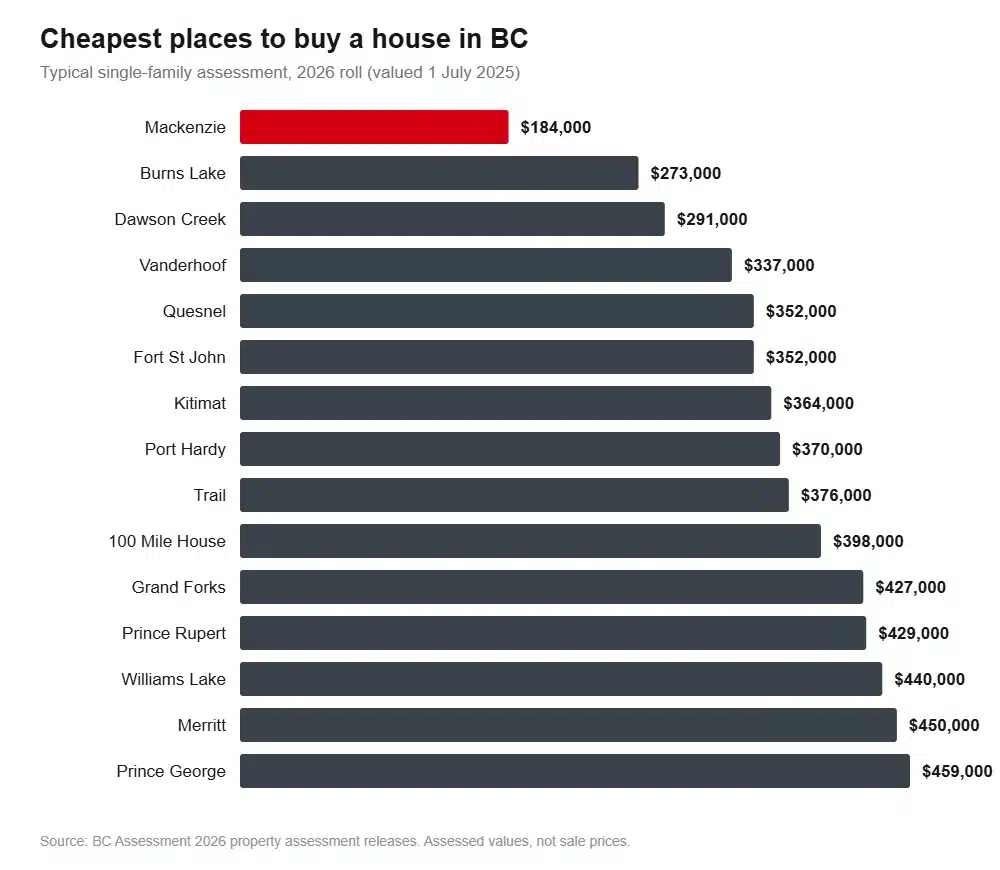
BC Assessment values every property in the province on the same date using the same method, which makes it the only source that lets you compare Mackenzie with Kerrisdale honestly. These are typical assessed values for a single-family home on the 2026 roll, reflecting market value as of 1 July 2025.
| Community | 2026 assessment | Change on 2025 | Region |
|---|---|---|---|
| Mackenzie | $184,000 | +6% | North Central |
| Burns Lake | $273,000 | +3% | North Central |
| Dawson Creek | $291,000 | +3% | Peace River |
| Vanderhoof | $337,000 | +1% | North Central |
| Quesnel | $352,000 | +4% | Cariboo |
| Fort St John | $352,000 | +2% | Peace River |
| Kitimat | $364,000 | +6% | North Coast |
| Port Hardy | $370,000 | +3% | North Vancouver Island |
| Trail | $376,000 | 0% | Kootenay |
| 100 Mile House | $398,000 | 0% | Cariboo |
| Grand Forks | $427,000 | +1% | Boundary |
| Prince Rupert | $429,000 | +3% | North Coast |
| Williams Lake | $440,000 | +5% | Cariboo |
| Merritt | $450,000 | −2% | Thompson |
| Prince George | $459,000 | +2% | North Central |
| Port Alberni | $485,000 | −3% | Vancouver Island |
| Terrace | $506,000 | +5% | North Coast |
| Cranbrook | $517,000 | +3% | East Kootenay |
| Castlegar | $519,000 | 0% | West Kootenay |
| Smithers | $527,000 | +4% | Bulkley Valley |
Source: BC Assessment 2026 property assessment releases for North Central, Southern Interior and Vancouver Island. Assessed values are not sale prices, and reflect 1 July 2025.
For scale, the same roll puts West Vancouver at $2,910,000 and Whistler at $2,834,000. A house in Mackenzie is assessed at roughly one-sixteenth of a house in West Vancouver.
What sellers are actually getting
Assessments describe the whole housing stock. Transaction prices tell you what is changing hands, and the two do not always agree. Recent board figures for the cheapest markets:
- South Peace River, including Dawson Creek: single-family average $334,698 in August 2026, on 31 sales
- BC Northern board, covering all of northern BC: average $469,047 in July 2026
- Prince Rupert: single-family average $392,205 in the first quarter of 2026, on 20 sales
- Terrace: $490,317 in Q1 2026, down from $545,067 a year earlier
- Quesnel: median under $389,900 for the first half of 2026, on 61 sales
Read those sales counts. Twenty transactions in a quarter is a thin market, and averages built on thin markets swing wildly. Powell River’s average fell 27.3 per cent year over year in July 2026, which sounds like a collapse until you notice it rests on 26 sales and the board’s quality-adjusted benchmark for the same month fell just 2.9 per cent.
Where rent costs least
CMHC surveys purpose-built rental across BC every October. Average two-bedroom rents, October 2025:
| Centre | Two-bedroom | Centre | Two-bedroom |
|---|---|---|---|
| Trail | $1,079 | Cranbrook | $1,472 |
| Prince Rupert | $1,154 | Penticton | $1,511 |
| Powell River | $1,182 | Chilliwack | $1,523 |
| Fort St John | $1,196 | Parksville | $1,563 |
| Dawson Creek | $1,202 | Vernon | $1,607 |
| Terrace | $1,205 | Abbotsford–Mission | $1,623 |
| Quesnel | $1,226 | Campbell River | $1,656 |
| Port Alberni | $1,279 | Kamloops | $1,673 |
| Salmon Arm | $1,336 | Nanaimo | $1,895 |
| Nelson | $1,359 | Kelowna | $2,098 |
| Prince George | $1,422 | Victoria | $2,121 |
| Williams Lake | $1,455 | Vancouver | $2,364 |
Source: CMHC Rental Market Survey, October 2025. The BC average was $2,053. Only purpose-built rental is surveyed, so in small towns where most rentals are basement suites the sample is thin.
Trail at $1,079 against Vancouver at $2,364 is a difference of $15,420 a year, on rent alone.
Cheap is not the same as affordable
This is where most affordability lists stop, and where they mislead. A $184,000 house is only affordable if there is an income attached to it.
BC’s median after-tax income for families and unattached individuals was $75,800 in 2024, marginally above the national $75,500 and well below Alberta’s $85,300. The province also has the highest poverty rate of any province at 13 per cent.
Unemployment varies enormously by region, and not in the direction you would guess:
| Economic region | Unemployment |
|---|---|
| Kootenay | 4.6% |
| Vancouver Island / Coast | 5.7% |
| Cariboo | 5.7% |
| Mainland / Southwest | 6.8% |
| North Coast and Nechako | 7.4% |
| Thompson-Okanagan | 7.5% |
| Northeast | 8.2% |
Source: WorkBC labour market update, June 2026, three-month moving average. Provincial rate 6.5 per cent.
Look at the two ends. The Northeast has the cheapest houses in BC and the highest unemployment. The Kootenay region has houses well below the provincial average and the lowest unemployment in the province. So the lazy version of this story, that cheap towns have no work, is only half true, and the half that is false points at the Kootenays.
Living Wage BC costs out what a household actually needs, community by community. The 2025 rates run from $21.55 in Grand Forks to $29.60 in Whistler, with Metro Vancouver at $27.85. Even the cheapest community in the province needs $3.30 an hour more than the $18.25 minimum wage.
What you give up, honestly
Healthcare, and this is the big one
Between January 2023 and mid-April 2024, 29 of BC’s 77 emergency departments closed unexpectedly at some point, for a combined 16,453 hours. Chetwynd’s ER was shut for 2,430 hours in that span, Mackenzie’s for 2,050, Kitimat’s for 1,690.
It has not resolved. Northern Health recorded 628 hours of ER closures across 46 events in 2025 in the northeast alone, and 115 hours across 12 incidents in March 2026. Staffing is the stated cause every time.
Family doctor access is also regional. BC says roughly 77 per cent of British Columbians had a primary care provider as of April 2026, but the waiting lists tell a sharper story: Island Health had 133 people per 1,000 population still waiting to be attached, Interior Health 88, against 41 in Vancouver Coastal.
Anyone with a chronic condition or young children should put this at the top of the list rather than the bottom.
Internet, if you work remotely
Ninety-seven per cent of BC households can get the 50/10 Mbps benchmark. In rural BC that falls to 80.3 per cent. One rural household in five still cannot get a connection that supports video calls reliably. Check the specific address, not the town.
Distance from serious medicine
BC has three Level 1 trauma centres and all are in the Lower Mainland: Vancouver General, BC Children’s, and Royal Columbian in New Westminster. Level 2 centres sit in Kamloops, Kelowna and Victoria. If you move to Mackenzie or Burns Lake, a serious injury means a transfer to Prince George at best.
What gets cheaper outside Metro Vancouver
Fuel is the clearest one, and it is structural rather than incidental. Provincial motor fuel tax on gasoline:
- Metro Vancouver: 27.00 cents a litre, of which 18.50 cents funds TransLink
- Greater Victoria: 20.00 cents, including 5.50 cents for BC Transit
- Everywhere else in BC: 14.50 cents
A driver in Prince George pays 12.5 cents a litre less provincial fuel tax than one in Burnaby, roughly $7.50 on a 60-litre fill. Note also that BC’s consumer carbon tax on gasoline, previously 17.61 cents a litre, was removed on 1 April 2025, so any cost breakdown still including it is out of date.
One thing that does not get uniformly cheaper: electricity. BC Hydro charges one province-wide residential schedule, but roughly 213,000 customers in the South Okanagan and Kootenay Boundary are served by FortisBC on a different structure, with a higher fixed charge and a flat rate rather than a cheap first tier. A small household in Trail can pay more per kilowatt hour than the same household in Prince George.
Where the trade actually works
Putting price, jobs and services together, a few places come out better than their reputation.
Trail and Castlegar. Trail has the cheapest two-bedroom rent in the province at $1,079 and a $376,000 assessment, and both sit in the Kootenay region, which has BC’s lowest unemployment at 4.6 per cent. Kootenay Boundary Regional Hospital is in Trail and Selkirk College is in Castlegar. This is the strongest price-to-opportunity combination in BC and almost nobody writes about it.
Cranbrook. At $517,000 it is not the cheapest, but it has a tertiary referral hospital, College of the Rockies, a certified airport and roughly 2,190 hours of sunshine a year, among the most in the province.
Prince George. $459,000, a $1,422 two-bedroom, a university, a Level 3 trauma centre and the service hub for the whole north. The trade is winter: an annual mean of 4.3°C and January lows averaging −11.7°C.
Port Alberni. $485,000 on Vancouver Island, with island weather and island access, in a region with 5.7 per cent unemployment. Cheaper than anywhere else on the Island by a wide margin. It sits a little over an hour past Nanaimo, so the crossing is the same one used for moving from Vancouver to Nanaimo.
Fort St John and Dawson Creek. The cheapest housing in the province with real wages attached, since the Northeast leads BC in mining and oil and gas employment at 15.7 per cent of the regional workforce. The flip side is 8.2 per cent unemployment, the highest in BC, because that industry is cyclical.
Frequently asked questions
Which place in BC is cheapest to live?
On the 2026 assessment roll, Mackenzie at a typical single-family value of $184,000, followed by Burns Lake at $273,000 and Dawson Creek at $291,000. For renting, Trail is cheapest at an average $1,079 for a two-bedroom.
Where in BC can you buy a house under $300,000?
Mackenzie, Burns Lake and Dawson Creek all have typical assessed values below $300,000. Vanderhoof, Quesnel, Fort St John, Kitimat and Port Hardy are all under $375,000. Bear in mind assessments reflect 1 July 2025 and are not sale prices.
Is it cheaper to live in northern BC?
On housing, dramatically. On fuel, yes, by 12.5 cents a litre against Metro Vancouver. On groceries, probably, though Statistics Canada does not publish a consumer price index below the provincial level for BC outside Vancouver and Victoria, so nobody can actually prove it. On heating, no: the north burns far more energy, and BC Hydro’s tiered rate pushes that consumption into the higher band.
What is the most affordable city in BC with jobs?
The Kootenays, on the published data. The region combines below-average house prices with BC’s lowest unemployment rate at 4.6 per cent. Trail, Castlegar, Nelson and Cranbrook all sit inside it.
Is BC the most expensive province?
Not on the closest official measure. Statistics Canada’s Survey of Household Spending put average BC household spending at $82,657 in 2023, below Alberta’s $88,186. BC does have the highest poverty rate of any province and among the highest shelter costs, which is a fairer way to put it. No official index compares prices between provinces, so anyone quoting one is estimating. If you are staying in the Lower Mainland, we have priced out Chilliwack and Mission, the two cheapest options at that end of the valley.
How we put this together
Assessments come from BC Assessment’s 2026 roll releases, rents from CMHC’s October 2025 survey, incomes and unemployment from Statistics Canada via WorkBC, fuel tax from the Province, and living wage figures from Living Wage BC.
Four cautions worth stating. BC Assessment values reflect 1 July 2025 and are not sale prices, though they are the only figures calculated the same way for every BC community. Small-town sale averages rest on very few transactions and swing hard. CMHC surveys purpose-built rental only, which in small towns is a fraction of the actual rental market. And no source publishes an income-to-price ratio by BC community, so we have not invented one.
Sources
- BC Assessment, North Central 2026 assessments
- BC Assessment, Southern Interior 2026 assessments
- BC Assessment, Vancouver Island 2026 assessments
- CMHC, 2025 Rental Market Report
- Statistics Canada, Canadian Income Survey 2024
- WorkBC, labour market monthly update
- Living Wage BC, 2025 rates
- Province of BC, motor fuel tax rates
- Province of BC, connectivity coverage
- Northern Health ER closure hours, 2025
- Province of BC, primary care attachment, April 2026
Staying inside the region? Maple Ridge and Pitt Meadows are the cheapest detached market in Metro Vancouver, with a transport bill attached.
Closer to Vancouver, the cheapest of the three Tri-Cities is Port Coquitlam, where the detached benchmark sits $355,300 below Coquitlam’s. Our area guide to the Tri-Cities works through what that difference actually buys you.
Inside Metro Vancouver itself the cheapest composite benchmark belongs to New Westminster, at $722,300 in August 2026, though that is largely because seven households in ten there live in apartments. Our breakdown of what it costs to live there explains what that number does and does not mean.
Making the move? Before you commit, the wider cost picture covers the bills that follow you to any BC address, and our look at where people actually settle weighs price against work and healthcare. We handle long-distance moves out of the Lower Mainland to the Interior and the north every month. Tell us the two addresses and we will give you a realistic number.
