

The pitch for Maple Ridge is simple arithmetic. At the August 2026 benchmark a detached house cost $1,177,800 here against $1,799,400 across Greater Vancouver as a whole. Call it $621,600 of difference, and it is why people move east.
The complication is also arithmetic, and it comes from Metro Vancouver’s own research. In its 2025 study of housing and transportation costs, Maple Ridge households spent about $25,000 a year getting around against $20,000 on housing. Only five places in the region spend more on transport than on shelter, and this is one of them.
So the honest version of the Maple Ridge cost question is not “how much cheaper is it” but “how much of the saving does the driving take back”. Here is what every line actually costs.
The short version
- Detached benchmark $1,177,800 in Maple Ridge, $1,188,900 in Pitt Meadows, against $1,799,400 board-wide.
- A two-bedroom purpose-built rental averaged $1,653 a month in October 2025, about 30 per cent below the regional average.
- Tax plus utilities on a typical house runs about $6,980 a year in Maple Ridge and $6,970 in Pitt Meadows, before the Home Owner Grant.
- Nobody collects your garbage in Maple Ridge. That is a private contract on top, and nobody publishes what it costs.
- A West Coast Express monthly pass from Port Haney is $300.20, which is $1,063 a year more than a three-zone TransLink pass, for five trains a day in one direction.
Buying
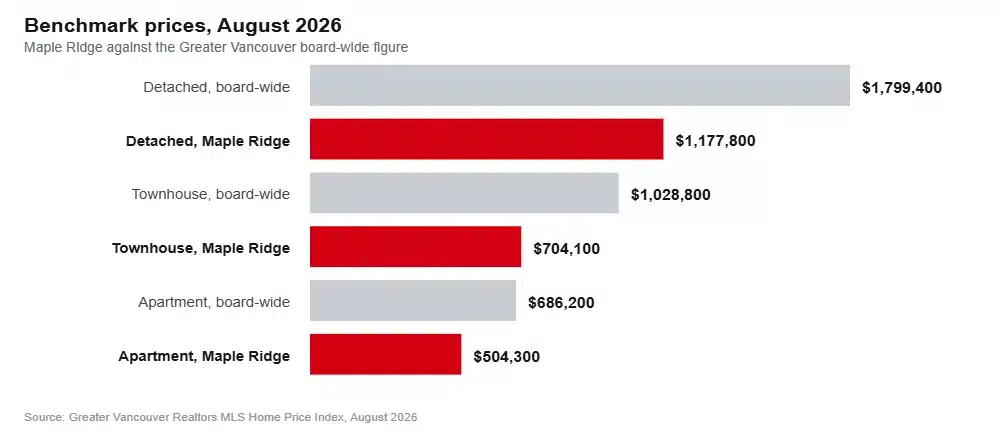
| August 2026 benchmark | Maple Ridge | Pitt Meadows | Board-wide |
|---|---|---|---|
| Detached | $1,177,800 | $1,188,900 | $1,799,400 |
| Townhouse | $704,100 | $746,900 | $1,028,800 |
| Apartment | $504,300 | $546,600 | $686,200 |
| Composite | $890,800 | $849,100 | $1,081,900 |
Data: Greater Vancouver Realtors MLS Home Price Index, August 2026. Benchmark prices are published separately for the two cities; sales counts and days on market are not.
Look at that table twice. The town next door is more expensive in every single property type, yet its composite benchmark comes in $41,700 lower. Blame the housing mix: Pitt Meadows has proportionally more attached and apartment stock. Anyone ranking the two towns on the composite alone gets it backwards.
The other number worth sitting with is the five-year change. A Maple Ridge detached house is worth 0.8 per cent more than it was five years ago. Apartments are up 92.8 per cent over ten years and down 11.3 per cent over three. If you bought a house here in 2021 expecting the last decade to repeat, it has not.
Renting, and why the number is thin
CMHC treats Maple Ridge and Pitt Meadows as a single rental zone, so there is no Maple Ridge-only rent of record. In the October 2025 survey the combined zone averaged $1,426 for a one-bedroom, $1,653 for a two-bedroom and $2,026 for three bedrooms or more, against $1,807, $2,364 and $2,820 for the Vancouver census metropolitan area.
Now the caveat that matters more than the numbers. CMHC surveyed 1,796 purpose-built rental units across both cities, for roughly 128,000 residents. Renting in Maple Ridge in practice means a basement suite, a rented townhouse or a condo, which is the secondary market CMHC does not measure. About one household in five rents here, well below the regional norm.
Rentals.ca does not list Maple Ridge in its national tables at all, so there is no asking-rent figure either. What can be said is directional: across BC, asking rents in August 2026 were down 4.5 per cent on the year, a twenty-fifth consecutive month of decline, with Coquitlam down 7.3 per cent and Langley 7.6.
One practical consequence of that. BC’s rent increase cap for 2026 is 2.3 per cent, and it applies to sitting tenants. In a falling market, a tenant who has stayed put can end up paying more than a new tenant next door. Moving can be a rent cut.
Property tax and utilities
The lower tax rate belongs to Maple Ridge, at 4.53578 per $1,000 of assessed value against 4.62200 in Pitt Meadows. On an identical assessment, Pitt Meadows costs $102 a year more.
Then you add the utility bill and it closes.
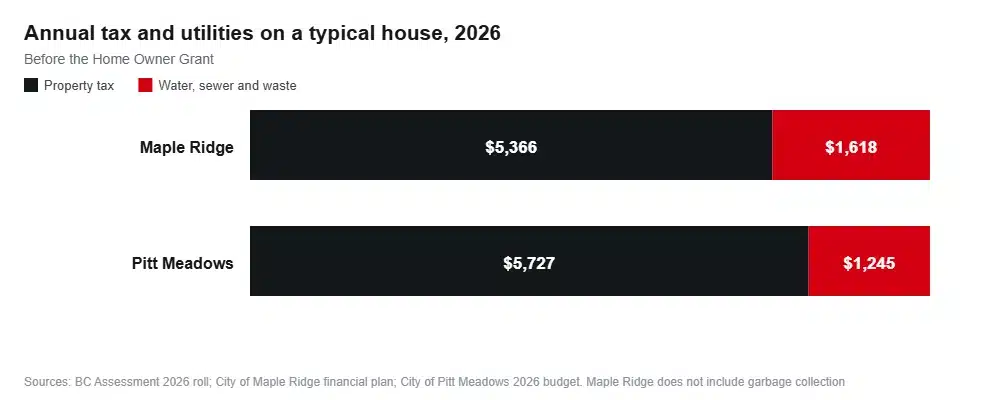
| Typical single-family home, 2026 | Maple Ridge | Pitt Meadows |
|---|---|---|
| Assessed value | $1,183,000 | $1,239,000 |
| Property tax, all authorities | $5,366 | $5,727 |
| Water and sewer | $1,618 | about $1,245 |
| Garbage and organics | private contract | included above |
| Home Owner Grant | −$570 | −$570 |
| Net annual cost | about $6,414 | about $6,402 |
Water, sewer and solid waste are not published as separate line items in Pitt Meadows, so that figure is worked back from the city’s own year-on-year budget walk and should be treated as an estimate.
Twelve dollars apart, and the Maple Ridge column is the one missing a service. No municipal garbage collection reaches single-family homes in Maple Ridge; residents arrange it privately, and no source publishes the going rate. Collection is on the notice next door.
For 2026 Maple Ridge raised municipal tax 3.5 per cent, water 4.5 and sewer 6.05, which the city puts at $181 a year on its average home. Next door the tax went up 6.5 per cent and utilities by $137, which comes to $318 a year. The Home Owner Grant of $570 covers roughly eight per cent of a typical Maple Ridge bill.
Energy
BC Hydro runs one schedule across the province. Its 2026 fiscal year rates are a 23.30 cent daily basic charge, 11.72 cents per kilowatt hour on the first tier and 14.08 cents above it, with the tier boundary at 22.1918 kilowatt hours a day. A further 3.75 per cent rise was approved for 1 April 2026 and the resulting schedule was not published anywhere we could verify, so budget a little above these.
FortisBC’s Mainland residential gas rate from 1 January 2026 is a 40.85 cent daily basic charge plus $11.264 per gigajoule all in. There is no longer a carbon tax line on a BC gas bill; the consumer carbon tax ended on 1 April 2025.
Getting around, which is the real story
Maple Ridge and Pitt Meadows sit together in TransLink’s Zone 3, the outermost one. A weekday morning trip downtown is a three-zone fare, the most expensive TransLink sells. Everything after 6:30pm on weekdays, and everything at the weekend, drops to a single zone, so the penalty is specifically a commuter penalty.
| Monthly pass, from 1 July 2026 | Per month | Per year |
|---|---|---|
| One zone (local buses, evenings, weekends) | $117.20 | $1,406 |
| Three zones (bus and SkyTrain to downtown) | $211.65 | $2,540 |
| West Coast Express, Zone 4 | $300.20 | $3,602 |
Source: TransLink fares effective 1 July 2026. Port Haney and Maple Meadows are both West Coast Express Zone 4.
The train deserves a paragraph of its own, because it is the single most misunderstood thing about living here. The ride from Port Haney to Waterfront takes 56 minutes and is a lovely one. It runs five times westbound in the morning, the last leaving Port Haney at 7:44am, and five times eastbound in the afternoon, the last leaving Waterfront at 6:20pm. Weekdays only. Nothing in the reverse direction, nothing at weekends.
If your day starts at nine and ends at five, it is close to perfect and worth every dollar of the $88.55 a month it costs above a three-zone pass. Work shifts, start at ten, or ever want a drink after work, and it does not exist for you. The all-day, all-week option is the R3 RapidBus along Lougheed to Coquitlam Central and the Millennium Line from there.
Driving is toll-free since the Golden Ears Bridge tolls came off on 1 September 2017. Tax-free it is not: Metro Vancouver carries 27 cents a litre in provincial motor fuel tax against 14.5 in the rest of BC, of which 18.5 cents funds TransLink. A household driving 20,000km a year pays roughly $225 more in fuel tax than the identical household in Kamloops, purely for living inside the TransLink boundary.
Which brings us back to Metro Vancouver’s own finding. Households in Maple Ridge spend about $25,000 a year on transportation and $20,000 on housing. In Pitt Meadows the split is $25,000 against $22,000. Regionally, 98 per cent of household transport spending is the car.
What you need to earn
Median household income is $93,000 in Maple Ridge and $94,000 in Pitt Meadows, against $90,000 across Metro Vancouver. Which is the quiet fact that makes the whole thing work: households here earn slightly more than the regional middle and pay materially less for shelter.
Living Wage BC put the Metro Vancouver rate at $27.85 an hour per working parent for 2025, which is $101,374 for two parents on a 35-hour week. Its budget allows $3,343 a month for a three-bedroom home including utilities and insurance. The average three-bedroom rent in this zone is $2,026 before those extras, which is where the eastern end of the region earns its reputation.
On buying, a detached benchmark house at $1,177,800 with 20 per cent down leaves a $942,240 mortgage. At a five per cent rate over 25 years that is roughly $5,470 a month before the $582 a month of tax and utilities, and before hydro, gas and either a transit pass or a car.
Frequently asked questions
Is Maple Ridge cheaper than Vancouver?
Substantially on housing. A detached benchmark of $1,177,800 against $1,799,400 board-wide, and a two-bedroom rent of $1,653 against $2,364 for the region. Whether it works out cheaper in the end depends on how far you drive.
How much is property tax in Maple Ridge?
About $5,366 a year on a typical single-family home for 2026, plus $1,618 in water and sewer, less the $570 Home Owner Grant if you qualify. Add a private garbage contract, which the city does not provide.
Is Pitt Meadows more expensive than Maple Ridge?
On housing, slightly, in every property type. On municipal bills the two land within about $15 a year of each other once utilities are counted, and Pitt Meadows includes garbage collection where Maple Ridge does not.
Is the West Coast Express worth it?
For a weekday downtown commuter with predictable hours, yes. A Zone 4 monthly pass costs $300.20 against $211.65 for three zones, and it buys a 56-minute ride with a seat. For anyone whose schedule moves, no, because there are only five trains each way and none at weekends.
What is a good salary to live in Maple Ridge?
The median household here earns $93,000, slightly above the regional figure. Two people on the Metro Vancouver living wage would gross about $101,000 between them. Buying a detached house at the benchmark realistically needs considerably more than either.
How we put this together
Figures come from CMHC, Greater Vancouver Realtors, BC Assessment, the Province of British Columbia, Metro Vancouver, TransLink, BC Hydro, FortisBC and the two cities’ own budget documents, linked where they appear.
Four gaps we would rather name than paper over. Nobody publishes an average commute time for Maple Ridge that we could verify; Statistics Canada’s tables would not render, so the figures circulating elsewhere are unsourced and we have used spending and distance instead. The Pitt Meadows utility charges are not itemised anywhere, so that line is derived from the city’s own budget walk. No source publishes childcare fees for either city. And the mortgage arithmetic uses an assumed rate, clearly labelled, rather than a quoted one.
Sources
- CMHC Rental Market Survey, Vancouver zones, October 2025
- Greater Vancouver Realtors MLS Home Price Index statistics
- City of Maple Ridge 2026 to 2030 financial plan bylaw
- City of Pitt Meadows 2026 budget
- BC Assessment, Lower Mainland 2026 property assessments
- Province of British Columbia, home owner grant
- TransLink pricing and fare zones
- TransLink, West Coast Express fares
- TransLink, West Coast Express schedule
- TransLink, Golden Ears Bridge
- Province of British Columbia, motor fuel and carbon tax rates
- Metro Vancouver, housing and transportation cost burden study update, 2025
- Metro Vancouver Housing Data Book, February 2025
- Living Wage BC, 2025 rates
- FortisBC residential rate schedule 1, effective January 2026
If the R3 into Coquitlam Central is part of your plan, the Tri-Cities cost breakdown covers what living at the other end of that bus route costs.
Pricing a move as well as a month? Our area guide covers which part of town suits which budget, the crime numbers answer the other common question, and the wider case for and against weighs the commute properly. When you have an address, tell us where you are moving from.
