

Two facts about the Tri-Cities that almost nothing written about them gets right. Of the three, Port Moody is the most expensive to own a home in and the cheapest to get around in. And Coquitlam’s four SkyTrain stations have not, at the whole-city average, bought it lower transport costs than Port Coquitlam, which has none.
Both come from Metro Vancouver’s own 2025 study of what households actually spend, and together they explain why comparing mill rates across these three cities tells you almost nothing useful.
The short version
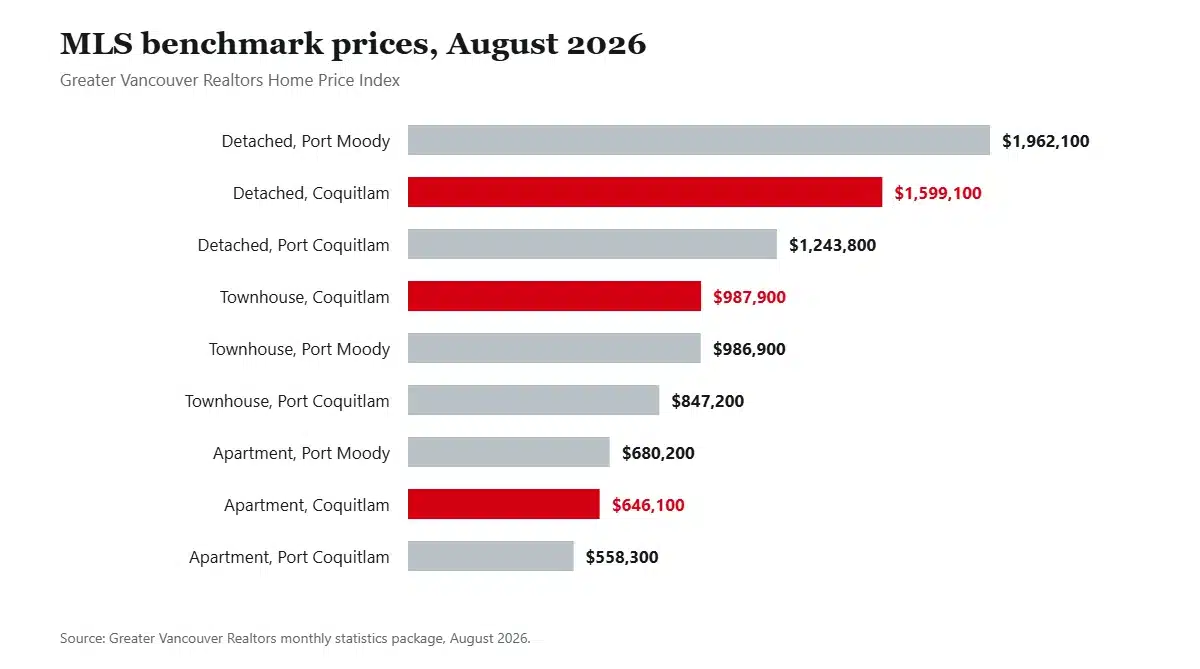
- Detached benchmark prices in August 2026: Port Moody $1,962,100, Coquitlam $1,599,100, Port Coquitlam $1,243,800.
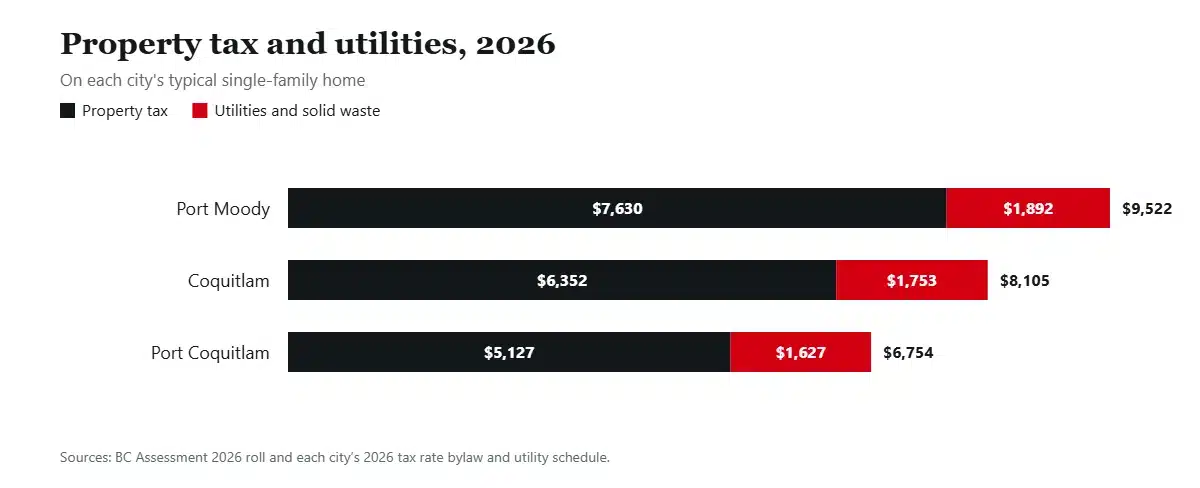
- Tax plus utilities on a typical single-family home runs about $9,520 a year in Port Moody, $8,100 in Coquitlam and $6,750 in Port Coquitlam.
- Almost all of the Coquitlam and Port Coquitlam gap is assessment level rather than municipal policy. On an identical house the two are $233 apart.
- CMHC does not publish a Coquitlam rent figure at all. Its survey collapses the three cities into one Tri-Cities zone of 6,108 purpose-built units.
- Households in Port Coquitlam out-earn Coquitlam households by $10,000 a year despite cheaper housing, which is a tenure story rather than a wealth one.
Buying
| August 2026 benchmark | Coquitlam | Port Coquitlam | Port Moody |
|---|---|---|---|
| Detached | $1,599,100 | $1,243,800 | $1,962,100 |
| Townhouse | $987,900 | $847,200 | $986,900 |
| Apartment | $646,100 | $558,300 | $680,200 |
| Composite | $981,400 | $840,300 | $1,037,400 |
Data: Greater Vancouver Realtors MLS Home Price Index, August 2026. The board publishes benchmarks separately for all three cities; days on market is not published by municipality at all.
Everything is down on the year: Coquitlam 6.4 per cent on the composite, Port Coquitlam 8.5, Port Moody 4.3. Stretch the horizon and the picture changes shape. Over five years a Coquitlam detached house is worth two per cent more; over ten it is up 30 per cent. Apartments are the volatile end, up 63 per cent over ten years in Coquitlam and down 13 per cent over three.
Renting, and the number that does not exist
There is no CMHC rent figure for Coquitlam. The survey collapses all three cities into a single zone it calls Tri-Cities, which averaged $1,936 a month across all unit types in October 2025 with a median of $1,825.
A second CMHC cut by municipality does exist, which puts Coquitlam at $1,909, Port Coquitlam at $1,918 and Port Moody at $2,284. Treat that last one carefully: CMHC itself flags the Port Moody figures as poor reliability, and its median comes in above its mean, which is the statistical signature of a thin sample. Vacancy rates for Coquitlam and Port Coquitlam were suppressed entirely, so anyone quoting one is inventing it.
The bigger caveat is the size of the stock. The three cities hold 6,108 purpose-built rental units between them, against 129,351 across the Vancouver region. Coquitlam has 17,155 renter households and only 4,562 purpose-built units, which means roughly three-quarters of Coquitlam renters live in condos, basement suites and laneway homes that CMHC does not survey and that generally cost more.
The Rentals.ca national report does not list any of the three cities, so there is no asking-rent figure of record either. What is certain: BC’s rent increase cap for 2026 is 2.3 per cent and it applies only to sitting tenants, not to a unit relet after a vacancy.
Property tax and utilities
Comparing mill rates here is close to useless, because the three cities put different services on different bills. Solid waste goes on the property tax notice in Port Coquitlam; its two neighbours bill it on the utility bill. Drainage sits inside the mill rate in Coquitlam and Port Moody, and Port Coquitlam does not break it out.
| Typical single-family home, 2026 | Coquitlam | Port Coquitlam | Port Moody |
|---|---|---|---|
| Assessed value | $1,649,000 | $1,358,000 | $1,778,000 |
| Rate per $1,000 | 3.8520 | 3.7754 | 4.29125 |
| Property tax | $6,352 | $5,127 | $7,630 |
| Solid waste on the tax notice | on utilities | $333 | on utilities |
| Utility bill | $1,753 | $1,294 | $1,892 |
| All in, per year | $8,105 | $6,754 | $9,522 |
Now the useful test. Put an identical $1.4 million house in each city and the picture changes: Coquitlam $7,146, Port Coquitlam $6,913, Port Moody $7,900. The Coquitlam and Port Coquitlam gap collapses from $1,351 to $233, which means nearly all of it is assessment level rather than anything a council decided. The Port Moody bill is genuinely higher on policy, by about $754 a year over Coquitlam on the same house.
One more thing worth knowing before you compare advertised tax increases. In Port Coquitlam property tax went up 1.95 per cent for 2026, which is $45 on an average home, and raised utilities by $90. Two-thirds of the actual increase was the half nobody advertises.
Energy
BC Hydro runs one schedule for the whole province. Its 2026 fiscal year rates are a 23.30 cent daily basic charge, 11.72 cents per kilowatt hour on the first tier and 14.08 cents above it, with the boundary at 22.1918 kilowatt hours a day. A further 3.75 per cent rise was approved for 1 April 2026 and we could not verify the resulting schedule anywhere, so budget slightly above these.
FortisBC’s Mainland residential gas rate from 1 January 2026 is a 40.85 cent daily basic charge plus $11.264 per gigajoule all in. There is no longer a carbon tax line on a BC gas bill; the consumer carbon tax ended on 1 April 2025.
Getting around, where the three cities separate
The Evergreen Extension opened in December 2016 with six stations, not the five most articles list. Burquitlam, Coquitlam Central, Lincoln and Lafarge Lake-Douglas are in Coquitlam. Moody Centre and Inlet Centre are in Port Moody. Port Coquitlam has none.
| SkyTrain to Waterfront | Scheduled time |
|---|---|
| Lafarge Lake-Douglas | 45 minutes |
| Coquitlam Central | 42 minutes |
| Inlet Centre | 39 minutes |
| Moody Centre | 37 minutes |
| Burquitlam | 32 minutes |
Source: TransLink station travel times, adding the Millennium Line run to Commercial-Broadway and the Expo Line run from there to Waterfront. These figures exclude the transfer wait at Commercial-Broadway, where the Millennium Line hands you to the Expo Line.
Everything here sits in Zone 3, so a weekday peak trip downtown is a three-zone fare at $211.65 a month, dropping to a single zone after 6:30pm on weekdays and all weekend.
The West Coast Express also stops at Port Coquitlam, Coquitlam Central and Moody Centre, and it is faster to Waterfront because it runs straight there with no transfer. We are not quoting a minute figure, because TransLink’s schedule pages would not return one. It costs more, at $248.75 a month from Coquitlam Central. And it runs five trains west in the morning and five east in the evening, weekdays only, with nothing in the reverse direction and nothing at weekends. For a Port Coquitlam resident with no SkyTrain station, that is a nine-to-five tool and nothing else. The all-day option there is the R3 RapidBus into Coquitlam Central.
Driving carries the regional surcharge either way. Metro Vancouver charges 27 cents a litre in provincial motor fuel tax against 14.5 in the rest of BC, of which 18.5 cents funds TransLink.
What the transit access is actually worth
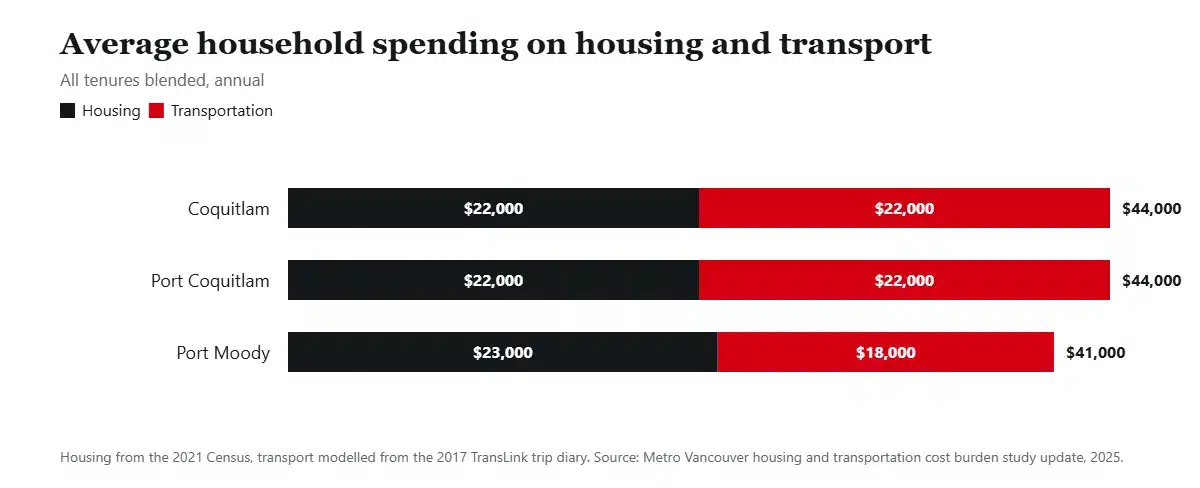
Port Moody spends the most on housing of the three and the least once both lines are added, because its modelled transport cost of $18,000 matches Vancouver and Burnaby. Its two stations sit inside its densest, most walkable areas, and the $4,000 a year it saves on getting around more than covers the $2,768 by which its tax and utility bill exceeds Port Coquitlam’s.
Those two rows come out identical at $22,000 and $22,000. Four SkyTrain stations against none, and no difference in the average. Most of Coquitlam’s land and most of its growth sit well outside the station catchments, up on Burke Mountain and Westwood Plateau. Buying near a station in Coquitlam is worth a great deal. Buying in Coquitlam is not the same thing.
One caveat to carry: those transport figures are modelled from a 2017 trip diary and the housing side comes from the 2021 census, so read the table as a structural comparison between places rather than a 2026 budget.
What you need to earn
Median household income in 2020 was $92,000 in Coquitlam, $102,000 in Port Coquitlam and $115,000 in Port Moody, against $90,000 across Metro Vancouver.
That Port Coquitlam out-earns Coquitlam by $10,000 while living in cheaper homes surprises people. Blame tenure and household mix rather than wealth: Coquitlam is 30.7 per cent renter against Port Coquitlam’s 22.9, with far more apartments, students, recent arrivals and single-person households, all of which pull a household median down.
Living Wage BC put the Metro Vancouver rate at $27.85 an hour per working parent for 2025, which grosses about $101,000 for two parents on a 35-hour week. That is a regional figure; no Tri-Cities living wage is published.
Frequently asked questions
Is Coquitlam expensive to live in?
Less than Vancouver and Burnaby, more than the Fraser Valley. A composite benchmark of $981,400, tax and utilities around $8,100 a year on a typical house, and household transport costs at the regional average.
Which Tri-City is cheapest?
On housing, Port Coquitlam clearly: a composite benchmark $141,100 below Coquitlam’s and an all-in municipal bill about $1,350 lower. Cheapest once transport is counted is Port Moody, because it is the only one where the SkyTrain sits where people actually live.
How much is property tax in Coquitlam?
About $6,352 a year on a typical single-family home for 2026, at a rate of 3.8520 per $1,000 of assessed value, plus roughly $1,753 in utilities. A typical strata home pays about $2,693 in tax.
How long is the SkyTrain from Coquitlam to downtown?
About 42 minutes from Coquitlam Central and 45 from Lafarge Lake-Douglas, adding TransLink’s own Millennium and Expo Line scheduled times. Neither includes the transfer wait at Commercial-Broadway, because the Millennium Line does not run downtown itself.
Does Port Coquitlam have SkyTrain?
No. It has a West Coast Express station with five trains each way on weekdays only, and the R3 RapidBus to Coquitlam Central. Every Tri-Cities address pays the same three-zone fare regardless.
How we put this together
Figures come from CMHC, Greater Vancouver Realtors, BC Assessment, Metro Vancouver, TransLink, BC Hydro, FortisBC, the Province of British Columbia and the three cities’ own tax and utility schedules, linked where they appear.
Four gaps we would rather name. No Coquitlam vacancy rate was published for October 2025, and CMHC and flags its Port Moody rent estimates as poor reliability, so neither appears here as a figure of record. No asking-rent comparison is possible either, because those tables do not cover these cities. Greater Vancouver Realtors publishes no days-on-market figure by municipality. And no source publishes childcare fees or grocery costs for any of the three, so we have not quoted any.
Sources
- CMHC Rental Market Survey, Vancouver zones, October 2025
- Greater Vancouver Realtors MLS Home Price Index statistics
- BC Assessment, Lower Mainland 2026 property assessments
- City of Coquitlam, property taxes
- City of Port Coquitlam, property taxes
- City of Port Moody, property taxes
- TransLink pricing and fare zones
- TransLink, SkyTrain station travel times
- TransLink, West Coast Express fares
- Metro Vancouver, housing and transportation cost burden study update, 2025
- Metro Vancouver Housing Data Book, February 2025
- Province of British Columbia, motor fuel and carbon tax rates
- Living Wage BC, 2025 rates
- FortisBC residential rate schedule 1, effective January 2026
Pricing a move as well as a month? Our area guide covers which part of the Tri-Cities suits which budget, the crime numbers answer the other common question, and the wider case for and against weighs the commute properly. When you have an address, tell us where you are moving from.
