

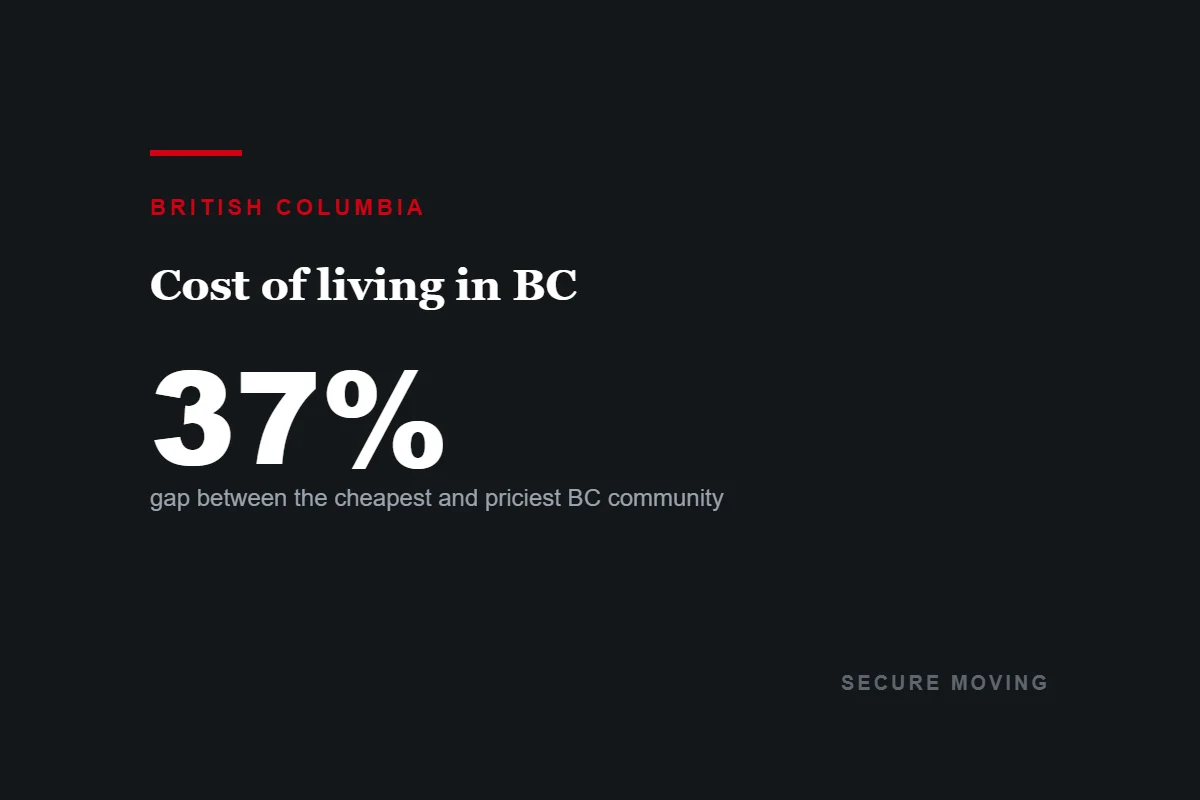
British Columbia is expensive, but not uniformly, and the spread inside the province is wider than the gap between BC and anywhere else in Canada. A household in Grand Forks needs $21.55 an hour to cover essentials. The same household in Whistler needs $29.60. That is a 37 per cent difference without leaving the province.
This guide separates the costs that are set provincially and do not move, the ones that vary by region, and the one that dominates everything: housing.
Housing, which decides most of it
The average MLS residential price across British Columbia was $929,619 in July 2026, down 1.3 per cent on a year earlier. The provincial figure hides an enormous range.
| Real estate board | Benchmark or average | Measure |
|---|---|---|
| Greater Vancouver | $1,081,900 | Composite benchmark, Aug 2026 |
| Victoria (core) | $1,301,800 | Single-family benchmark, Aug 2026 |
| Fraser Valley | $869,900 | Composite benchmark, Aug 2026 |
| Vancouver Island (excl. Victoria) | $794,500 | Single-family benchmark, Jul 2026 |
| Interior, all regions | $781,200 | Single-family benchmark, Aug 2026 |
| Chilliwack | $720,300 | Composite benchmark, Jul 2026 |
| Kamloops | $684,000 | Single-family benchmark, Jul 2026 |
| Kootenay and Boundary | $640,700 | Single-family benchmark, Jul 2026 |
| BC Northern | $469,047 | Average price, Jul 2026 |
| South Peace River | $334,698 | Single-family average, Aug 2026 |
Sources: BC Real Estate Association and the individual boards. Benchmarks describe a typical property and are quality-adjusted; averages are not, so the two are not directly comparable. The South Peace River figure rests on 31 sales.
Renting varies just as widely. CMHC’s October 2025 survey put the provincial average two-bedroom at $2,053, ranging from $1,079 in Trail to $2,364 in Vancouver. Squamish was second at $2,179 and Victoria third at $2,121; the cheapest after Trail were Prince Rupert at $1,154, Powell River at $1,182 and Fort St John at $1,196.
One thing that helps once you are in a place: BC caps annual rent increases for existing tenants. The 2026 maximum is 2.3 per cent, down from 3.0 in 2025 and 3.5 in 2024, with three full months of written notice required and one increase per twelve months.
Costs that are the same everywhere in BC
Several significant lines do not vary by where you live in the province, which is worth knowing before you start comparing towns.
Health premiums: zero. BC eliminated Medical Services Plan premiums on 1 January 2020 and none are payable.
Minimum wage: $18.25 an hour since 1 June 2026, up just over 2.1 per cent. It now rises automatically each year, tied to the previous calendar year’s average inflation.
Car insurance: ICBC’s basic rates have not risen in seven consecutive years and are held through spring 2027. Territory does affect what you pay, and ICBC divides the province into 14 of them on the grounds that urban crash risk and rural road conditions differ, but it does not publish how much difference that makes. Anyone quoting you a percentage saving for moving to the Interior is guessing.
Electricity, mostly. BC Hydro charges one residential schedule province-wide, so a kilowatt hour costs the same in Fort Nelson as in Kitsilano. The rates set in April 2025 are a daily basic charge of 23.30 cents, then 11.72 cents per kWh for the first 1,376 kWh in a two-month billing period and 14.08 cents beyond that. A further 3.75 per cent increase was directed for April 2026. Check bchydro.com for the schedule currently in force.
What changes depending on where you are
Fuel, by a wide margin
Provincial motor fuel tax on gasoline is not the same across BC:
| Area | Tax per litre | What the extra funds |
|---|---|---|
| Metro Vancouver | 27.00¢ | 18.50¢ to TransLink |
| Greater Victoria | 20.00¢ | 5.50¢ to BC Transit |
| Rest of British Columbia | 14.50¢ | — |
Source: Province of BC, motor fuel tax and carbon tax rates.
A Metro Vancouver driver pays 12.5 cents a litre more than one in Kelowna or Prince George, roughly $7.50 on a 60-litre fill and a few hundred dollars a year for most households.
Worth correcting a common error: BC’s consumer carbon tax on gasoline was eliminated on 1 April 2025. It had been 17.61 cents a litre. Any cost-of-living breakdown that still includes it is 18 months out of date.
Which utility serves you
Roughly 213,000 customers in the South Okanagan and Kootenay Boundary get electricity from FortisBC rather than BC Hydro, on a different structure: a $47.84 customer charge per two-month period and a flat 14.96 cents per kWh with no cheaper first tier. A small, low-consumption household in Trail or Castlegar can pay more per kilowatt hour than the same household anywhere on BC Hydro.
Heating
This is where the north pays. A Prince George winter, with January lows averaging −11.7°C against Vancouver’s +3.3°C, means far more energy for the same indoor temperature. BC Hydro’s tiered rate makes the penalty worse than proportional, because the extra consumption lands in the 14.08-cent band rather than the 11.72-cent one.
We have not put a dollar figure on this, because Environment Canada’s heating degree day tables for BC stations could not be pulled reliably, and a made-up number would be worse than none.
Food and inflation
Canada’s Food Price Report 2026 forecasts food prices rising 4 to 6 per cent this year, with a family of four spending about $17,571.79. British Columbia was not among the provinces flagged for above-average increases.
Measured rather than forecast, grocery inflation nationally was 3.1 per cent in July 2026, and Vancouver’s all-items consumer price index rose 3.0 per cent over the same twelve months.
One limitation worth naming, because it undercuts a claim you will see everywhere: Statistics Canada does not publish a consumer price index for anywhere in BC except Vancouver and Victoria. There is no Kelowna, Prince George, Kamloops or Nanaimo CPI. So “groceries cost more in northern BC” is probably true and is not measured by anyone.
What it actually takes to get by, community by community
Living Wage BC costs out a real household budget for 27 BC communities: shelter, food, childcare, transport, health, phone and internet, clothing, education and a contingency fund, net of income tax and government benefits. It is the most useful cost-of-living figure published for the province because it is calculated the same way everywhere.
| Community | 2025 living wage | Community | 2025 living wage |
|---|---|---|---|
| Whistler | $29.60 | Penticton | $25.10 |
| Squamish | $28.00 | Prince Rupert | $24.90 |
| Metro Vancouver | $27.85 | Kamloops | $24.45 |
| Golden | $27.80 | Nelson | $24.45 |
| Revelstoke | $27.80 | Nanaimo | $24.40 |
| Greater Victoria | $27.40 | Fraser Valley | $24.25 |
| Kitimat | $27.25 | Vernon | $24.10 |
| Powell River | $26.65 | Columbia Valley | $23.35 |
| Sunshine Coast | $26.65 | Prince George | $23.15 |
| Kelowna | $25.95 | Trail | $22.95 |
| Pemberton | $25.90 | Port Alberni | $22.60 |
| Cowichan Valley | $25.75 | Grand Forks | $21.55 |
| Comox Valley | $25.35 | Campbell River | $25.30 |
| Daajing Giids | $25.30 | BC minimum wage | $18.25 |
Source: Living Wage BC, 2025 rates. The 2025 calculation blends three household types weighted by population, a change from earlier years, so these rates are not comparable to pre-2025 figures.
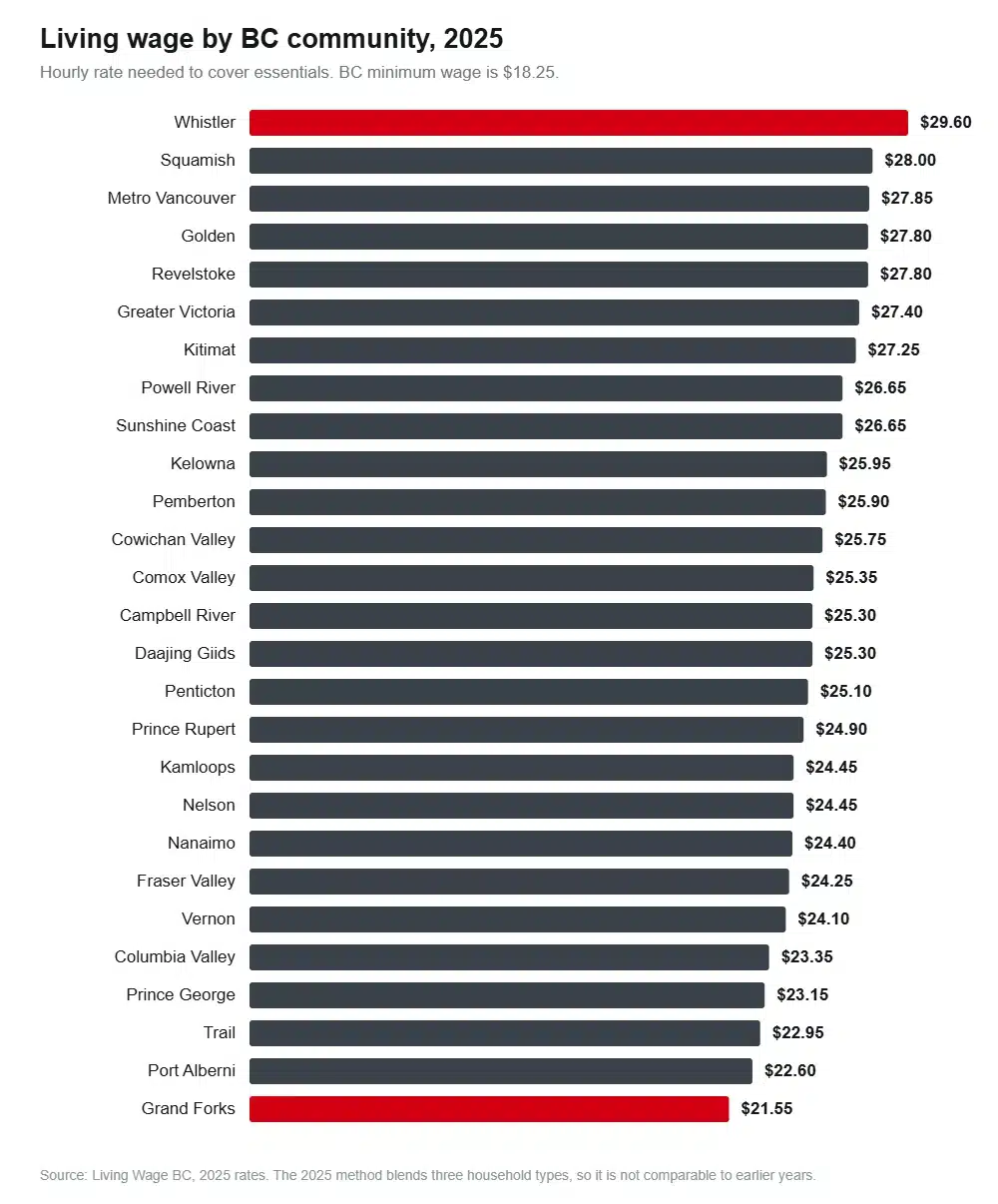
Every one of the 27 sits above the minimum wage, and the cheapest by $3.30 an hour. Note also that resort towns cluster at the top: Whistler, Squamish, Golden and Revelstoke all outrank Greater Victoria, because housing in a ski town costs what housing in a city costs without the wages to match.
Incomes, and the gap
BC’s median after-tax income for families and unattached individuals was $75,800 in 2024, a little above the Canadian median of $75,500 and well below Alberta’s $85,300. The province also has the highest poverty rate in Canada, at 13.0 per cent.
Unemployment sat at 6.5 per cent province-wide in June 2026, ranging from 4.6 per cent in the Kootenays to 8.2 per cent in the Northeast.
Is BC the most expensive province?
Probably not, on the closest thing to an official measure, and the honest answer is more interesting than the slogan.
Statistics Canada’s Survey of Household Spending put average BC household spending at $82,657 in 2023, second among the provinces behind Alberta at $88,186 and ahead of Ontario at $81,975. Shelter took 34.8 per cent of BC household consumption, and BC shelter spending rose 16.9 per cent between 2021 and 2023.
Two caveats matter here. That survey measures what households spend, which reflects income as much as prices, so Alberta’s higher figure is partly higher earnings rather than higher costs. And Statistics Canada publishes no index comparing prices between provinces, so nobody can put a defensible percentage on “BC is X per cent more expensive than Alberta”. Anyone who does is estimating. If you are weighing the two provinces against each other, the practical side of moving between BC and Alberta is much easier to pin down. For Ontario, our Toronto vs Vancouver cost of living comparison runs the numbers on rent, tax and transit, and the moving out of BC checklist covers the paperwork if you go.
The defensible version: BC has among the highest shelter costs in Canada, the highest provincial poverty rate, and incomes only marginally above the national median. That combination is what people are describing when they say the province is expensive.
Frequently asked questions
How much do you need to live comfortably in BC?
Living Wage BC’s 2025 calculations cover essentials only, with no debt repayment, savings or home ownership. They range from $21.55 an hour in Grand Forks to $29.60 in Whistler, with Metro Vancouver at $27.85. For a two-earner household in Metro Vancouver that implies roughly $101,000 a year between them, before anything discretionary.
What is the cheapest part of BC to live in?
On the living wage measure, Grand Forks, Port Alberni and Trail. For housing alone, the northeast and north-central: Mackenzie, Burns Lake and Dawson Creek all have typical assessed house values under $300,000. Our guide to the most affordable places in BC goes through these community by community.
Does BC cost more than Ontario?
On household spending in 2023, marginally: $82,657 in BC against $81,975 in Ontario. Housing widens the gap, with a Greater Vancouver composite benchmark of $1,081,900 against $934,600 for the Toronto region.
Why is gas so expensive in Vancouver?
Chiefly the TransLink levy. Metro Vancouver carries 27 cents a litre in provincial motor fuel tax against 14.5 cents in the rest of BC, of which 18.5 cents funds TransLink. That levy does not apply outside the South Coast service area.
Do you still pay MSP premiums in BC?
No. They were eliminated on 1 January 2020 and none are payable in 2026.
How much can my rent go up in BC?
2.3 per cent for 2026, once in any twelve-month period, with three full months of written notice. The cap applies to existing tenancies; a landlord can set any rent for a new tenant.
How we put this together
Prices come from the BC Real Estate Association and the individual boards, rents from CMHC’s October 2025 survey, incomes and spending from Statistics Canada, fuel and rent-cap rules from the Province, and living wage figures from Living Wage BC.
Three things we could not do. Statistics Canada publishes no consumer price index for BC below Vancouver and Victoria, so regional grocery and services comparisons are not available from any primary source. Environment Canada’s heating degree day tables would not extract, so there is no dollar figure here for the northern heating penalty. And ICBC does not publish premium differences between its 14 territories, so we have not estimated one.
Sources
- BC Real Estate Association, housing market activity
- CMHC, 2025 Rental Market Report
- BC Residential Tenancy Branch, rent increases
- Living Wage BC, 2025 rates
- BC Government, minimum wage, June 2026
- Province of BC, motor fuel and carbon tax rates
- BC Utilities Commission, residential energy rates
- Statistics Canada, Canadian Income Survey 2024
- Statistics Canada, Survey of Household Spending 2023
- Canada’s Food Price Report 2026
- Province of BC, MSP premiums
On the coast, North Vancouver is where the gap between asking rent and rent actually paid is widest in the country.
Inside Metro Vancouver, Maple Ridge is where the housing saving and the driving cost pull hardest against each other.
The Tri-Cities sit in the middle of the regional range on almost everything. We have priced out Coquitlam, Port Coquitlam and Port Moody line by line, tax notice and utility bill included.
One municipality is worth a look on its own. New Westminster has the lowest composite benchmark price of any area the real estate board reports, and residents there buy electricity from the city rather than from BC Hydro. We have costed it out line by line.
Comparing two places and pricing the move itself? If Vancouver is one of them, we have broken that city down line by line, and the wider comparison puts cost next to work, crime and climate. Send us both addresses and we will tell you what it costs to get between them.
