

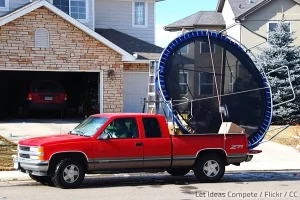
The question people ask is how to get it apart and back together. The question that decides the job is whether the new yard can take it.
Health Canada’s backyard trampoline guidance, updated May 2026, asks for at least 2 metres of clearance around the sides and 8 metres of overhead space, on flat, level ground. Eight metres is about 26 feet. Under a mature maple, next to a fence line, or on a sloping lawn, a trampoline that was fine at the old address may have nowhere to go at the new one.
Measure that first. Everything below assumes the destination passes.
Two Canadian bodies advise against home trampolines
We are going to state this plainly because it is the published position of the relevant Canadian authorities, and a page that leaves it out is being selective.
The Canadian Paediatric Society and Parachute Canada recommend against the use of recreational trampolines at home, because of the potential for serious injury. Health Canada carries that recommendation on its own trampoline page. The Canadian Paediatric Society’s guidance for parents goes further: “Parents should not buy trampolines for their children or teens to use at home”, and “Trampolines should not be considered play equipment.” It notes injuries are most common among children aged 5 to 14 and that trampoline-related injuries are rising in Canada.
None of that means we will refuse to move your trampoline, and plenty of families use them carefully. But if you are deciding whether to take it to the new house at all, that is the position of the people who study the injuries, and you should have it.
If you are keeping it, Health Canada’s own use guidance is short and worth following: active adult supervision during use, no children under six years of age, one person jumping at a time, no somersaults or flips because they “can cause permanent spine injuries and should never be attempted”, and pre-use checks on frame integrity, secure springs, locked leg braces, intact padding and a hole-free jumping surface. On nets, Health Canada’s point is worth quoting: safety nets “are designed to prevent jumpers from falling off the trampoline and hitting the ground”, and most injuries happen on the mat during jumping rather than by falling off.
Both trampoline standards were revised in July 2024
| Standard | Covers | Current edition |
|---|---|---|
| ASTM F381 | Components, assembly, use and labelling of consumer trampolines | F381-24 |
| ASTM F2225 | Consumer trampoline enclosures | F2225-24 |
F381-16 is superseded, so any page citing “ASTM F381” without an edition, or citing the 2016 version, is out of date. The scope covers consumer trampolines with a bed of at least 3,300 square inches, about 21,300 square centimetres, and a height of at least 20 inches, or 51 centimetres, for single-user home use. The standard itself states the equipment is “not recommended for use by children under six years of age”, which is where Health Canada’s under-six line comes from.
Two details in F381-24 that matter on a relocation: trampoline ladders “shall not be included as component parts in packaging”, and roller stands are required for portable models. If your trampoline came with a ladder, it did not come from a manufacturer following the current standard.
We have not quoted clause text from either standard, because ASTM sells them and we have not read them. What is above is the published scope and metadata.
Check for buried utilities before you drive a single peg
This is the one genuine hazard in a trampoline relocation and it is not the trampoline.
Springfree’s own ground anchor manual carries this warning: “Before installation, check for underground power, gas, telephone, water, or other utility lines and pipes. Failure to do so could result in serious or fatal injury.” Anchor pegs are driven into the ground, at depth, in a spot you have not dug before.
In British Columbia, BC 1 Call is the free service that arranges utility locates before you dig, describing itself as “the link between the excavating community and the owners of underground facilities.” Requests go in online or on 1-800-474-6886, and its members respond within 3 business days of notification, or 5 for large projects. So start it while the trampoline is still standing at the old house rather than on the morning the anchors go in.
Anchoring: pegs to full depth, no wind rating published
Anchors are not optional if the trampoline is going somewhere exposed, and they are also where the unsourced advice piles up.
What Springfree does publish, in its anchor manual and on its Canadian site:
- All pegs must be installed to their full depth; anchors cannot secure the trampoline if they are not “fully and properly installed”.
- The S155 model requires 8 anchors.
- A four-anchor ground anchor kit is $99 CAD, with an eight-anchor option, and jumbo models “may require two sets of anchors… depending on weather conditions in your area”.
- On severe weather: “If you anticipate severe weather, consider lowering the enclosure, moving the trampoline to a sheltered location or disassembling the trampoline completely.”
- Springfree states it “is not responsible for any damages caused as a result of unforeseen anchoring conditions or by acts of nature.”
What nobody publishes, and we looked: a wind-speed threshold at which a trampoline becomes a hazard. Not Springfree, not ASTM in the material we could read, not Health Canada. If a page gives you a figure in kilometres per hour, it is not citing anyone.
One correction worth making explicitly. Health Canada’s page covers trampolines and inflatable play structures, and the anchoring and “don’t use in windy or rainy conditions” instructions on it are written about the inflatables. Attributing them to trampolines would be a misquote of a government source, so we have not done it.
Take it apart, and use the manufacturer’s manual
Moving a trampoline in one piece works over short, flat, obstacle-free ground with enough people. Here is what makes it a bad idea otherwise: a 14-foot trampoline is a rigid circle wider than any gate, its weight is all in a thin steel ring, and a frame that flexes on an uneven carry is a frame with a bent leg and a joint that no longer seats.
Most manufacturers publish a disassembly manual for your specific model, and it is better than any generic sequence. Springfree publishes model-by-model manuals for its Jumbo Square, Compact Round, Compact Oval, Jumbo Oval, Large Oval, Large Square, Medium Oval and Medium Round frames, plus separate disassembly manuals in English and French, and dedicated manuals for the shifting wheels and the ground anchor. Find yours before you start. It will tell you the order, and the order is what stops you fighting a spring-loaded frame.
The general sequence, for a spring trampoline without a model manual to hand:
- Enclosure net and poles first, top down. Photograph the pole-to-frame brackets before you undo them.
- Safety pads off, and note where the ties attach.
- Springs, with a spring tool, working around the circle in a star pattern rather than sequentially so the tension comes off evenly. This is the step that hurts people; a spring released under load is a projectile.
- Mat out and folded, kept clean and dry.
- Frame apart, legs first then the ring sections. Bag the hardware by assembly and label it.
- Anchors out of the ground and kept with the kit.
Springfree also offers its own relocation service, described as “Moving house (we take it down, you move it, we put it back up)”, performed by its trained installers with pricing by phone estimate. For a Springfree frame under warranty that is worth a call before you book anyone, for the same reason the pool table page recommends checking with the dealer.
Getting the parts out and to the truck
- The frame ring sections and the legs are the awkward load, not the heavy one. Long, curved and easy to bend if they are loaded across other things.
- Springs go in a bucket or a box, not loose in a truck. A hundred loose springs in a moving van is a hundred opportunities to scratch something.
- The mat travels folded and dry. Damp mat stored folded grows mould.
- The net is the part that gets lost. Bag it with the poles.
- Doorways, if it is coming through the house: the narrowest doorway the BC Building Code permits inside a dwelling is 610 mm, about 24 inches, and required entrances are 810 mm. Frame sections are fine; an assembled frame is not.
Rebuilding at the new address
- Level the ground first. Health Canada’s instruction is flat, level ground, and a trampoline on a slope loads one side of the frame permanently.
- Confirm the clearances, 2 metres to the sides and 8 metres overhead, before the frame goes together. Measuring after assembly is measuring too late.
- Reassemble in the reverse order, from your photographs and the model manual.
- Springs in a star pattern again, so the mat tensions evenly.
- Anchors to full depth, after the utility locate.
- Run the pre-use check from the Health Canada list before anyone gets on it: frame, springs, leg braces, padding, mat.
When to hand it over
- You do not have the model manual and it is a spring trampoline. The spring step is the one worth not improvising.
- The frame is a jumbo or a rectangular model. More sections, more tension, more to get wrong.
- It is a Springfree or another frame under warranty, where the manufacturer offers its own relocation service.
- The new yard needs levelling or the clearances are marginal, which is a landscaping question before it is a moving one.
How Secure Moving handles a trampoline
We will disassemble, transport and reassemble a trampoline, working from your model’s manual where you have it. What we will not do is drive anchor pegs at a new address without a utility locate, because Springfree’s own manual is unambiguous about what is underneath, and neither should anyone else.
And we will tell you, before the truck is booked, if the destination does not have 2 metres of side clearance and 8 metres overhead, because that is the thing that makes the whole job pointless.
Our team works across the region as a moving company in Vancouver, and our guides to moving heavy furniture up stairs and moving a pool table cover the other two jobs where disassembly is the right answer.
Frequently asked questions
How much space does a trampoline need?
Health Canada asks for at least 2 metres of clearance around the sides and 8 metres of overhead space, on flat, level ground. Since 8 metres is about 26 feet, overhanging branches are usually the binding constraint. Check the new yard against those figures before you take the trampoline apart.
Can you move a trampoline without taking it apart?
Over short, flat, obstacle-free ground with enough people, yes. It is a poor idea otherwise: the frame is a rigid circle wider than any gate, its weight is all in a thin steel ring, and a frame that flexes on an uneven carry ends up with a bent leg and a joint that no longer seats. Most manufacturers publish a disassembly manual for the specific model, which makes the proper route easier than it looks.
Do I need to anchor a trampoline?
If it is going anywhere exposed, yes. Springfree’s anchor manual requires pegs installed to their full depth and specifies 8 anchors for its S155 model, and advises that in anticipated severe weather you consider lowering the enclosure, moving the trampoline to shelter, or disassembling it. No named source publishes a wind-speed threshold, so treat any figure in kilometres per hour as unsourced.
Is it safe to drive anchor pegs into a new lawn?
Not until you have had a utility locate. The Springfree manual warns to check for underground power, gas, telephone, water and other lines before installation, because failure to do so “could result in serious or fatal injury”. BC 1 Call arranges locates free of charge on 1-800-474-6886 or online, with members responding within 3 business days, so start it while the trampoline is still at the old address.
What standard applies to backyard trampolines in Canada?
ASTM F381-24 for the trampoline and ASTM F2225-24 for the enclosure, both revised on 17 July 2024. The 2016 edition is superseded. Scope is consumer trampolines with a bed of at least 3,300 square inches and a height of at least 20 inches, and the standard itself states the equipment is not recommended for children under six.
Should I keep the trampoline at all?
That is your call, and here is the published position so you can make it: the Canadian Paediatric Society and Parachute Canada recommend against home recreational trampolines, Health Canada carries that recommendation, and the Paediatric Society states that trampolines should not be considered play equipment. Injuries are most common among children aged 5 to 14 and are rising in Canada. Keeping it, the use rules above matter more than the assembly does.
