

Last updated: August 2026
Langley is the middle option. More expensive than Abbotsford, cheaper than Vancouver, and, unlike Abbotsford, inside Metro Vancouver, on TransLink, and getting a SkyTrain in 2029.
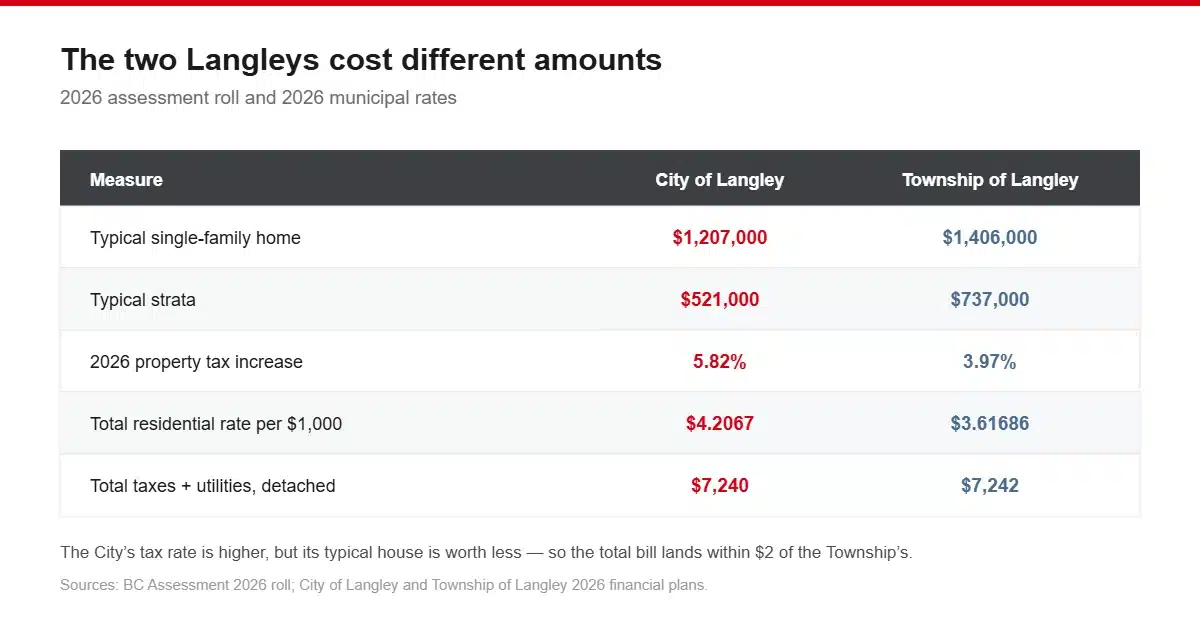
There’s one complication that most cost-of-living articles about Langley skip entirely: there are two Langleys, and they cost different amounts to live in. The City of Langley and the Township of Langley are separate municipalities with separate tax rates, separate utility bills and, as of the 2026 assessment roll, a $199,000 gap in typical house value.
Here’s the real picture, split where it needs splitting.
Langley at a glance
| City of Langley | Township of Langley | |
|---|---|---|
| Population | ~35,316 | ~157,831 (Township estimate, Jan 2026) |
| Area | ~10 km² | 316 km² |
| Typical single-family home (BC Assessment 2026) | $1,207,000 | $1,406,000 |
| Typical strata (BC Assessment 2026) | $521,000 | $737,000 |
| 2026 property tax increase | 5.82% | 3.97% |
| Total residential tax rate per $1,000 | $4.2067 | $3.61686 |
| Total taxes + utilities, typical detached house, 2026 | $7,240 | $7,242 |
That last row is the interesting one. The City’s tax rate is higher, but its typical house is worth less, so the total bill lands in almost exactly the same place. And both are cheaper than Surrey ($7,729) and dramatically cheaper than Vancouver ($10,977).
For the record: the City of Langley has the third-lowest combined property taxes and utility fees for detached homes in Metro Vancouver.
Rent
Here’s a limitation worth knowing about: CMHC does not report the City and Township separately. Its rental survey uses a single combined zone called “Langley City and Langley DM.” Neither does the real estate board. So for rent and home prices, Langley is one market as far as the official data is concerned.
CMHC survey rents: what people currently in purpose-built rentals actually pay, October 2025 survey:
| Unit | Average rent |
|---|---|
| Bachelor / studio | $1,354 |
| 1 bedroom | $1,765 |
| 2 bedroom | $2,203 |
| 3 bedroom or larger | $2,216 |
| All units | $2,007 |
Vacancy sat at 3.0%, which is at the top of CMHC’s balanced range, on a rental universe of 4,065 purpose-built units. That’s a small formal rental stock for a population approaching 200,000. Most Langley renting happens in secondary suites, basement suites and rented condos, which this survey doesn’t capture.
Asking rents: what’s advertised now, and what a new tenant pays:
- Rentals.ca, July 2026: Langley overall $2,239; 1BR $1,899; 2BR $2,457. That ranked Langley the 16th most expensive rental market in Canada, down from 13th.
- Zumper, August 2026: studio $1,599, 1BR $1,800, 2BR $2,365, 3BR $3,097. Median across all types $2,015, down 12.4% year over year.
Rents are falling here, meaningfully.
How Langley compares — same CMHC survey, October 2025, so this is like-for-like:
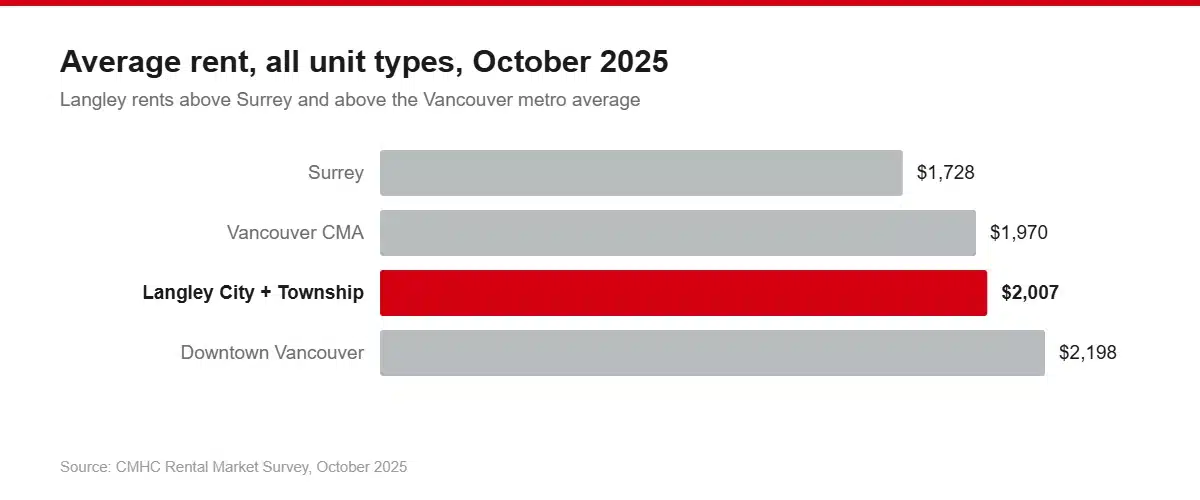
| Zone | All units, average |
|---|---|
| Surrey | $1,728 |
| Vancouver CMA overall | $1,970 |
| Langley City + Township | $2,007 |
| Downtown Vancouver | $2,198 |
Langley rents above the Vancouver metro average and above Surrey. That surprises people. The explanation is stock: Langley’s purpose-built rental universe is small and heavily weighted toward newer buildings in Willoughby, and new buildings rent for more.
Buying
Benchmark prices for Langley (City and Township combined), July 2026, Fraser Valley Real Estate Board:
| Type | Benchmark | 12-month change |
|---|---|---|
| Detached | $1,500,900 | −6.2% |
| Townhouse | $811,400 | −4.9% |
| Apartment | $534,200 | −9.0% |
Same board, same month, for comparison:
| Detached | Townhouse | Apartment | |
|---|---|---|---|
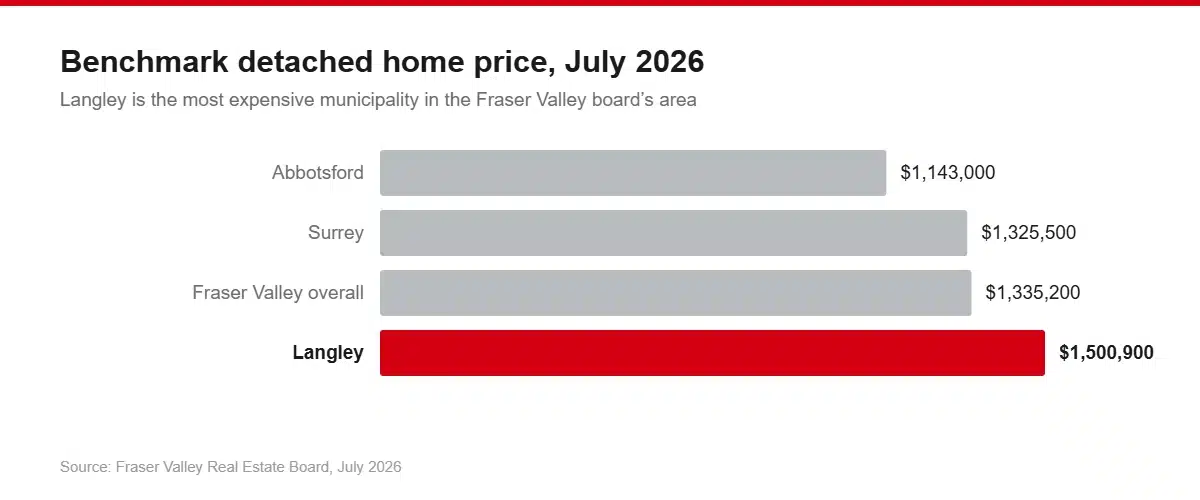
| Langley | $1,500,900 | $811,400 | $534,200 |
| Surrey | $1,325,500 | $753,000 | $474,100 |
| Abbotsford | $1,143,000 | $602,000 | $380,900 |
| Fraser Valley overall | $1,335,200 | $757,300 | $469,500 |
Langley is the most expensive municipality in the Fraser Valley board’s area, more than Surrey, and about 31% more than Abbotsford on a detached house.
The market is soft. Board-wide in July 2026, active listings were 32% above the ten-year average, the sales-to-active-listings ratio was 11%, and homes took about 40 days to sell. That’s a buyer’s market by any reasonable definition.
BC Assessment’s 2026 roll, valued 1 July 2025, splits the two municipalities:
| Single-family | Strata | |
|---|---|---|
| City of Langley | $1,207,000 (−8%) | $521,000 (−5%) |
| Township of Langley | $1,406,000 (−3%) | $737,000 (−3%) |
| Surrey | $1,464,000 (−6%) | $649,000 (−7%) |
| Abbotsford | $1,082,000 (−5%) | $470,000 (−3%) |
| Vancouver | $2,092,000 (−5%) | $772,000 (−3%) |
The City is the cheaper Langley to buy into, by a wide margin on both house types. That’s the clearest practical reason to care about which Langley you’re looking at.
Property tax
City of Langley put taxes up 5.82% for 2026, about $182 a year on a typical single-family home and $77 on a typical multi-family one. The increase breaks down as fire services 3.57%, police 0.50%, recreation 0.71%, with the rest going to operations and infrastructure. In 2025, an average single-family home paid about $2,835 in municipal property tax.
Total 2026 residential rate: $4.2067 per $1,000, made up of general municipal $2.5937, school $1.1606, TransLink $0.3586, Metro Vancouver $0.0555, BC Assessment $0.0381 and Municipal Finance Authority $0.0002.
Township of Langley put taxes up 3.97%, roughly $9 a month, or about $107 a year, on an average assessed home. Composition: core municipal services 0.90%, RCMP 1.59%, fire 1.26%, bylaws 0.22%.
Total 2026 residential rate: $3.61686 per $1,000.
The Township publishes a useful breakdown of where its own share goes. On a home paying $2,826 in Township tax: general municipal services $1,073 (38%), police $647 (23%), fire $438 (16%), roads $428 (15%), parks $240 (8%). Township taxes are 53% of your total bill; school tax is 32%, TransLink 10%, regional agencies 3%.
Both are due 2 July 2026.
For comparison, 2026 increases elsewhere: Surrey 2.6%, Abbotsford 4.94%, Vancouver 0% on property tax with utilities up 4.2%.
Utilities
Electricity is BC Hydro for both municipalities, on a two-step tiered rate: a lower rate for the first 1,376 kWh in a 62-day billing period, a higher one above that, plus a daily basic charge. BC Hydro approved increases of 3.75% in April 2025 and another 3.75% in April 2026, roughly $3.75 a month each time for an average customer. It also introduced an optional flat blended rate, pitched at around 12.63¢/kWh in 2025, which BC Hydro said could save higher-use households about $60 a year. Worth a look if your household runs hot. Check bchydro.com for the current per-kWh figure; the utility’s own page and the regulator’s summary didn’t agree when we checked.
Natural gas is FortisBC. Rate Schedule 1, effective 1 July 2026: basic charge $0.4085/day, delivery $8.257/GJ, storage and transport $1.347/GJ, cost of gas $1.660/GJ, plus riders.
Water, sewer and garbage — City of Langley:
- Garbage and organics: $432.00/year for 2026, up $41 (10.5%) from $391
- Sewer: $75.00 per dwelling unit per year plus $2.41/m³, charged on 80% of metered water
- Water: $1.89/m³ plus $75.00 per dwelling unit per year — this is the 2025 rate; the 2026 schedule wasn’t published at time of writing
- Water meters are read annually in March and billed on the June tax notice
Water, sewer and garbage — Township of Langley (flat annual rates, 2026):
| Single-family | Multi-family | Secondary suite | |
|---|---|---|---|
| Water | $779.96 | $667.22 | $233.99 |
| Sanitary sewer | $716.47 | $609.00 | $214.94 |
| Garbage (base + 240L cart) | $426.00 | — | — |
| Garbage (base + 120L cart) | $326.00 | — | — |
Note for 2026: Township single-family water went up $18.40 while sanitary sewer came down $66.13, so most detached households are slightly ahead. Multi-family did considerably better, with sewer down $173.60 and water down $99.34, after Council split the rates by dwelling type.
One change to watch: the Township no longer includes utility fees on your property tax statement. They’re billed separately now.
Transit — and the SkyTrain
This is where Langley pulls away from the rest of the Fraser Valley.
Both Langleys are inside Metro Vancouver and the TransLink service area. You pay the TransLink levy ($0.35860 per $1,000 on both tax bills) and you ride the TransLink network. Abbotsford, twenty minutes east, does neither.
Fares, effective 1 July 2026:
| 1-Zone | 2-Zone | 3-Zone | |
|---|---|---|---|
| Adult, Compass stored value | $2.85 | $4.20 | $5.40 |
| Adult, cash | $3.50 | $5.10 | $6.70 |
| Concession | $2.30 | $3.40 | $4.60 |
| Adult monthly pass | $117.20 | $156.70 | $211.65 |
The rule that matters for Langley riders: all bus and HandyDART trips are a 1-Zone fare at all times. Since Langley has no SkyTrain station yet, every Langley transit trip starts on a bus, so you’re paying $2.85 stored value regardless of how far you go. Trips starting after 6:30pm on weekdays and anytime at weekends are also 1-Zone system-wide.
Carvolth Exchange in Willoughby is the park-and-ride: 679 spaces, $2 a day or $40 a month, open 4am to 2am, no overnight parking.
Getting to Vancouver and Surrey today:
- Route 555 from Carvolth Exchange to Lougheed Station: a scheduled 38 minutes, then SkyTrain
- Route 502 from Langley Centre to Surrey Central Station along Fraser Highway: a scheduled 47 minutes
Getting there from late 2029: the Surrey Langley SkyTrain. Sixteen kilometres of elevated guideway along Fraser Highway from King George Station to 203 Street in Langley City, eight new stations, $5.996 billion: $4.4 billion from the Province and $1.3 billion from Canada, the largest federal transit investment in BC.
Two of the eight stations are in Langley City: Willowbrook (196 Street) and Langley City Centre (203 Street), both transit exchanges. Projected trip time from Langley City Centre to King George: about 22 minutes, more than 25 minutes faster than the bus.
As of May 2026 all eight stations were under construction, foundations were complete at six, more than 5 km of guideway was installed and trackwork had begun. Projected ridership is 56,000 daily trips in the opening year, rising to 80,000 by 2050.
If you are buying in Langley City or Willoughby, this is the single biggest thing on the horizon.
Wages and childcare
The Metro Vancouver living wage is $27.85/hour (2025), which is the applicable regional rate for both Langleys as Metro Vancouver member municipalities. Abbotsford’s Fraser Valley rate is $24.25. BC’s minimum wage rose to $18.25/hour on 1 June 2026.
The living-wage calculation assumes, for a family of four in Metro Vancouver: $3,343/month shelter, $1,266 food, $908 out-of-pocket childcare, $567 transportation. Those are the most useful published monthly budget assumptions for this region.
On childcare, BC’s Fee Reduction Initiative caps what participating providers charge after the provincial reduction, up to $900/month off infant and toddler group care, $545 for ages 3 to kindergarten, $115 for school-age group care, with fees not reduced below $200/month full-time. No published survey covers Langley specifically, so call providers directly.
So what does Langley actually cost?
Langley sits above Surrey and the Metro Vancouver average on rent, above every other Fraser Valley municipality on house prices, and slightly below Surrey on total property taxes and utilities.
What you’re paying the premium for is position: inside Metro Vancouver, on TransLink, with a SkyTrain line arriving in 2029 and a large stock of new housing.
If you want the cheapest version of Langley, look at Langley City. A typical single-family home there is assessed $199,000 below the Township equivalent, and a typical condo $216,000 below. It’s also where the SkyTrain terminates.
If you want cheaper than Langley altogether, keep driving east. Abbotsford runs about 31% less on a detached house, but it isn’t in Metro Vancouver, isn’t on TransLink, and isn’t getting a train.
Frequently asked questions
Is Langley cheaper than Surrey?
On property taxes and utilities, marginally: about $7,240 for a typical City of Langley detached home and $7,242 in the Township, against $7,729 in Surrey. On house prices, no: a benchmark detached home in Langley was $1,500,900 in July 2026 against $1,325,500 in Surrey. On rent, no either: $2,007 average against Surrey’s $1,728.
What’s the average rent in Langley BC?
$2,007/month across all unit types in the October 2025 CMHC survey, which measures what current tenants pay. Advertised rents are higher, around $2,015 to $2,239 median depending on the source, as of mid-2026.
Which is cheaper, Langley City or Langley Township?
The City, clearly, on purchase price: $1,207,000 versus $1,406,000 for a typical single-family home on the 2026 assessment roll, and $521,000 versus $737,000 for strata. Total taxes and utilities on a typical detached house land within $2 of each other.
Is Langley in Metro Vancouver?
Yes. Both the City and the Township are Metro Vancouver member municipalities and both are in the TransLink service area. Abbotsford is not.
When does the SkyTrain get to Langley, and what will it do to prices?
Late 2029, terminating at 203 Street in Langley City. We’re not going to predict what it does to prices, but as of May 2026 all eight stations were under construction and the projected trip to King George Station is about 22 minutes.
The provincial cost guide covers how Langley compares with the rest of BC on rent, fuel and hydro.
On the other side of the bridge, Maple Ridge and Pitt Meadows price out lower on housing and higher on driving.
The move itself is one more line in the budget. Here’s what a move to Langley costs with us.
