

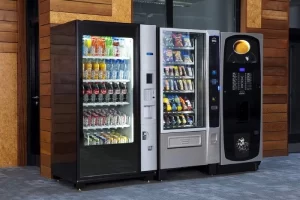
Two numbers decide this job before you touch anything.
About 720 lb empty. Royal Vendors publishes that figure in its own service manual for a current beverage machine, alongside dimensions of 72 inches high, 39 inches wide and 36.5 inches deep.
Thirty-nine inches wide. Hold that against the building code: the widest doorway a BC dwelling is required to have is 810 mm, about 31.9 inches, at the entrance. A standard beverage machine is seven inches wider than that. It does not go through a code-minimum front door, and interior doorways can legally be as narrow as 610 mm, about 24 inches.
So the real first question is not how to lift it. It is whether there is an opening it fits through at all, and what has to come off if there isn’t.
Measure the route, then decide if the job is possible
Machine dimensions from the manufacturer’s manual, then every opening on the route:
| Opening | BC Building Code minimum |
|---|---|
| Required entrance to a dwelling | 810 mm (31.9 in) |
| Most rooms | 760 mm (29.9 in) |
| Bathrooms, walk-in closets, rooms off a 710 mm hallway | 610 mm (24 in) |
| Stairs serving a single dwelling unit | 860 mm wide, 1,950 mm headroom |
| Required exit and public stairs, residential buildings | 900 mm wide, 2,050 mm headroom |
A 39-inch machine needs roughly 991 mm of clear opening. Practically that means a double door, a patio slider with the panel out, a garage, a commercial entrance, or a door slab and stops removed and the frame measured again. Removing a door slab typically buys you the thickness of the slab and the stop, which is often enough and sometimes is not.
Measure the machine and the opening yourself before anyone quotes. This is the job where “we’ll see on the day” produces a truck, a crew and a machine that stays where it is.
What the manufacturer actually says about transporting one
This is the part worth having, because the manual is specific where the internet is vague. Royal Vendors’ service manual carries a section headed “IMPORTANT NOTE ON TRANSPORTING THE RVV”, and it reads:
“Before transporting the RVV, always ensure that the protective transport packaging is replaced, including: • Packing tape to secure the case support; • Styrofoam block on top of the motor cover, below the elevator arm; • Binder clips to secure each belt, placed approximately in the middle of each belt’s run; and • Cardboard to protect the glass. Improper packaging before shipping could cause damage.”
Three things follow.
The internal mechanism is the fragile part, not the cabinet. The instructions are all about immobilising the elevator arm, the belts and the case support. A machine that travels with its mechanism loose arrives looking fine and vending badly.
The glass needs protecting separately. Cardboard against the glass is the manufacturer’s own instruction.
The original transport packaging matters enough that the manufacturer says to put it back. If it is gone, you are reproducing it: tape, foam, clips and cardboard.
And here is what the manual does not say
We read it looking for the things every vending-machine-moving page asserts, and it contains none of them:
- No maximum tilt angle.
- No instruction on whether the machine may be laid on its back or side.
- No waiting period before powering on the refrigeration after transport. The “stand it upright for 24 hours” rule is not in there.
- No instruction to remove the coin mechanism or bill validator.
- No floor loading figure.
We also could not obtain published weights or transport instructions from Crane, Dixie-Narco, AMS or Seaga. So if a page gives you a tilt limit in degrees or a settling time in hours, ask where it came from.
What the manual does warn about, sharply, is tipping during service: the support leg under the bottom hinge plate of the main door has to be fitted before the door is opened, because “failure to do so may result in the vender tipping forward, potentially resulting in broken bones, dismemberment, or even death!” That is the manufacturer’s own punctuation. A 720 lb cabinet with a heavy door swung open has its centre of gravity somewhere you do not want it.
The refrigerant question, answered properly
There is a lot of confident writing about refrigerant and moving appliances, most of it wrong in one direction or the other. Here is where the law actually sits.
Moving a sealed machine is not regulated activity. BC’s Ozone Depleting Substances and Other Halocarbons Regulation prohibits releasing a halocarbon and restricts servicing refrigeration equipment to an approved person. Picking a machine up, wheeling it and driving it is neither. Nothing in that regulation, or in the federal one, prohibits tilting or laying down a sealed appliance.
The federal regulation people usually cite does not apply to you. The Federal Halocarbon Regulations, 2022 are scoped to systems owned by the Crown or a federal work or undertaking, or located on federal or Indigenous lands. A machine in a Surrey basement or a Burnaby office is governed by the BC regulation.
What is regulated is disposal. If the machine is being scrapped rather than moved, refrigerant must be recovered using compliant equipment or the unit delivered to an authorised facility. An article about getting rid of an old machine is on much firmer legal ground than one about moving a working one.
Where the line does get crossed is damage. If the refrigerant circuit is breached during handling, a release has occurred and the prohibition is engaged. That is a practical reason to protect the condenser and the lines at the back of the machine, not just the glass at the front.
So what about standing it upright before switching it on?
The mechanical reasoning behind the advice is real: compressor oil can migrate if a sealed system is tipped or inverted, and running the compressor before the oil has returned is hard on it. What does not exist, as far as we could find, is any manufacturer or regulator publishing a number of hours.
Our practice is to keep a refrigerated machine upright throughout the move where the route allows it, and where it has had to be tipped, to leave it standing and unplugged for several hours before power goes on. We will tell you that is our practice rather than a published rule, because that is what it is.
One thing the manual is specific about on the far side: allow a minimum of 4 inches, about 10 cm, of clearance at the back for proper ventilation of the refrigeration system. A machine pushed flush against a wall runs hot and fails early, and that is a manufacturer instruction rather than a preference.
Which standards exist, and which do not
Two worth knowing about, and neither covers transport.
NAMA, the vending trade association, publishes a “Standard for the Sanitary Design and Construction of Food and Beverage Vending Machines” and runs a Machine Evaluation Program. Both are about public health and sanitary construction. Neither addresses moving or transporting a machine.
NSF/ANSI 25 is the consensus standard for food and beverage vending machines. The current edition is NSF/ANSI 25-2025, which revised the 2023 edition. Also a food-safety standard rather than a transport one.
No equipment or safety standard governs how a vending machine is moved. Which means the manufacturer’s manual is the only authority, and that is why the section above matters.
Before the machine moves
- Empty it completely. Product, coin box, bill stacker, water if there is a tank. A loaded beverage machine adds hundreds of pounds and every one of them is a shifting liquid.
- Unplug it and coil the cord where it cannot be run over. A severed cord on a vending machine is a service call.
- Replace the transport packaging per the section above: case support taped, foam above the motor cover, binder clips on the belts, cardboard against the glass.
- Lock the door and tape it. The door is the heaviest single component and the one that swings.
- Take the keys off the machine. They travel with a person.
- Photograph the back before it goes against a wall or into a truck, so damage to the condenser or lines is attributable.
- Protect the floor along the entire route. Four small feet under 720 lb is a point load, and it marks hardwood, vinyl and tile.
Equipment, honestly assessed
A standard hand truck is not the tool. Magliner publishes a blanket 500 lb capacity for its hand trucks unless otherwise noted. A 720 lb machine is 44 per cent over that before you add anything.
A pallet jack works where the floor does. Flat, hard, continuous floor and a machine on a pallet or with clearance underneath for the forks. It does not work on carpet, on a step, or on a route with a threshold.
Stair-climbing equipment exists and is specialised. Magliner lists appliance trucks with stair-climber and stair-crawler wheel configurations as distinct products, and powered stair-climbing hand trucks in its powered range. Worth knowing that it publishes no per-model load capacities for those, and no stated limits on stair use, so anyone quoting you a stair-climber capacity should say where they got it.
Lifting straps top out below the machine’s weight. Forearm Forklift publishes up to 800 lb and Shoulder Dolly’s heavy-duty Pro Lift straps up to 1,000 lb, so straps are within range on paper. But a strap carry means the load is on people, and a 720 lb cabinet on two people is outside any sensible reading of a risk assessment.
There is no legal lifting limit in BC, and that is the point
BC’s Occupational Health and Safety Regulation, Part 4, sections 4.46 to 4.53, contains no weight threshold and no numeric trigger. The duty is to identify the factors that expose workers to musculoskeletal injury, assess the risk, and eliminate or minimise it, taking account of the force required, the work postures, the size and weight distribution of the object, the floor surfaces and the working heights, with controls reviewed at least annually.
For a vending machine that framework produces a clear answer: this is an equipment job with a planned route, not a people job with more people.
The floor question nobody answers
We could not find a published floor-loading figure for a vending machine from any source, not the manufacturer, not the building code material we retrieved, not the trade association.
What we can tell you is the shape of the problem. A 720 lb machine, plus product, standing on four small levelling feet, concentrates load at four points rather than spreading it. A concrete slab makes it a non-issue. On a wood-framed upper floor, a residential basement over a crawlspace, or an older building, it is a question for someone who can read the framing, which is an engineer or a building manager rather than a moving company. If the machine is going somewhere other than a ground-floor slab, ask before it arrives.
When you need help with this
Realistically, most of the time. The honest triggers:
- Any route with a step, a stair or a threshold.
- Any opening under about 40 inches clear, where door removal is in play.
- Any destination above or below grade on a wood-framed floor.
- A refrigerated machine you intend to keep working.
How Secure Moving handles a vending machine
We measure the machine and every opening on the route before quoting, and we will tell you if the answer is that it does not fit. We replace or reproduce the manufacturer’s transport packaging, protect the glass and the condenser, move the machine upright where the route allows, and leave a refrigerated unit standing and unplugged for several hours before power goes on. We protect the floor along the whole route, because four feet under 720 lb is what damages a floor.
Secure Moving carries $5 million in liability coverage and active WorkSafeBC registration. In a commercial installation our commercial moving service is the right starting point, and for anything in the region our team works as a moving company in Vancouver.
If you are moving other heavy equipment at the same time, our guides to moving heavy furniture up stairs and moving a pool table cover the same equipment and route thinking.
Frequently asked questions
How much does a vending machine weigh?
Royal Vendors publishes about 720 lb (327 kg) empty for a current beverage machine measuring 72 by 39 by 36.5 inches. Loaded product adds substantially more. We could not obtain published weights from Crane, Dixie-Narco, AMS or Seaga, so for a different make the manufacturer’s manual is the source.
Will a vending machine fit through a normal door?
A 39-inch machine needs roughly 991 mm of clear opening. The widest doorway a BC dwelling is required to have is 810 mm, about 31.9 inches, at the entrance, and interior doorways can legally be as narrow as 610 mm. So no, not through a code-minimum door. You are looking at a double door, a patio slider with the panel removed, a garage, a commercial entrance, or a removed door slab with the frame re-measured.
Can you lay a vending machine down to move it?
The Royal Vendors service manual for a current machine contains no instruction either way, and no tilt-angle limit. We keep a refrigerated machine upright where the route allows, because compressor oil can migrate in a tipped sealed system, and we leave a machine that has been tipped standing and unplugged for several hours before power goes on. That is our practice rather than a published rule, and we will say so.
How long should a vending machine stand before being plugged in?
No manufacturer or regulator we could find publishes a figure, so the widely quoted 24 hours has nothing behind it that we can verify. Compressor oil can migrate when a sealed system is tipped, so the mechanical reasoning is real. Several hours upright and unplugged is our own practice on a machine that has been laid over.
Do refrigerant rules apply when moving a vending machine?
Not to the moving itself. BC’s halocarbon regulation prohibits releasing refrigerant and restricts servicing refrigeration equipment to an approved person; transporting a sealed machine is neither. The federal halocarbon regulation applies only to federal works and undertakings and federal or Indigenous lands. What is regulated is recovery before disposal, and the practical risk on a move is breaching the circuit through damage, which is why the condenser and lines get protected.
Can my floor take a vending machine?
No published floor-loading figure for a vending machine exists that we could find. At 720 lb on four small levelling feet, the load is concentrated rather than spread. Over a ground-floor concrete slab it is not a question; on a wood-framed upper floor, a basement over a crawlspace or an older building, ask a building manager or an engineer before the machine arrives.
How much clearance does a vending machine need at the back?
At least 4 inches, about 10 cm, for proper ventilation of the refrigeration system, which is Royal Vendors’ own installation instruction. Pushed flush to a wall, a machine runs hot and fails early. The manual also specifies levelling with a spirit level using the four levelling legs, with the door closed and latched.
