

Before anything else, a piece of geography that trips up nearly every guide to this subject. North Vancouver is two municipalities, and the line between them runs straight through a neighbourhood. Upper Lonsdale from 25th to 29th Street is the City. North of 29th it is the District. Deep Cove, Edgemont, Lynn Valley, Blueridge, Norgate and Pemberton Heights are all District. Lower Lonsdale, Central Lonsdale, Moodyville and Grand Boulevard are all City.
That matters because the two municipalities have different tax notices, different utility bills, different councils and, on the 2021 census, a $37,000 gap in median household income. Picking a North Vancouver neighbourhood means picking one of them, whether you realise it or not.
One thing to get out of the way about prices
No public source publishes house prices by North Vancouver neighbourhood. Greater Vancouver Realtors reports “North Vancouver” as a single area on its home price index, without even splitting City from District. We checked two separate monthly packages to be sure.
So when a page tells you the benchmark price in Edgemont, that number came from an unpublished brokerage extract or from nowhere at all. Published figures cover the area as a whole: in August 2026, a detached benchmark of $2,088,400, townhouses at $1,247,400 and apartments at $770,300. Everything below describes character, supply, transit and trade-offs, because those are the things a primary source will actually stand behind.
The two housing markets
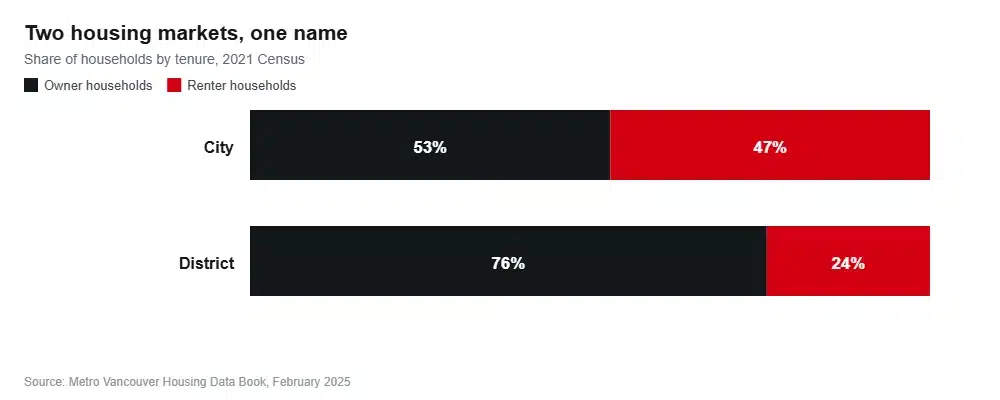
Nearly half the City rents. Three-quarters of the District owns. The City’s median household age is 42.0 and the District’s 44.4, and the City fits 58,120 people into 11.83 square kilometres while the District spreads 88,170 across 160.66. One is a small dense city. The other is a set of mountain suburbs with a shoreline.
City of North Vancouver
Lower Lonsdale
The City’s biggest and fastest-changing neighbourhood, running from the water up to 3rd Street. Transit here is the best on the North Shore by a wide margin: the SeaBus leaves Lonsdale Quay every ten minutes at peak and reaches Waterfront in twelve, where the Expo Line, Canada Line and West Coast Express all meet in one building. The R2 RapidBus stops here too.
Best for anyone who works downtown and does not want a car. The trade-off is density, construction and the highest renter share in either municipality.
Central Lonsdale
The mixed-use spine around 17th to 21st, and where Lions Gate Hospital sits. It had the highest concentration of seniors of any City neighbourhood in the last count that measured it, which tells you something about walkability and services. Frequent buses run down Lonsdale to the Quay.
Best for people who want shops and a hospital within walking distance without living on the waterfront.
Moodyville
The most interesting small planning story in either municipality. In 2016 the City rezoned the blocks between East 1st and East 5th, Ridgeway to St David’s, to allow townhouses, stacked townhouses and low apartments at three and four storeys. Buildings there have to hit an advanced energy standard, with triple glazing, continuous air barriers and heat exchangers, and the rules bend where a builder is going for Passive House.
Best for buyers who want new, efficient, ground-oriented housing near the Quay. One catch: a good deal of it is still a building site.
Grand Boulevard
Heritage housing around the green corridor that gives the area its name. In the City’s own neighbourhood profile it stood out as the one place where the share of children was rising rather than falling.
Best for families who want a City address with a detached house and a park in the middle of it.
Mahon, Tempe, Westview, Marine-Hamilton and Cedar Village
Small pockets of a few thousand people each. Tempe recorded the highest average family income in the City and the fewest people moving in or out. Westview had an ownership rate around 80 per cent. Cedar Village had the highest share of children and the smallest population to spread it across. Those figures come from a 2006 base, so treat them as character rather than current data.
District of North Vancouver
Lynn Valley
One of four centres the District has designated to take almost all of its growth, with 1,220 units approved between 2011 and 2022. A town centre, a library people go out of their way to see, and Lynn Canyon at the top of the road. Argyle Secondary, one of the district’s three French Immersion high schools, is here.
Best for families who want trees and a real centre. Transit is a local bus down to Lonsdale and nothing faster.
Lynn Creek, which everyone calls Lower Lynn
The District’s largest growth area by a distance, with 2,253 units approved over the same period, and its best-connected one. Phibbs Exchange sits next door and the R2 RapidBus runs through it. From 7 September 2026 that route reaches all the way to Metrotown as a one-seat ride, every six or seven minutes, which changes the commuting maths for this corner of the North Shore.
Best for commuters who want new stock and do not need a detached house.
Lions Gate Village, or Lower Capilano
The District’s western growth centre, closest to the Lions Gate Bridge and Park Royal, with 1,472 units approved since 2011. Contested, too. A proposal at 1634 and 1748 Capilano Road would put 478 purpose-built rental homes into a 37-storey tower plus a twelve-storey hotel, and it advanced to public hearing over the objection of the mayor, who noted on the record that residents had been told the site would top out at 18 storeys.
Best for people who want to be near the bridge and the mall, and who are comfortable buying into an area whose scale is still being argued about.
Maplewood
Eighty hectares along Dollarton Highway turning from industrial to mixed use. At full build-out the plan runs to roughly 1,500 homes with about a third below market, 4,500 jobs across a million square feet of new business space, and 14 hectares of expanded light industrial land. Only 501 units were approved through 2022, so most of this is ahead rather than behind.
Worth knowing what it costs: the plan removes 250 older purpose-built rental units and 16 hectares of trees. Best for people who want to buy early into a place that will look different in ten years.
Edgemont
The village everyone mentions, and the honest thing to say about it is that the District has decided it will not change. Edgemont is designated an “other” village centre rather than a growth centre, and it does not appear as a separate line in the District’s own development tracking at all. Every District unit approved outside the four growth centres between 2011 and 2022 came to 1,629 across the whole municipality.
So the character is protected by policy, and the scarcity is structural. That is why it is expensive and why so little comes up. Handsworth Secondary, another French Immersion school, is the catchment.
Deep Cove
Prettiest address on the North Shore and the one with the most documented downside. In a 2023 District survey, 89 per cent of 653 respondents agreed that parking needed managing differently, and 93 per cent recognised high demand against low supply near the popular spots.
Council acted in 2024. Of 910 on-street spaces, roughly 770 of which had been unrestricted, 350 became resident-only, 280 became time-limited with a resident exemption and 110 became time-limited for anyone. Permits cost $35 a year, two per household plus a visitor pass, generally enforced 8am to 8pm. Panorama Drive, Caledonia Avenue, Eastleigh Lane and Banbury Road are resident-only year round.
Best for people who genuinely want the water and the trailheads on their doorstep and accept that their street is a destination every summer weekend.
Parkgate and Seymour, Blueridge, Pemberton Heights, Norgate
Quieter residential District areas with no growth allocation and no rapid transit. Parkgate has a village centre and Windsor Secondary, the third French Immersion high school. Blueridge sits against the Berkley escarpment, which matters for a reason covered below. Pemberton Heights and Norgate are the District’s named neighbourhoods that are not centres at all.
Best for people who want space and quiet and have accepted that they will drive.
Where the growth is actually going
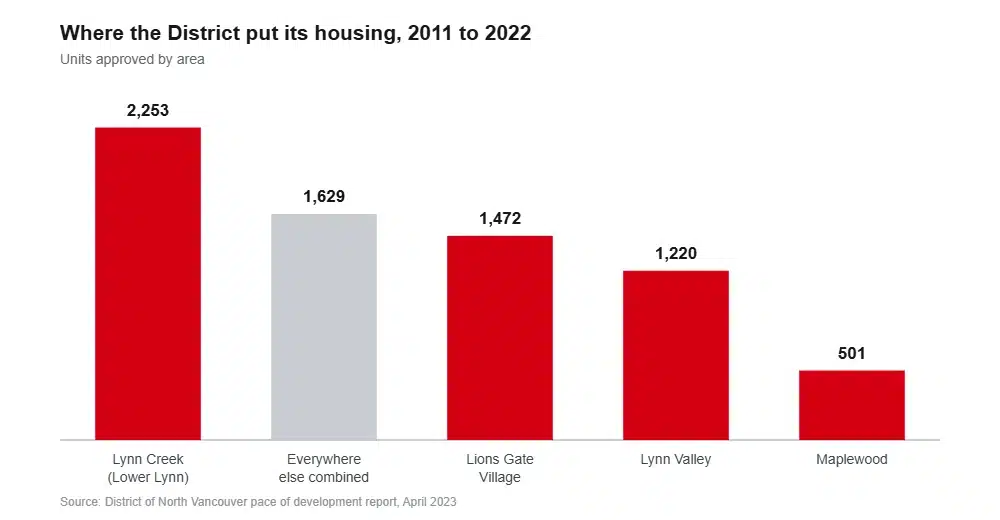
Four centres took 83 per cent of everything approved over a decade. The District’s updated official community plan, approved in December 2025, keeps that pattern and targets 22,369 new homes by 2041. If you want a neighbourhood that will look the same in fifteen years, the chart tells you where to look. Chasing new stock and better transit instead? Same chart, other end.
Which bridge you will be using
This is the most useful practical distinction in North Vancouver and almost nobody writes it down. There are two road crossings off the North Shore, and where you live decides which one you are stuck with.
East District areas, meaning Maplewood, Seymour, Blueridge, Deep Cove and Lynn Creek, funnel to the Ironworkers Memorial. Western areas, meaning Norgate, Lions Gate Village, Edgemont and Pemberton Heights, head for Lions Gate. Lower Lonsdale residents can skip both and take the SeaBus.
The Ironworkers carried 130,700 vehicles a day in 2025 across six lanes, which is 21,800 per lane, the heaviest per-lane load of any crossing in the region and six per cent above 2019. The Lions Gate carried 56,600 across three lanes and is down six per cent. Neither has had a lane added since 1968.
Schools, and a clean split
One school district covers both municipalities. There is a tidy way to think about the difference for families.
All three French Immersion secondary schools are in the District: Argyle in Lynn Valley, Handsworth near Edgemont and Windsor at Parkgate. Commit to immersion through Grade 12 and you are effectively choosing a District catchment. The International Baccalaureate anchor runs the other way. Carson Graham in the City delivers the Middle Years Programme to every student in Grades 8 to 10, not by application, with the Diploma Programme in Grades 11 and 12.
On capacity, the district’s five-year capital plan asks for expansions clustered in central North Vancouver and around Lynn Creek and Seymour, which is exactly where both municipalities are directing housing. The plan takes Carson Graham from 1,100 places to 1,400, Sutherland from 950 to 1,150, Seymour Heights from 250 to 525 and Lynnmour from 250 to 450.
The slope question
A 2010 engineering review for the District assessed nine escarpment areas after the 2005 Berkley landslide. Most sites came back inside the District’s acceptable risk range, but the practical consequence is real: parts of Blueridge, Riverside, Westlynn, Pemberton Heights, Capilano River East and the Mosquito Creek escarpment sit inside slope hazard development permit areas, which constrain what can be built and can require a geotechnical report.
This is not a reason to avoid the District. Read the schedules attached to a specific property instead before you fall in love with the view.
Frequently asked questions
What is the nicest neighbourhood in North Vancouver?
Depends entirely on what you are optimising for. Edgemont and Deep Cove for village character, Lower Lonsdale for transit and walkability, Lynn Valley for family space with a real centre, Grand Boulevard for a heritage house on a City lot.
Is Deep Cove part of the City of North Vancouver?
No. Deep Cove sits in the District, as do Edgemont, Lynn Valley, Blueridge, Norgate, Parkgate and Pemberton Heights. The City is the Lonsdale corridor and the blocks around it.
Which North Vancouver neighbourhood has the best transit?
Lower Lonsdale wins without much competition, on the strength of a twelve-minute SeaBus running every ten minutes at peak. Lynn Creek is second, on the R2 RapidBus and Phibbs Exchange.
Is SkyTrain coming to the North Shore?
Nothing is funded. Rapid transit across Burrard Inlet has been studied since 2018 and the Lonsdale to Waterfront alignment keeps scoring best on ridership, but there is no committed project. The concrete improvement is the R2 RapidBus extension to Metrotown.
Where is the cheapest place to live in North Vancouver?
Nobody publishes prices by neighbourhood, so any specific answer is guesswork. Defensible instead: the City has lower assessed values than the District on the 2026 roll, $1,937,000 against $2,056,000 for a typical detached home and $820,000 against $928,000 for typical strata, and apartments are concentrated in the City.
How we put this together
Area names come from the City’s own community profile and official community plan and from the District’s 2025 plan update materials. Development figures come from the District’s pace of development reporting, prices from Greater Vancouver Realtors, demographics from Metro Vancouver’s housing data book, transit facts from TransLink and schools from School District 44.
Three things we would not do. We have not published neighbourhood-level prices, because no primary source publishes them. No visitor count for Quarry Rock or Deep Cove appears here, because the District’s own documents contain attitudes rather than counts. And the City’s only neighbourhood-level demographic profile rests on a 2006 census base, so those figures appear here as character notes rather than current data.
Sources
- City of North Vancouver community profile by neighbourhood
- City of North Vancouver Official Community Plan
- District of North Vancouver, Official Community Plan update materials, 2025
- District of North Vancouver, pace of development report, 2011 to 2022
- City of North Vancouver, Moodyville development guidelines
- District of North Vancouver, Deep Cove parking review engagement report
- District of North Vancouver, Deep Cove parking
- Metro Vancouver Housing Data Book, February 2025
- TransLink, SeaBus schedules
- TransLink, R2 Marine Willingdon RapidBus
- School District 44, French Immersion
- School District 44, five-year capital plan
- BGC Engineering, District of North Vancouver landslide risk summary
- Greater Vancouver Realtors MLS Home Price Index statistics
Narrowed it down to two or three? Our read on what the crime numbers actually say covers the City and District separately, and the cost breakdown does the same for tax, rent and utilities. When you have picked one, tell us where you are moving from.
