

Richmond gives you something almost nothing else in Metro Vancouver does: a rapid transit line to downtown in around 25 minutes, an international airport on your doorstep, farmland inside the city limits, and a food scene that people drive across the region for. By most measures it is also the most diverse city in the country, with 60.3% of residents born outside Canada.
And it sits on a river delta at roughly sea level, behind 49 kilometres of dikes, which is the part most guides mention in a sentence and then move past. This one does not, because it is the single most consequential thing about buying property here.
Who lives here: 241,375, and 60% born abroad
The 2021 census counted 209,937 residents. The city’s own current estimate, built from that count plus building permits, is 241,375. Growth between 2016 and 2021 ran at 5.9%, or a little over 1% a year, which is moderate for the region.
Immigrants make up 60.3% of the population on 2021 census data, and Richmond is widely reported as having the highest immigrant share of any large Canadian municipality. Between 2016 and 2021 the city took in 13,705 recent arrivals, fourth-highest among Metro Vancouver’s seventeen municipalities.
Worth noting on all of these: the 2026 census was taken in May 2026, but population counts are not released until 10 February 2027. Any “2026 population” figure you see quoted for Richmond right now is an estimate, not a count.
Flood risk, explained properly
Most of Richmond is built on the Fraser River delta at or near sea level, and the dike system is what keeps it dry. This is manageable and managed. It is not something to discover after you have an accepted offer.
The current position, from the city’s own flood protection programme:
| Item | Current | Planned |
|---|---|---|
| Dike length | 49 km | n/a |
| Dike crest elevation | 3.5 m | being raised to 4.7 m |
| Design standard | 1-in-500-year flood event | n/a |
| Timeline for the raise | n/a | roughly 50 years, accelerated by council |
Richmond plans against one metre of sea level rise by 2100 on provincial guidance, plus a further 0.2 metres of local land subsidence, with roughly 50 centimetres expected by 2050.
The 2026 budget put $33.6 million into flood protection out of a $245.7 million capital programme across 89 projects, and North and South dike upgrade projects are both in public engagement this year. One recent example gives the scale: the No. 3 Road South drainage pump station and dike elevation project came to about $13 million across federal, provincial and city contributions, and protects around 29,000 residents, 50 businesses and eight square kilometres of farmland.
What this means for a buyer is concrete. Richmond has a floodplain designation bylaw, and new construction is subject to flood construction levels, which set how high the habitable floor must sit. Before you commit to an address, ask for its flood designation, ask what the flood construction level is for that lot, and check what your insurer will write. Those three questions take a day and they are the difference between an informed purchase and a surprise.
Housing: detached down 9% year over year
Richmond’s market softened through 2026, in line with the region.
| Property type | Benchmark price | Change year over year |
|---|---|---|
| Detached | $1,933,000 | −9.0% |
| Townhouse | $1,025,100 | −7.2% |
| Apartment | $649,000 | −8.1% |
Benchmark prices, June 2026. Source: Greater Vancouver REALTORS. A more recent month is published monthly, so check the current package before making a decision on these.
BC Assessment’s 2026 roll shows the same direction: the typical detached home assessed at $1,745,000, down 8% from $1,890,000, and the typical strata unit at $735,000, down 6% from $784,000. Both reflect market value as of 1 July 2025.
On the rental side, CMHC’s October 2025 survey put the average rent across all unit types in its Richmond zone at $1,887, with a median of $1,868 and a vacancy rate of 3.1%. Bedroom-by-bedroom averages for Richmond specifically are not published at that geography, so treat the all-unit figure as an indication rather than a quote for a one-bedroom.
City property tax went up 3.04% for 2026, roughly $71 a year on an average residential property.
Canada Line: airport to downtown in 25 minutes
The Canada Line runs from Richmond to downtown Vancouver and to the airport, with stations through the city centre and out to Sea Island, operating from about 5am to 1am. Airport to downtown is quoted at around 25 minutes, and a trip from central Richmond is comparable.
Current TransLink adult fares, effective 1 July 2026:
| Fare | One zone | Two zones | Three zones |
|---|---|---|---|
| Compass stored value | $2.85 | $4.20 | $5.40 |
| Adult monthly pass | $117.20 | $156.70 | $211.65 |
Bus and HandyDART trips are charged as one zone at all times. A Canada Line trip downtown crosses a zone boundary, so check TransLink’s zone map for your own station before budgeting a pass.
By road, Richmond connects north to Vancouver over the Oak Street, Knight Street and Arthur Laing bridges, and south to Delta through the George Massey Tunnel. That tunnel is being replaced, and the project has moved: the estimated cost now sits around $8.5 billion, the province replaced the original consortium in June 2026 and split the work into five contracts, major construction is targeted to begin in 2027, and opening has slipped to around September 2031. Those figures come via reporting on provincial numbers rather than a ministry document, so treat the timeline as indicative.
Living beside an international airport
Vancouver International handled 26.9 million passengers in 2025, up 2.7%, along with 365,000 tonnes of cargo, and the airport authority puts its contribution to national GDP above $15 billion a year. For a lot of Richmond residents that is the employer.
That also means aircraft noise, and the airport takes the question seriously enough to publish a noise management plan, a guide written specifically for homebuyers and owners, and live flight tracking with noise monitoring. Use them. Which parts of Richmond sit under approach paths is exactly the sort of thing that is obvious on a contour map and invisible on a viewing.
Schools: District 38, and where to check a catchment
Richmond is served by School District 38. For results, the Fraser Institute published its most recent report card on BC elementary schools on 3 September 2026, rating schools out of ten, and that is the place to look your catchment up rather than relying on reputation.
No current secondary school ratings exist for any BC school. The Fraser Institute stopped publishing its BC secondary report card after the province changed its high school assessments, so any high school score you find quoted for Richmond is years out of date.
A $1.96 billion hospital rebuild, midway through
Richmond Hospital is midway through a redevelopment worth about $1.96 billion across four phases, funded mainly by the province with contributions from Vancouver Coastal Health and the hospital foundation.
The new Yurkovich Family Pavilion adds 113 beds, expands the emergency department from 62 to 86 treatment spaces, takes operating rooms from eight to eleven, and adds three CT scanners and a second MRI. Phase two construction was expected to begin in 2026 for completion in 2029. Costs on this project have risen substantially from earlier estimates, so check the health authority’s project page for the current figure before relying on it.
Safety: good, but not the region’s safest
Richmond does well here, and the numbers support the reputation without quite making it the safest large city in the region.
In the 2024 provincial policing report Richmond recorded 13,798 Criminal Code offences across a population of 242,965, a rate of 57 per 1,000. Level with Burnaby, below Vancouver at 60 and New Westminster at 61, and above Surrey at 53. Richmond manages it with 292 officers at $325 per resident, roughly half Vancouver’s cost per head.
We have worked through the Richmond crime statistics separately if you want the detail.
Farmland, and why it shapes the city
Around 39% of Richmond’s land area sits in the Agricultural Land Reserve, roughly 4,993 hectares. That is why a city of a quarter of a million people still has working farms and cranberry bogs inside its boundary, and why development pressure concentrates so heavily into the City Centre around the Canada Line.
Richmond adopted a targeted update to its Official Community Plan on 9 February 2026, replacing conventional zoning with five neighbourhood types, allowing low-rise apartments and townhouses along arterial roads, and enabling compact transit-oriented development. If you are reading older advice about what can be built where, it is out of date.
The case for and against
Works well if: you want rapid transit and airport access, you value the food and the cultural mix, you work at or around YVR, or you want an apartment in a walkable city centre rather than a car-dependent suburb.
Works badly if: you are uneasy about floodplain living, you want a detached house on a modest budget, since the benchmark ran to $1.93 million, or you need quiet skies.
Comparing across the region, we have the same treatment for the North Shore and a provincial overview in our comparison of BC communities.
Moving to Richmond
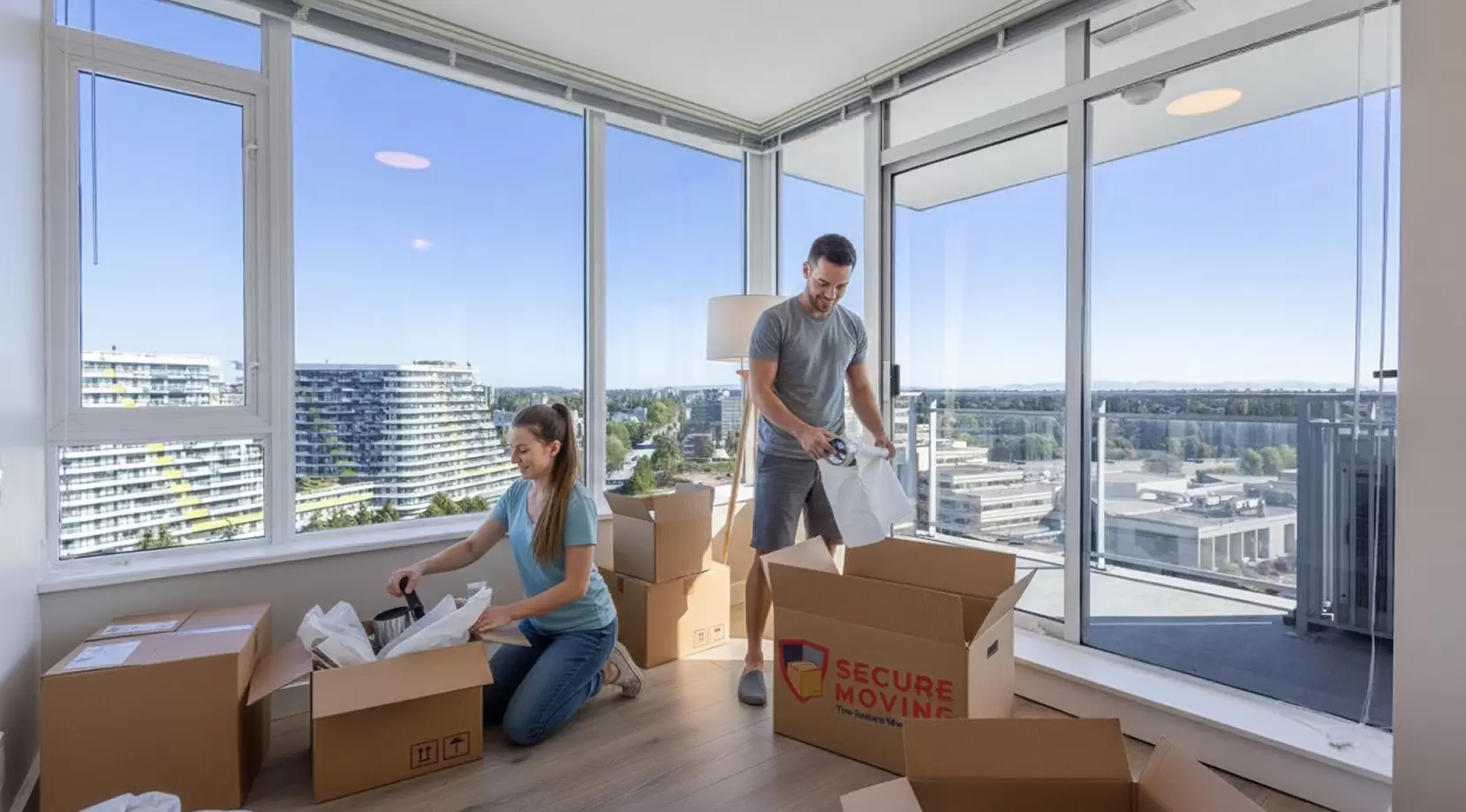
Two things about Richmond moves catch people out. City Centre towers run on booked elevators and loading bays with height limits, so the building’s rules decide your schedule more than the distance does. And the bridges and tunnel are the only ways in, which makes timing around the Massey Tunnel worth more than an early start.
Our residential moving checklist covers the sequencing. Our Richmond team can quote your address, our Burnaby crews handle the cross-region runs, and you can see everywhere we work. We cover it all as a Vancouver moving company.
Frequently asked questions
Is Richmond BC a good place to live?
For people who want transit, airport access and the country’s most diverse food scene, it is one of the strongest options in Metro Vancouver. Trains reach downtown in around 25 minutes, and 60.3% of residents were born outside Canada. The trade-offs are floodplain geography, aircraft noise in parts of the city, and a detached benchmark price of $1,933,000 as of June 2026.
Does Richmond BC flood?
Richmond sits on the Fraser delta at or near sea level, protected by 49 km of dikes built to 3.5 m and designed for a 1-in-500-year event, now being raised toward 4.7 m. The city plans against one metre of sea level rise by 2100 plus 0.2 m of subsidence, and put $33.6 million into flood protection in its 2026 capital budget. New construction is subject to flood construction levels, so ask for the designation and the required floor height for any specific address.
Is Richmond expensive compared with nearby cities?
Expensive, though prices fell through 2026. The June 2026 benchmarks were $1,933,000 detached, $1,025,100 townhouse and $649,000 apartment, each down 7% to 9% year over year. Average rent across all unit types in CMHC’s Richmond zone was $1,887 in October 2025, at 3.1% vacancy.
Is Richmond BC safe?
Comparatively, yes. The 2024 provincial policing report recorded 57 Criminal Code offences per 1,000 residents in Richmond, level with Burnaby, below Vancouver and New Westminster, above Surrey. Richmond also polices at $325 per resident against Vancouver’s $606.
How long does it take to get from Richmond to downtown Vancouver?
About 25 minutes on the Canada Line, which runs from roughly 5am to 1am. The trip crosses a fare zone boundary, so check TransLink’s zone map before buying a monthly pass, which costs $117.20 for one zone and $156.70 for two as of 1 July 2026.
