

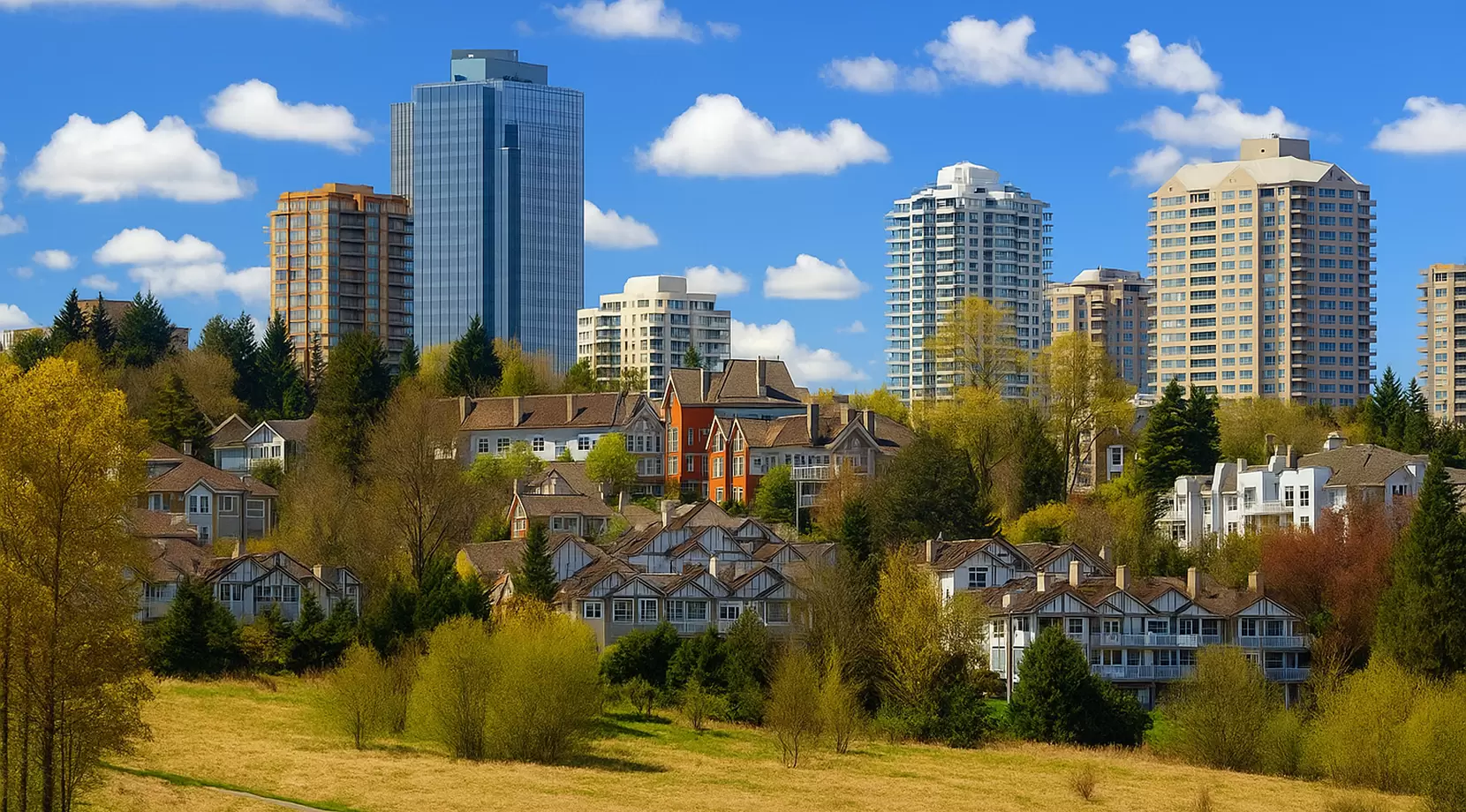
Burnaby is the rare Metro Vancouver city where you can buy a newer apartment above a SkyTrain station, walk to a lake the same afternoon, and still be twenty minutes from downtown Vancouver. Just under 250,000 people live here, making it British Columbia’s third-largest city, and the density is concentrated into four town centres rather than spread evenly.
Two things changed this year that anyone moving here should know about. Burnaby replaced its 1965 zoning bylaw on 1 July 2026, which resets what can be built on a single-family lot and near a station. And the long-promised Burnaby Hospital expansion delivered its first phase in the spring, then had its second phase paused in the provincial budget.
Three housing markets, not one
The city is reported as three separate real estate areas, and the gap between them is real money. Anyone quoting you a single “Burnaby benchmark price” is averaging three different markets.
| Area | Detached | Townhouse | Apartment |
|---|---|---|---|
| Burnaby East | $1,694,900 (−13.8%) | $852,700 (−4.4%) | $707,600 (−7.7%) |
| Burnaby North | $1,816,500 (−10.2%) | $888,200 (−5.3%) | $669,700 (−7.3%) |
| Burnaby South | $1,887,800 (−10.2%) | $933,600 (−7.4%) | $731,500 (−7.1%) |
Benchmark prices, August 2026, with the change against August 2025. Source: Greater Vancouver REALTORS.
Every category is down year over year, and detached homes are down by double digits in all three areas. That is the story of Burnaby’s 2026 market: a softening one, not a rising one.
BC Assessment’s 2026 roll points the same way, with the typical detached home assessed at $1,959,000, down about 4% from $2,044,000, and the typical strata unit at $706,000, down about 4% from $732,000. Those reflect market value as of 1 July 2025, so use them for your tax bill rather than for an offer.
CMHC surveys Burnaby as three rental zones
CMHC surveys Burnaby as three zones rather than one city, and average rents across all unit types in its October 2025 survey came out at $1,958 in the Central Park and Metrotown zone, $1,847 in North Burnaby and $1,641 in Southeast Burnaby.
Vacancy is where it gets uncomfortable. The headline zone rates looked loose, at 5.6% in North Burnaby and 3.6% in the southeast, but CMHC flags both as low reliability. The figures it rates as very good are the bedroom-level ones, and they are tight: 0.5% vacancy for one-bedroom units in Southeast Burnaby, 0.7% for two-bedrooms, and 0.6% for three-bedroom-plus units in North Burnaby.
Read that as a functionally full market for family-sized rentals. CMHC suppresses most bedroom-by-bedroom rent averages at this geography, so a clean Burnaby-wide table by unit size does not exist.
Property tax up 2.9%, plus a 1.9% growth levy
Burnaby’s 2026 property tax went up 2.9%, adding about $61 to an average home, plus a separate 1.9% Growth Infrastructure Investment Levy worth about another $39.
On utilities, the city held the water charge flat for residents by drawing on reserves to absorb Metro Vancouver’s 6.4% wholesale increase, and raised the sewer charge 3.5%, around $26 a year for a house and $14 for a condo.
Two SkyTrain lines, four town centre stations
Two SkyTrain lines serve the city, the Expo and the Millennium, with town centre stations at Metrotown, Brentwood, Lougheed and Edmonds, plus Production Way–University for the bus connection up to SFU. No Metro Vancouver municipality outside Vancouver itself has more rapid transit coverage.
TransLink’s current adult fares, effective 1 July 2026 after an average 5% increase:
| Fare | One zone | Two zones | Three zones |
|---|---|---|---|
| Compass stored value | $2.85 | $4.20 | $5.40 |
| Adult monthly pass | $117.20 | $156.70 | $211.65 |
All bus and HandyDART trips are charged as one zone at any time and any distance. SkyTrain fares depend on how many zones the trip crosses, so check TransLink’s zone map for your own commute before you budget a monthly pass.
One project to understand correctly: the Millennium Line’s Broadway extension is under construction and now scheduled to open in autumn 2027, having slipped from an earlier target. It does not add stations in Burnaby. What it changes is the transfer, taking Burnaby riders further west along Broadway without changing trains.
The new zoning bylaw, and why it matters to a buyer
Burnaby adopted a new zoning bylaw on 9 June 2026, effective 1 July, replacing one written in 1965.
Two provisions change the ground under your decision. Small-scale multi-unit housing rules now allow three to six dwellings on lots that previously held one house, depending on lot size and transit proximity. And within 800 metres of a SkyTrain station, buildings of eight to twenty storeys are permitted under the province’s transit-oriented area rules, after the province declined Burnaby’s request to exempt Brentwood.
In practice: the quiet single-family street near a station is a less safe assumption than it was two years ago, and the supply of apartments around Brentwood, Metrotown, Lougheed and Edmonds is going to keep growing. Whether that reads as opportunity or as risk depends on whether you are buying to live in or to keep a view.
Schools: 41 elementary, eight secondary
Burnaby School District 41 runs 41 elementary and eight secondary schools for around 27,000 students.
The Fraser Institute published its most recent report card on BC elementary schools on 3 September 2026, rating schools out of ten on provincial assessment results. Look your catchment up there rather than relying on a neighbourhood reputation, and note that no current secondary ratings exist for any BC school: the Fraser Institute suspended that report card after the province changed its high school assessments, and has said it will not resume without provincewide testing. Any secondary score you find quoted is stale.
SFU on the mountain, BCIT’s largest campus
Simon Fraser University’s original campus sits on top of Burnaby Mountain, with the UniverCity residential community built alongside it. BCIT’s Burnaby campus is the institute’s largest, home to its Health Sciences Centre and a trades complex, and it opened Tall Timber student housing with 469 beds in autumn 2025. BCIT enrols more than 44,000 students across all campuses.
Having two major post-secondary institutions inside the city shapes the rental market, particularly around the mountain and near Production Way.
Healthcare, half-delivered
Burnaby Hospital’s redevelopment is the clearest example of why a relocation guide should give you dates rather than adjectives.
Phase one opened between February and March 2026: a new six-storey pavilion with 83 beds, new mental health, maternity and neonatal intensive care units, an expanded emergency department and additional operating rooms, at a cost of roughly $700 million.
Phase two has been paused. It would have added the Keith and Betty Beedie Acute Care Tower with 160 more beds and a BC Cancer centre, and was slated to start in late 2025 for completion in 2030. The province held it back in its 2026 budget, citing a projected deficit and slower capital spending. Burnaby’s mayor has publicly objected and called it a broken commitment, so treat this as live rather than settled.
The short version: Burnaby’s hospital is materially better than it was in 2025, and materially smaller than what was promised.
145 parks, and what the density buys back
Burnaby has 145 parks and about 3.5 hectares of parkland for every 1,000 residents, which is the trade-off the town centre towers pay for.
Burnaby Lake sits near the geographic centre of the city, run by Metro Vancouver rather than the city itself. Deer Lake carries the art gallery, the village museum and the summer concert site. Central Park is wedged against the Vancouver boundary beside Metrotown. Burnaby Mountain Conservation Area covers the slopes below SFU, and Barnet Marine Park reaches the inlet on the north side.
57 offences per 1,000, below Vancouver
Burnaby recorded 57 Criminal Code offences per 1,000 residents in the 2024 provincial policing report, below Vancouver and New Westminster, level with Richmond, above Surrey and Coquitlam. Violence has been falling and property crime, shoplifting above all, has been rising. We work through what those measures do and do not show, and why no official source ranks Burnaby’s neighbourhoods, in our read on the Burnaby crime numbers.
The case for and against
Works well if: you want rapid transit without Vancouver prices, you are buying an apartment or townhouse rather than a detached house, you want parks and lakes inside the city, or you work or study at SFU or BCIT.
Works badly if: you need a detached house on a budget, since even the cheapest of the three areas benchmarks at $1.69 million; you want a single-family street guaranteed to stay that way; or you are moving for the hospital expansion that has been paused.
If you are comparing across the region, we have the same treatment for North Vancouver and Maple Ridge, an area breakdown for New Westminster, and a provincial overview in our comparison of BC communities. For what it costs month to month, see our Burnaby cost of living breakdown.
Moving to Burnaby
Most moves into Burnaby end at a tower, and towers have rules: a booked elevator, a loading bay with a height limit, a window of hours the strata will allow. Getting that wrong costs a day.
Timing matters too, and our guide to when to book a move covers the seasonal and month-end pressure. Our Burnaby movers know which buildings need what, and as a moving company in Vancouver we run the region daily.
Frequently asked questions
Is Burnaby a good place to live?
For apartment and townhouse buyers who want rapid transit and parks without Vancouver prices, yes. There are two SkyTrain lines, 145 parks, and both SFU and BCIT inside the boundary. The weak points are detached house prices, which benchmark between $1.69 million and $1.89 million depending on the area, and a hospital expansion whose second phase was paused in the 2026 provincial budget.
How much does a house cost in Burnaby?
It depends which of the three reported areas you are in. In August 2026 the detached benchmark was $1,694,900 in Burnaby East, $1,816,500 in Burnaby North and $1,887,800 in Burnaby South, all down by more than 10% year over year. Apartments ran between $669,700 and $731,500.
What are the best areas to live in Burnaby?
Brentwood and Metrotown for towers, shopping and the shortest SkyTrain trips. Burnaby Heights and Deer Lake for established streets. The Burnaby Mountain area for anyone connected to SFU. Under the zoning bylaw that took effect on 1 July 2026, expect more density within 800 metres of any station, so check what is permitted next door before you buy for a view. Our area-by-area guide to Burnaby’s neighbourhoods goes through each of them.
Is it cheaper to live in Burnaby than Vancouver?
On housing, yes, though less than it used to be. Burnaby’s apartment benchmarks sat between $669,700 and $731,500 in August 2026. Transit costs the same across the region, with an adult monthly pass at $117.20 for one zone and $156.70 for two, effective 1 July 2026.
How long is the commute from Burnaby to downtown Vancouver?
Both the Expo and Millennium lines serve the city, with stations at Metrotown, Brentwood, Lougheed, Edmonds and Production Way–University, so most trips downtown are a single ride of roughly 20 to 30 minutes depending on the station. The Broadway extension opening in autumn 2027 adds no Burnaby stations but shortens westbound trips past Commercial–Broadway.
