

Last updated: August 2026
If you search Abbotsford and crime, you’ll hit two stories that contradict each other. One is that Abbotsford was Canada’s murder capital. The other is that it’s a quiet Fraser Valley city where people move to raise kids.
Both are true. They’re just fifteen years apart.
Here’s the actual data, where it comes from, and the parts of the picture that no dataset covers.
The short answer
Abbotsford’s Crime Severity Index was 95.5 in 2025, down 1% on the year before.
For context, in the same year:
| Crime Severity Index, 2025 | |
|---|---|
| Canada | 75.0 |
| Vancouver | 83.5 |
| Abbotsford–Mission | 95.5 |
| British Columbia | 92.4 |
| Nanaimo | 106.0 |
| Kelowna | 103.7 |
| Kamloops | 126.2 |
| Chilliwack | 134.3 |
Source: Statistics Canada, police-reported crime, released 22 July 2026.
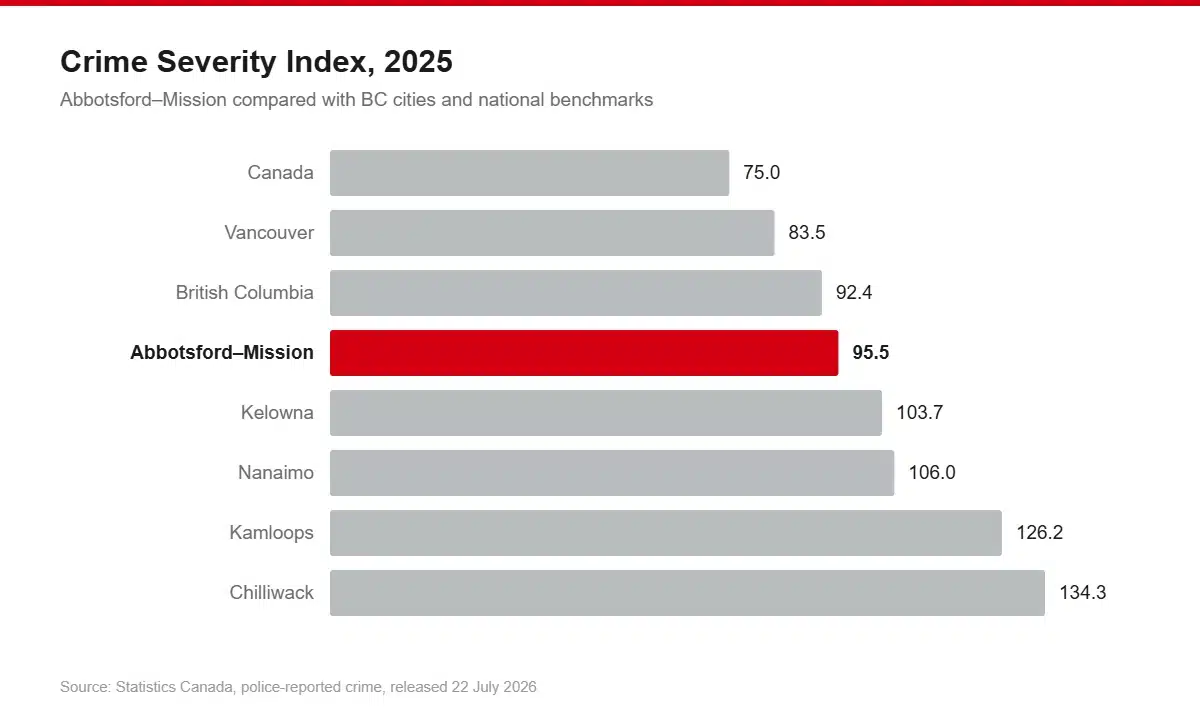
So: higher than the national average, roughly in line with BC as a whole, above Vancouver, and well below Kelowna, Kamloops and Chilliwack.
On raw crime rate rather than severity, Abbotsford–Mission recorded 6,717 incidents per 100,000 people in 2025, up 4% year over year. That’s below the BC rate of 6,943 and above the national rate of 5,585.
One important note on geography: Statistics Canada reports this at the level of the Abbotsford–Mission census metropolitan area, which includes Mission and the rural areas between. The Abbotsford Police Department’s own figure for the city alone was a CSI of 103 in 2024. Different boundary, different number, same order of magnitude.
What the Crime Severity Index actually measures
Worth understanding, because it gets misread constantly.
The CSI weights offences by seriousness. A homicide moves it far more than a bike theft. So a city can have a rising crime rate and a falling severity index at the same time, which is exactly what happened in Abbotsford–Mission in 2025: more incidents, less serious ones.
It’s also a comparative index, not a probability. A CSI of 95.5 doesn’t mean anything about your odds of being a victim. It means the total weighted volume of police-reported crime, per person, indexed against a 2006 national baseline of 100.
The gang violence years, and what changed
This is the part people actually remember, so let’s be direct about it.
Abbotsford was labelled Canada’s murder capital in 2008–2009. Across those two years there were 15 homicides, and the 2009 homicide rate hit 6.7 per 100,000. Abbotsford also had the highest property crime rate in Canada in 2006. The driver was organised crime competing over the drug trade.
Then it turned around, fast. Research from the University of the Fraser Valley’s Centre for Public Safety and Criminal Justice Research documents what followed:
- Abbotsford Police established a Gang Suppression Unit in 2010, working with the provincial anti-gang agency and targeting prolific offenders.
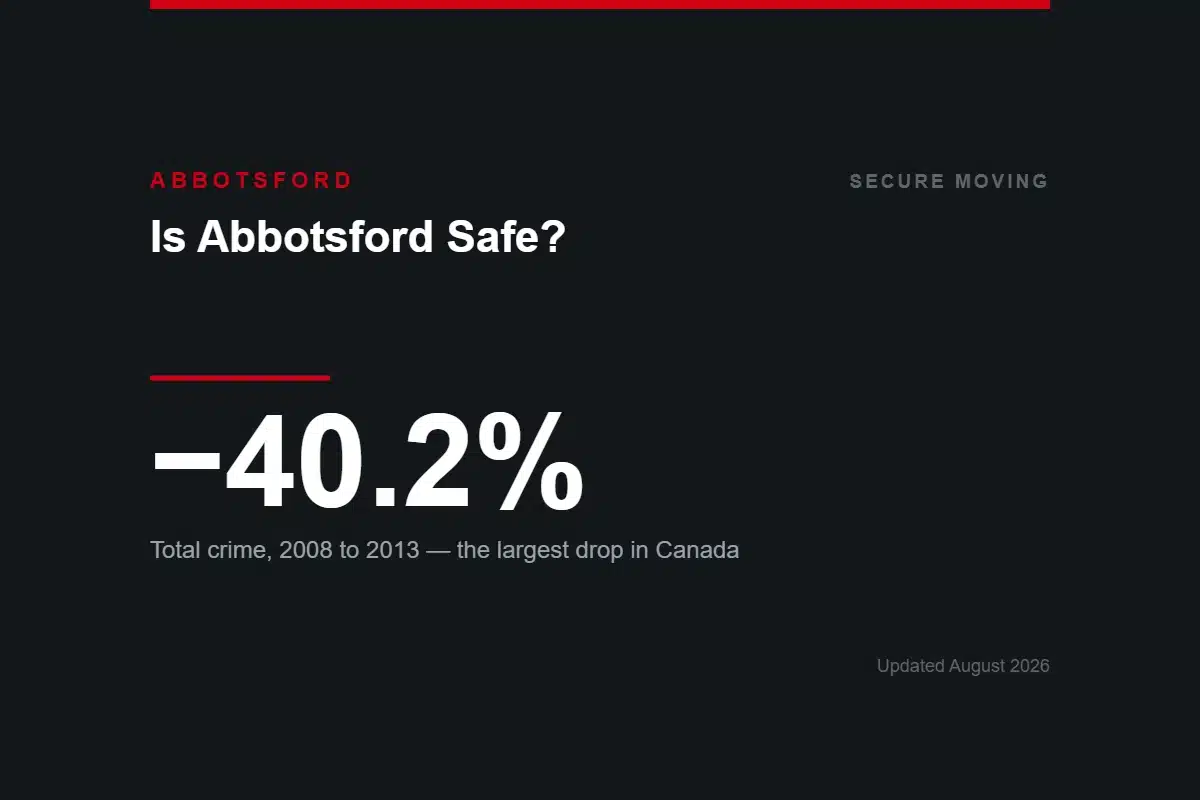
- Overall crime fell 40.2% between 2008 and 2013, the largest decline of any major Canadian municipality over that stretch.
- Property crime fell 49.6% from 2008 to 2012.
- 2011 was a murder-free year, with a homicide rate of 0.8 per 100,000.
- By 2012, Abbotsford’s crime rate sat 6.6% below the national average.
That’s not spin. It’s one of the more thoroughly documented crime reductions in Canadian policing, and it’s the reason the reputation and the reality drifted so far apart.
What’s happening right now
The current issue in Abbotsford isn’t gang shootings. It’s extortion.
Since November 2023 there have been nearly 90 extortion-related incidents in the city, ten of which involved shots fired. The majority were non-violent. The targeting has been concentrated in the South Asian business community, a pattern seen across Metro Vancouver and Surrey as well.
Abbotsford Police responded with Operation Community Shield in September 2025, a dedicated internal task force with experienced officers reassigned to it. It was followed by Project Disengage in December 2025, aimed at people being recruited into the violence. In the final quarter of 2025 alone that work produced 1,820 patrols and safety checks, 87 individualised safety plans, two arrests, and four files transferred to the provincial extortion task force, plus expanded camera coverage and automated licence plate recognition.
It appears to be working. In the first half of 2026 there were 14 extortion incidents, against 59 for all of 2025, and zero incidents of extortion-related violence.
The rest of the first-half 2026 picture, from the Police Department’s report to the Police Board:
| H1 2026 | Change vs H1 2025 | |
|---|---|---|
| Violent crimes | 1,151 | −5.3% |
| Property crimes | 3,174 | +1% |
| Impaired drivers | 552 | −16.4% |
| Fatal collisions | 2 | unchanged |
Violent crime down, property crime flat, impaired driving down sharply.
The honest caveat about neighbourhoods
Search “safest neighbourhoods in Abbotsford” and you’ll find confident rankings. Ignore them.
No credible source publishes Abbotsford crime statistics by neighbourhood. We checked:
- The Abbotsford Police Department’s annual reports for 2024 and 2025 contain no neighbourhood or district breakdowns.
- Statistics Canada publishes at the metropolitan-area and municipal level only.
- The City of Abbotsford publishes 20 community-area profiles covering population, income, education and housing, but not crime.
What does exist is the Abbotsford Police crime map at abbypd.ca/crime-mapping, which plots individual incidents from the past six months and updates nightly. You can filter by crime type and area and look at your own street.
Read the department’s own caveat before you draw conclusions from it, though. APD states that not all crime types appear on the map “because of privacy concerns,” and that it gives “an overview of the city’s crime picture, as opposed to a detailed and comprehensive account.”
The commercial sites that rank Abbotsford neighbourhoods by safety are modelling estimates, not police data. Several of them also confuse Abbotsford BC with Abbotsford, Wisconsin and Abbotsford, Australia. If you want a read on a specific street, use the APD map and then go stand on it at 9pm on a Friday.
What the numbers don’t cover
Two things worth naming honestly, because they shape how safe a place feels regardless of the CSI.
Homelessness has risen sharply. Abbotsford’s 2023 point-in-time count found 406 people experiencing homelessness, up from 333 in 2020 and 274 in 2017, a 247% increase since 2011. The regional report noted the rise “continues to outpace the increase in emergency shelter beds.” Notably, Abbotsford accounted for 37% of the regional count while holding 52% of the region’s population, so the city is not an outlier within the Fraser Valley. But visible homelessness is real here, concentrated in the city centre, and it’s what a lot of people are actually reacting to when they ask whether Abbotsford is safe.
Police response and staffing. APD had 233 sworn officers in 2025 with a Priority 1 average response time of 10 minutes 44 seconds. Whether that feels adequate depends a great deal on where in a 375-square-kilometre city you live.
So, is it safe?
If you want the number: Abbotsford sits somewhat above the Canadian average for crime severity, roughly at the BC average, and well below several comparable BC cities. Violent crime fell in the first half of 2026, and the extortion problem that dominated 2024 and 2025 has dropped dramatically this year.
If you want the judgement: Abbotsford in 2026 is an ordinary mid-sized Canadian city on crime, and the reputation it carries is fifteen years out of date. Property crime is the realistic risk for most residents: it’s what actually happens to people here, and it’s the one number that hasn’t improved. Lock your vehicle, don’t leave anything in it, and pay attention to garage and shed security.
That’s a much less dramatic answer than the one the internet gives you, but it’s the one the data supports.
Frequently asked questions
What is Abbotsford’s crime rate?
6,717 incidents per 100,000 people in 2025 for the Abbotsford–Mission area, up 4% on 2024. That’s below the BC rate of 6,943 and above the Canadian rate of 5,585.
Is Abbotsford’s crime getting worse or better?
Mixed, and it depends which measure. The crime rate rose 4% in 2025, while crime severity fell 1% — more incidents, less serious ones. In the first half of 2026, violent crime fell 5.3% and impaired driving fell 16.4%, while property crime was flat.
Is Abbotsford still Canada’s murder capital?
No. That was 2008–2009. Overall crime fell 40.2% between 2008 and 2013, the largest decline of any major Canadian municipality in that period, and 2011 was a murder-free year.
Which are the safest neighbourhoods in Abbotsford?
Nobody publishes that, and any site claiming to rank them is estimating. The Abbotsford Police Department’s crime map at abbypd.ca/crime-mapping shows actual reported incidents from the past six months and is the only reliable tool for looking at a specific area.
Is Abbotsford safer than Chilliwack or Surrey?
Safer than Chilliwack on crime severity, since Abbotsford–Mission was 95.5 in 2025 against Chilliwack’s 134.3. Vancouver was lower at 83.5. Statistics Canada doesn’t report Surrey as a separate metropolitan area, so there’s no clean like-for-like comparison.
The provincial crime table shows where Abbotsford sits against every other BC municipality.
None of this is a reason not to move here. When you’re ready, we can take care of the move to Abbotsford.
