

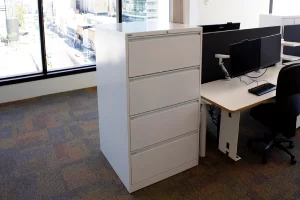
A loaded file cabinet is usually the heaviest single object in an office, and the least interesting to look at, which is why it is the thing that goes wrong.
Two problems run in parallel. The cabinet is heavy, awkwardly proportioned and full of parts that slide. And the contents are personnel files, client records and signed agreements, which are the only things in the office you genuinely cannot re-buy. This page handles both.
No manufacturer publishes a loaded weight
You will find pages that tell you a four-drawer lateral file weighs a specific number of pounds loaded. We went looking for that figure in the manufacturers’ own published specifications, from HON, Steelcase, Global and Teknion, and could not source a single published loaded weight from any of them. Every result was a reseller listing rather than the manufacturer. We also could not find a manufacturer-published figure for the weight of a full letter- or legal-size drawer of paper.
So rather than repeat a number with nothing behind it, here is what you can do in two minutes that is better than any average:
Weigh one drawer. Pull a full drawer out, put it on a bathroom scale, multiply by the number of drawers, and add the empty cabinet. That is your actual cabinet, not a notional one, and it is the number that decides whether this is a two-person lift or an equipment job.
What we can tell you from published sources is where the equipment tops out. Magliner, one of the main hand-truck manufacturers, publishes that all its hand trucks have a 500 lb capacity unless otherwise noted. Lifting straps go higher: Forearm Forklift publishes up to 800 lb, and Shoulder Dolly’s heavy-duty Pro Lift straps up to 1,000 lb. If your weighed figure approaches the first of those numbers, the answer is not a bigger effort, it is different equipment.
There is no legal lifting limit in BC, and that cuts both ways
Content citing “the WorkSafeBC lifting limit” turns up regularly. There isn’t one. Part 4 of BC’s Occupational Health and Safety Regulation, sections 4.46 to 4.53, sets out an ergonomics regime with no weight threshold and no numeric trigger anywhere in it. What it requires instead is that an employer identify the factors that may expose workers to musculoskeletal injury, assess the risk, and eliminate or minimise it, considering among other things the force required, the work postures, the size, shape and weight distribution of the object, the floor surfaces, and the working heights. Controls must be monitored and reviewed at least annually.
That is a more useful framework than a number would be, because a 90 lb cabinet down a tight stairwell is a worse risk than a 150 lb one across a flat floor, and a weight limit cannot express that. It is also the reason a professional crew turns up with equipment rather than more people.
Empty it, and know where the paper went
Empty every drawer. Not “most of it”, not “the heavy ones”. A partly loaded cabinet has a shifting centre of gravity, which is the specific condition in which a cabinet tips on a dolly.
Keep the filing order. The reason people leave files in a cabinet is to avoid re-sorting them, and that is a false economy. Pack drawer contents into banker’s boxes in order, one drawer per box where the volume allows, and label the box with the cabinet, the drawer number and the range it covers. Reloading then takes minutes.
Do not overfill the boxes. Paper is denser than almost anything else you will pack. A banker’s box of files that a person can comfortably lift is about two-thirds full, and a full one is a back injury waiting for a set of stairs.
The records part, which most guides skip entirely
If the cabinet holds employee records, client files or anything with personal information in it, the move is a custody question as well as a lifting question. A few practical habits, which are about discipline rather than law:
- Seal and label boxes so the contents are identifiable without being readable. “Accounts, 2023, A to F” on the outside; nothing on the outside that is itself sensitive.
- Keep a list of what went into which box, held by one named person.
- Do not leave loaded boxes or unlocked cabinets unattended in a lobby, a loading bay or an open truck.
- Lock the cabinets for transport once they are empty, and carry the keys separately from the cabinets.
- Account for every box at the far end before the crew leaves, against the list.
None of that is difficult. All of it is the difference between a move and an incident report.
Break it down where the cabinet lets you
Remove the drawers if they come out. Most vertical files release with a catch or a lever on the drawer slide; many lateral files do not, and forcing one damages the slide. If the drawers come out, the cabinet becomes two manageable problems instead of one unmanageable one, and the drawers travel flat and stacked.
If the drawers stay in, immobilise them. Stretch wrap around the whole body, or tape across the drawer fronts with a low-tack tape that will not lift the finish. A drawer that slides out on a stairway turns a controlled carry into a fall.
Watch for the interlock. Many lateral files have a mechanism that allows only one drawer open at a time, and some have a single lock that secures the whole stack. Find it and use it. It is there precisely because an open drawer on a tall cabinet is a tip-over.
A note on standards, since furniture tip-over gets discussed a lot: the tip-over standard that Health Canada has determined applies to free-standing clothing storage units, meaning dressers and the like, is scoped to units with at least 3.2 cubic feet of enclosed storage, and it does not cover office file cabinets. There is no mandatory tip-over standard we could find that does. Which means the safeguard is the interlock and your own habits, not a regulated design feature.
Wrap it, and protect the route
Blankets then wrap, in that order. Moving blankets take the impact; stretch wrap holds the blankets on and keeps the drawers shut. Wrap applied directly to a painted steel cabinet in warm weather can mark it.
Corners and edges take the damage. On a cabinet the vulnerable points are the top edges and the drawer-front corners, because those are what catch on a door frame.
Protect the doorway, not just the cabinet. Door jamb protectors, or a folded blanket taped to the frame at the pinch point. A cabinet that scrapes a jamb in a leased office is a deposit conversation.
Will it fit? Measure the narrow point
This is the question that actually decides the day, and most people measure the wrong opening.
The narrowest doorway the BC Building Code permits inside a dwelling is 610 mm, about 24 inches — bathrooms, walk-in closets and rooms off a 710 mm hallway. Other rooms are 760 mm and required entrances and stair openings are 810 mm. In commercial space the numbers are usually more generous, but a home office is a dwelling, and a converted bedroom off a narrow hallway is exactly where the 610 mm case shows up.
On stairs, the code figures are: required exit and public stairs in residential buildings not less than 900 mm wide; stairs serving a single dwelling unit not less than 860 mm; headroom not less than 2,050 mm, or 1,950 mm within a single dwelling unit. Vancouver’s own building by-law matches those stair figures.
Measure, in this order: the cabinet’s height, width and depth; every doorway on the route at its narrowest; the stairway width and the headroom at the turn; and the elevator car’s internal depth and door height. A five-drawer vertical file standing 60 inches tall will not go into a small elevator upright and has to be tipped, which is a different job.
Load them last, upright, strapped to the wall
- Cabinets go on last and come off first if they are going to the same floor, because they are the pieces you least want to carry over other people’s furniture.
- Load them against the truck wall, upright, strapped. A file cabinet is tall and narrow and will go over on a corner if it is freestanding in the box.
- Never stack anything heavy on top of a cabinet. The top panel is not structural on most of them.
- Keep drawers and cabinet bodies together if you separated them, ideally on the same load.
- Reassemble and check the drawers run before the crew leaves. A slide bent in transit is a five-minute fix on the day and a service call later.
Three honest reasons to hand it over
- Your weighed figure is over about 150 lb and there are stairs. Equipment and a trained pair beats effort.
- The drawers do not come out. A loaded-design lateral that cannot be broken down is a specialist carry.
- The contents are records you are accountable for. Then the value in a professional crew is the inventory and the chain of custody, not the lifting.
How Secure Moving handles cabinets
We assess the cabinets before quoting, which for a file-heavy office means counting cabinets and drawers rather than estimating square footage. We break down what breaks down, wrap and strap what does not, and put the drawer contents into labelled boxes in filing order so reloading is a short job rather than a week of re-sorting. At the far end we reassemble and check the slides.
Secure Moving carries $5 million in liability coverage and active WorkSafeBC registration. For an office move in the region, our team works as a moving company in Vancouver.
Where the cabinets are part of a wider office move, our guide to what a Vancouver move costs sets out what drives the quote, and our guide to moving heavy furniture up stairs covers the stairway part in more detail.
Frequently asked questions
How much does a file cabinet weigh?
We could not find a published loaded weight from any of the major manufacturers, so rather than quote an average: pull one full drawer, weigh it on a bathroom scale, multiply by the number of drawers and add the empty cabinet. That gives you your cabinet rather than a notional one. For context, Magliner publishes a 500 lb capacity for its hand trucks and lifting straps are rated to 800 or 1,000 lb depending on the model.
Should I empty a file cabinet before moving it?
Yes, every drawer. A partly loaded cabinet has a shifting centre of gravity, which is the condition in which cabinets tip on a dolly. Pack the contents into banker’s boxes in filing order, one drawer per box where volume allows, labelled with the cabinet and drawer number so reloading takes minutes.
Can you move a file cabinet with the drawers in?
Yes, if they do not come out, but they must then be immobilised — stretch wrap around the body, or tape across the drawer fronts with a tape that will not lift the finish. Also find the interlock, which many lateral files have to allow only one drawer open at a time. A drawer that slides out on a stairway turns a controlled carry into a fall.
Is there a legal limit on how much a mover can lift in BC?
No. BC’s Occupational Health and Safety Regulation sets out an ergonomics regime, in Part 4, with no weight threshold anywhere in it. The requirement is to identify, assess and control the risk of musculoskeletal injury, considering force, posture, the object’s size and weight distribution, floor surfaces and working heights, with controls reviewed at least annually. Any page citing a WorkSafeBC weight limit has invented it.
Will a five-drawer file cabinet fit in an elevator?
Measure the car’s internal depth and the door height first. Most five-drawer vertical files, at around 60 inches tall, have to be tipped to enter a small residential elevator, which is a different and riskier job than wheeling it in upright. Also measure the narrowest doorway on the route — the BC Building Code permits interior doorways as narrow as 610 mm, about 24 inches.
How do I protect confidential files during an office move?
Seal and label boxes so the contents are identifiable without being readable, keep a list of what went into which box held by one named person, never leave loaded boxes or unlocked cabinets unattended in a lobby or an open truck, lock the emptied cabinets and carry the keys separately, and account for every box against the list before the crew leaves.
