

Vancouver is more expensive than Toronto to rent or buy in. Toronto is more expensive to be taxed in, to buy a home in once you count closing costs, and to heat through the winter. Put it all together and the two cities are much closer than their reputations suggest, and which one costs you more depends mostly on whether you rent or buy, what you earn, and whether you have kids in daycare.
This comparison uses official 2025 and 2026 figures (CMHC, the two big real estate boards, provincial tax tables and the cities’ own budgets) rather than crowd-sourced cost-of-living sites. Where a number is an estimate or the two cities measure something differently, we say so.
Already decided on the move?
Secure Moving runs the Vancouver to Toronto route. Our Vancouver to Toronto movers page covers what the trip costs, how long it takes and how a cross-country move is scheduled.
The quick verdict
| Cost | Vancouver | Toronto | Cheaper |
|---|---|---|---|
| Asking rent, all units (Aug 2026) | $2,704 | $2,570 | Toronto, by about $134/month |
| Home prices | Higher | Lower | Toronto, especially for houses |
| Land transfer tax on a $900,000 home | $16,000 | $28,950 | Vancouver, by $12,950 |
| Income tax at $90,000 (2026) | $17,265 | $18,252 | Vancouver, by about $990 |
| Sales tax | 12% (5% on restaurant meals) | 13% HST | Vancouver |
| Transit, monthly | $117.20 (1 zone) to $248.50 (3 zones) | Capped at $155.10 | Depends where you live |
| Infant and toddler childcare (median, 2025) | $34/day | $22/day | Toronto |
| Heating demand | Lower | About 39% higher | Vancouver |
Rent: the gap depends on which rent you mean
There are three different “average rents” in each city, and most comparisons mix them up. They tell very different stories.
- Purpose-built rentals, all tenants (CMHC, October 2025). This is what people in long-standing rental buildings pay, including tenants who have been there for years. A two-bedroom averaged $2,363 in Vancouver and $2,034 in Toronto, a gap of $329 a month.
- Condo rentals (CMHC, October 2025). Two-bedroom condos rented for about $2,900 in both cities. Practically no difference.
- New-listing asking rents (Rentals.ca, August 2026). What you will actually see when you start looking. Across all unit types, $2,704 in Vancouver and $2,570 in Toronto, a gap of about $134 a month.
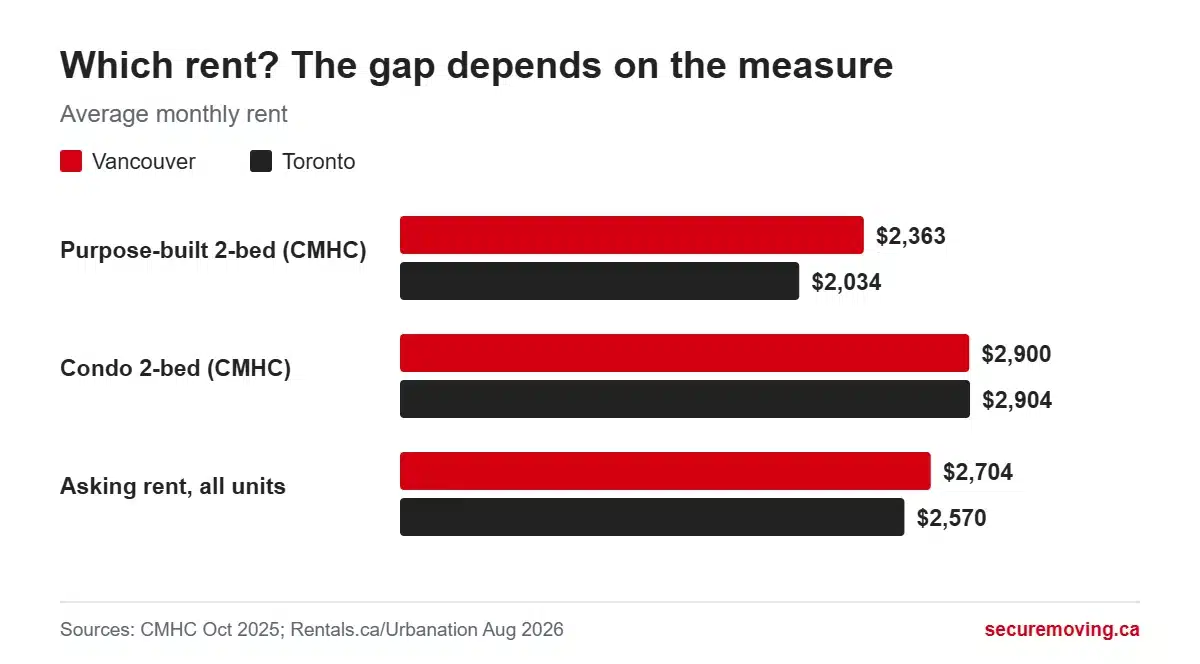
For someone moving between the cities, the asking-rent figure is the one that matters, because you will be signing a new lease at today’s prices. On that measure Vancouver costs roughly $1,600 a year more. Both cities’ asking rents are falling: Vancouver down 4.1 per cent over the year to August 2026 and Toronto down 1.4 per cent. Vacancy is the highest Vancouver has seen since 1988, at 3.7 per cent in purpose-built rentals, against 3.0 per cent in Toronto. Renters in both cities have more bargaining power than they did two years ago.
Buying a home
The two real estate boards publish different measures, so treat the comparison as directional. Greater Vancouver Realtors’ September 2026 benchmark prices were $1,784,700 for a detached house, $1,016,700 for a townhouse and $682,500 for an apartment. In the City of Toronto, the Toronto Regional Real Estate Board’s August 2026 average sale prices were $1,525,749 for a detached house and $651,648 for a condo apartment.
So a house in Vancouver costs noticeably more, roughly 17 per cent on these figures, while condos are much closer, around 5 per cent apart. Prices are falling in both cities: Vancouver’s composite benchmark was down 5.5 per cent year over year and Toronto’s down 4.5 per cent.
Land transfer tax: Toronto’s double hit
Here is the cost most comparisons miss entirely. Buyers in the City of Toronto pay Ontario’s land transfer tax and then Toronto’s municipal land transfer tax on top, at the same rates. BC has a single provincial property transfer tax with lower brackets.
| Purchase price | Toronto (Ontario + municipal) | Vancouver (BC PTT) | Difference |
|---|---|---|---|
| $900,000 | $28,950 | $16,000 | $12,950 more in Toronto |
| $900,000, first-time buyer | $20,475 | $16,000 | $4,475 more in Toronto |
| $1,300,000 | $44,950 | $24,000 | $20,950 more in Toronto |
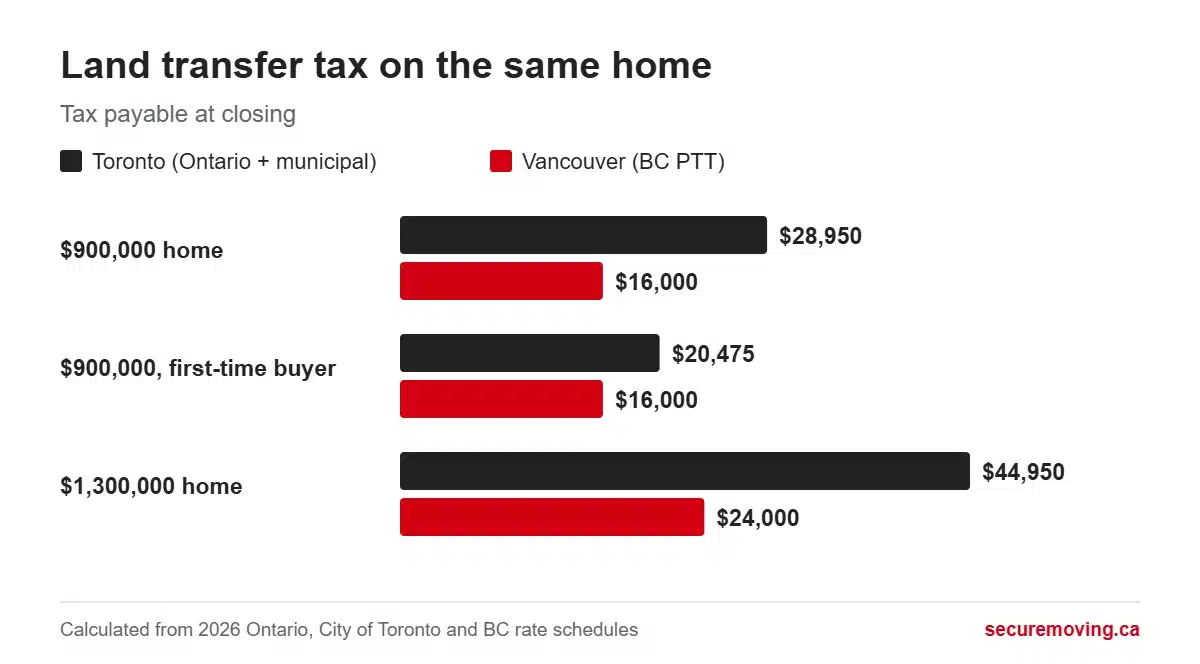
First-time buyers get rebates of up to $4,000 from Ontario and $4,475 from Toronto. BC’s first-time buyer exemption covers the tax on the first $500,000, but only for homes priced at $835,000 or less, with a partial exemption up to $860,000. Above that it disappears, which is why a first-time buyer at $900,000 in Vancouver pays the full $16,000.
Property tax
Vancouver’s 2026 residential tax rate is about $3.36 per $1,000 of assessed value, all authorities included. Toronto’s is about $7.67 per $1,000. That looks like a huge gap, but there is a catch: Toronto still assesses homes at their January 2016 values, while BC Assessment uses current values. The City of Toronto says the average 2026 bill is about $5,300. In Vancouver, a home at the September 2026 composite benchmark of $1,075,900 would pay roughly $3,600 before the provincial home owner grant. Typical homes come out lower in Vancouver, but a detached house there still pays more than most Toronto houses because of its much higher value.
Income tax: Ontario takes more at most incomes
BC raised its lowest income tax rate from 5.06 to 5.6 per cent for 2026, which narrowed the gap. Ontario still charges more at most salaries because of two things BC does not have: the Ontario Health Premium, which adds $600 to $900 a year, and a surtax on higher provincial tax bills.
| Employment income (2026) | BC total tax | Ontario total tax | Extra in Ontario |
|---|---|---|---|
| $60,000 | $8,805 | $9,207 | $402 |
| $90,000 | $17,265 | $18,252 | $987 |
| $150,000 | $38,223 | $41,416 | $3,193 |
These are federal plus provincial income tax for a single person with employment income only, after basic personal credits. CPP and EI are left out because they are almost identical in both provinces. Interestingly, Ontario’s base provincial tax is actually a little lower than BC’s at $60,000; it is the health premium and the surtax that tip the result.
Sales tax, everyday spending and transit
Ontario charges 13 per cent HST. BC charges 5 per cent GST plus 7 per cent PST, so 12 per cent on most things, and only the 5 per cent GST on restaurant meals because prepared food is exempt from BC’s PST. If you eat out a lot, that difference adds up: on $400 a month of restaurant bills, it is about $32 a month.
Prices also rose at different speeds over the past year. In July 2026, inflation ran at 3.0 per cent in Vancouver and 1.7 per cent in Toronto.
Transit is a closer call than it looks. Since 1 September 2026, the TTC no longer sells most monthly passes. Instead, rides are free after 47 paid fares in a calendar month, which caps spending at $155.10 at the $3.30 PRESTO fare. TransLink, after its July 2026 fare increase, charges $117.20 for a one-zone monthly pass, $176.50 for two zones and $248.50 for three. Living and working inside Vancouver, you will pay less than in Toronto. Commuting from Surrey or Coquitlam into downtown, you will pay considerably more.
Cars, heating and utilities
Car insurance is hard to compare fairly. ICBC does not publish an average premium, but BC’s basic rates are frozen until spring 2027, the seventh year without an increase, and the 2021 switch to Enhanced Care cut premiums by an average of $496. In Ontario, a 2026 quote study by the comparison site MyChoice put Toronto’s average at about $2,348 a year for a 35-year-old driver with a clean record. Get real quotes for your own car and record before you decide.
Heating is where Toronto’s climate shows up in the budget. Toronto Pearson records about 39 per cent more heating degree days than Vancouver airport, a standard measure of how much heating a building needs. Vancouver averages under 40 cm of snow a year, so winter tires and snow clearing are optional extras at the coast rather than necessities.
Electricity is priced so differently that a simple comparison is misleading. BC Hydro uses a two-step rate, with a cheaper first block, and Ontario uses time-of-use pricing with a 23.5 per cent provincial rebate. Both provinces ended their consumer carbon tax on fuel on 1 April 2025.
Childcare
Neither province has reached $10 a day across the board. Ontario capped licensed childcare fees at $22 a day and froze them for 2026. In BC, many centres charge $10 a day, but not all. The Canadian Centre for Policy Alternatives found median fees in April 2025 of $22 a day for infants and toddlers in Toronto against $34 a day in Vancouver, although 44 per cent of Vancouver’s preschool spaces were at $10 a day. For a family with a child under three, Toronto is likely to be cheaper unless you land a $10-a-day spot in BC.
What people earn
Costs only matter against income. The living wage, the hourly pay needed to cover basic local costs as calculated by Living Wage BC and the Ontario Living Wage Network, was $27.85 an hour in Metro Vancouver and $27.20 in the Greater Toronto Area in 2025, an almost identical bar. Pay in many jobs is also similar or higher in BC. Job Bank data, for example, puts the median wage for registered nurses at $47.58 an hour in BC against $42.00 in Ontario.
People are voting with their moving trucks. Between January and March 2026, 4,725 people moved from Ontario to BC and 3,164 went the other way, a net gain of 1,561 for BC. Ontario has lost people to other provinces for more than three years running.
So which city is cheaper for you?
- Renting a one or two-bedroom: Toronto, but only by around $100 to $150 a month at today’s asking rents. Income tax savings in BC claw back part of that at middle and higher incomes.
- Buying a condo: close. Vancouver’s apartment prices run slightly higher, but you would pay about $13,000 less in transfer tax on a $900,000 purchase and less property tax each year.
- Buying a house: Toronto, clearly. The price gap on detached homes outweighs the tax differences.
- Young family: Toronto on childcare, unless you find a $10-a-day space in BC. Vancouver on heating, sales tax and, often, salaries in public-sector jobs.
- Car-free downtown life: Vancouver’s one-zone transit pass beats Toronto’s cap by about $38 a month.
Moving between Vancouver and Toronto?
Call 604-500-3003 or get a free quote for the cross-country move. Typical costs and transit times are on our Vancouver to Toronto movers page.
Frequently asked questions
Is Toronto cheaper than Vancouver?
For housing, mostly yes. Asking rents average about $134 a month less in Toronto and detached houses cost roughly 17 per cent less. But Ontario’s income tax, health premium, double land transfer tax and 13 per cent HST claw much of that back, so the overall gap is smaller than most people expect.
Do you pay more tax in BC or Ontario?
Ontario, at most incomes. On a $90,000 salary in 2026, combined federal and provincial income tax is about $987 higher in Ontario, mainly because of the Ontario Health Premium. Sales tax is also higher in Ontario.
How much does it cost to move from Vancouver to Toronto?
It depends mainly on the weight of your shipment and whether you use a dedicated truck. The Vancouver to Toronto movers page breaks down costs by home size and transit times.
Which city has better weather?
That depends on what you hate more. Vancouver trades long, grey, rainy winters for mild temperatures and little snow. Toronto has colder, snowier winters with more sunshine and hot, humid summers.
How we put this together
Rents are from CMHC’s October 2025 Rental Market Survey and the Rentals.ca and Urbanation national rent report for August 2026. Home prices are Greater Vancouver Realtors’ September 2026 benchmarks and the Toronto Regional Real Estate Board’s August 2026 City of Toronto averages, which are different measures. Income tax is our own calculation from 2026 federal, BC and Ontario rates and basic personal amounts for a single taxpayer with employment income, excluding CPP and EI. Transfer taxes are calculated from the Ontario, City of Toronto and BC rate schedules. Property tax rates are from each city’s 2026 budget documents. Other figures come from the TTC, TransLink, the Province of BC, MyChoice, the Canadian Centre for Policy Alternatives, Living Wage BC, the Ontario Living Wage Network, Job Bank, Statistics Canada and BC Stats. The heating comparison uses 1981 to 2010 heating degree day normals.
Sources
- CMHC, Rental Market Reports, major centres (October 2025 survey)
- Rentals.ca and Urbanation, National Rent Report
- Greater Vancouver Realtors, September 2026 statistics package
- Toronto Regional Real Estate Board, August 2026 Market Watch
- Province of BC, Budget 2026 tax changes
- KPMG, 2026 federal and provincial tax rates and brackets
- City of Toronto, municipal land transfer tax
- Province of BC, first-time home buyers’ exemption
- City of Toronto, property tax rates 2026
- City of Vancouver, 2026 tax rates council report
- TTC, monthly fare capping now in effect
- Daily Hive, TransLink fares from July 2026
- Province of BC, ICBC basic rate freeze
- MyChoice, car insurance market overview 2026
- Canadian Centre for Policy Alternatives, childcare fees 2025
- CP24, Ontario childcare fees frozen for 2026
- Job Bank, registered nurse wages
- BC Stats, quarterly population highlights
- BNN Bloomberg, July 2026 inflation by city
Leaning toward Vancouver? Our cost of living in Vancouver guide goes deeper on monthly budgets, and cost of living in BC compares the rest of the province. Heading the other way, our moving out of BC checklist covers health coverage, licences and taxes.
