

Ask what rent costs in Vancouver and you can get $2,364, $2,900 or $3,100 for the same two-bedroom apartment. All three numbers are correct. They measure different things, and the gap between them is the difference between what a long-term tenant pays and what you will be quoted next month.
That is the trouble with most cost-of-living guides for this city. They quote one number, from one source, without saying which question it answers. This one lays out where every figure comes from, then builds three household budgets from the pieces.
Rent: three numbers, three meanings
Vancouver has three widely quoted rent measures and they are not interchangeable.
| Measure | 2-bedroom | What it actually tells you |
|---|---|---|
| CMHC, purpose-built rental | $2,364 | What sitting tenants pay in apartment buildings, including people who moved in years ago |
| CMHC, rented condos | $2,900 | What condo renters pay, a market with shorter tenancies |
| Statistics Canada, asking rent | $3,100 | What a place listed today is advertised at |
CMHC figures are the October 2025 survey for the Vancouver census metropolitan area (2025 Rental Market Report). Asking rent is Q1 2026 for the same area (Statistics Canada, Quarterly Rent Statistics).
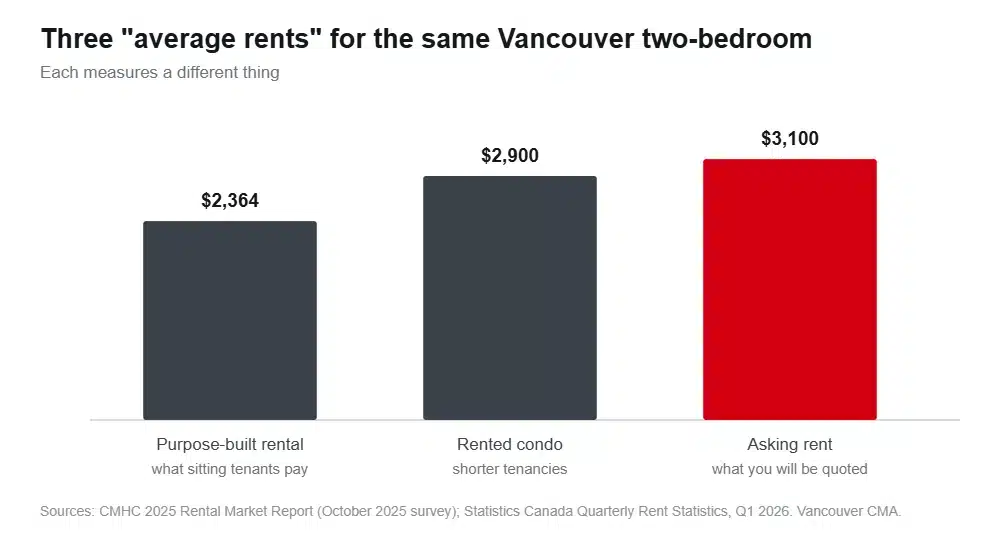
If you are moving here, the third row is your number. A newcomer cannot rent at the average of a building where half the tenants signed in 2018.
The measures also point in opposite directions right now. Advertised rents are falling: down 2.2 per cent year over year in Statistics Canada’s data, and down 4.8 per cent for a Vancouver one-bedroom in the July 2026 Rentals.ca report, which put the average at $2,377. Rents actually being paid are still rising, up 2.2 per cent in CMHC’s survey. Both are true at once because falling asking rents only reach a household when it moves.
Why advertised rents are falling
Vacancy. CMHC measured purpose-built rental vacancy across Metro Vancouver at 3.7 per cent in October 2025, up from 1.6 per cent a year earlier and the highest reading in more than thirty years. Landlords in a 1.6 per cent market do not negotiate. In a 3.7 per cent market, some do.
Turnover rents show it plainly. CMHC’s average two-bedroom rent on turnover was $2,696, down from $2,883 twelve months before. Same apartments, new tenant, roughly $190 less a month.
What rent looks like by area
CMHC breaks the city into survey zones. These are averages across all unit sizes, so a zone with lots of studios looks cheaper than one with lots of family apartments. Read them as relative, not absolute.
| Zone | Average rent | Vacancy |
|---|---|---|
| Marpole | $1,540 | 2.6% |
| East Hastings | $1,827 | 3.8% |
| Mount Pleasant / Renfrew Heights | $1,903 | 2.5% |
| West End / Stanley Park | $1,914 | 1.7% |
| South Granville / Oak | $1,929 | 1.8% |
| Southeast Vancouver | $1,968 | 2.4% |
| English Bay | $2,020 | 2.7% |
| Kitsilano / Point Grey | $2,051 | 1.7% |
| Downtown | $2,198 | 4.3% |
| Westside / Kerrisdale | $2,385 | 2.4% |
Source: CMHC Housing Market Information Portal, October 2025.
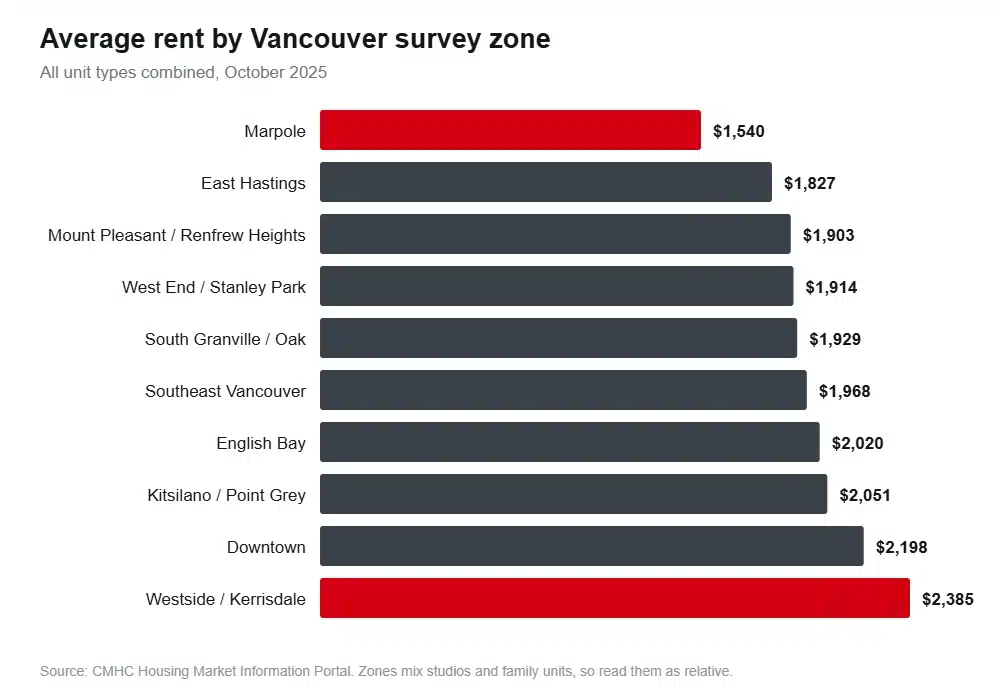
Marpole at $1,540 against Kerrisdale at $2,385 is an $845 monthly gap inside one city, and the two are a twenty-minute bus ride apart. Downtown’s 4.3 per cent vacancy is the loosest submarket in the city, which is worth knowing if you are negotiating.
Once you are in: the rent increase cap
British Columbia caps annual rent increases for existing tenants. The 2026 maximum is 2.3 per cent, down from 3.0 per cent in 2025. A landlord may raise rent once every twelve months, with three full months of written notice, and may not round up.
This is the quiet reason long tenancies are worth so much here. A tenant five years into a lease is typically paying well under market, which is also why the CMHC and asking-rent figures diverge as far as they do.
Buying a place
Greater Vancouver’s MLS composite benchmark price was $1,081,900 in August 2026, down 5.6 per cent year over year. The market has been softening for two years.
| Property type | Benchmark, July 2026 | Year over year |
|---|---|---|
| Detached house | $1,822,900 | −7.0% |
| Townhouse | $1,030,400 | −6.0% |
| Apartment | $688,000 | −7.5% |
Greater Vancouver Realtors via CREA statistics, July 2026. Benchmark prices describe a typical property, not an average of sales.
The east-west split inside the city is enormous. A detached house benchmarked at $1,621,400 on the east side and $2,932,700 on the west in August 2026. Same city, same school system, roughly $1.3 million apart.
Financing costs have eased. As of early September 2026 the Bank of Canada’s overnight rate sat at 2.25 per cent after six consecutive holds, with prime at 4.45 per cent, five-year fixed mortgages available from around 4.09 per cent and variable from about 3.30 per cent.
The closing cost people forget
British Columbia’s property transfer tax applies on top of the purchase price: 1 per cent on the first $200,000, 2 per cent from $200,000 to $2 million, 3 per cent above that, plus a further 2 per cent on residential value over $3 million. On a $1 million condo that is $18,000 payable at completion.
First-time buyers get relief, though the threshold has not moved with prices. A full exemption applies on the first $500,000 where the property is worth $835,000 or less, phasing out entirely by $860,000. Given that the apartment benchmark is $688,000, this is genuinely useful for condo buyers and irrelevant to anyone shopping for a townhouse.
Property tax and utilities
Vancouver City Council approved a zero per cent property tax increase for 2026, the first in recent memory. Utility fees rose 4.2 per cent, roughly $107 a year for a typical single-family home, so the combined municipal bill for a median house still went up about 1.7 per cent.
Vancouver’s 2026 residential rate totals $3.36394 per $1,000 of assessed value. Only $1.93406 of that is the City’s own levy. The rest is provincial school tax, TransLink, Metro Vancouver and BC Assessment, collected on the same bill.
A $2 million assessment therefore attracts about $6,728 a year. A zero per cent rate change does not mean a flat bill, though: the levy is redistributed by assessed value, so a home whose assessment rose faster than the city average still pays more.
Flat-rate utility charges for an unmetered single-family home in 2026: $867 for water, unchanged from 2025, and $1,238 for sewer. Garbage and green bin fees run roughly $117 to $224 and $189 to $320 respectively, depending on cart size, plus a $24 street cleaning levy.
Electricity and gas
BC Hydro’s residential rates set in April 2025 are a daily basic charge of 23.30 cents, then 11.72 cents per kilowatt hour for the first 1,376 kWh in a two-month billing period and 14.08 cents beyond that. The tiered structure means a large, electrically heated house pays a meaningfully higher marginal rate than an apartment. Check bchydro.com for the schedule currently in force, since rates are reset each April.
FortisBC gas bills rose about 1.5 per cent on 1 July 2026, roughly $1.57 a month for a typical residential customer.
Getting around
TransLink fares went up an average of 5 per cent on 1 July 2026.
| Adult fare | 1 zone | 2 zones | 3 zones |
|---|---|---|---|
| Compass stored value | $2.85 | $4.20 | $5.40 |
| Cash or Compass Ticket | $3.50 | $5.10 | $6.70 |
| Monthly pass | $117.20 | $156.70 | $211.65 |
Source: TransLink, Pricing and Fare Zones, effective 1 July 2026. Adult DayPass $12.55; concession monthly pass $66.95 for all zones; children 12 and under travel free.
A detail worth thousands over a few years: zones only apply to SkyTrain, SeaBus and West Coast Express. Buses are always one zone, and after 6.30pm on weekdays plus all day at weekends and on holidays, everything is one zone. Plenty of people buy a three-zone pass they never needed.
Driving
Metro Vancouver has the most expensive fuel in Canada, and the reason is structural rather than mysterious. Motor fuel tax on gasoline in the South Coast transportation service area runs 27 cents a litre, of which 18.5 cents funds TransLink. That levy does not apply outside Metro Vancouver, which is why a tank costs noticeably less in Chilliwack.
Kalibrate put the Metro Vancouver pump price at 182.5 cents a litre on 24 August 2026, with a rise of about 10 cents expected in early September as federal fuel taxes returned. British Columbia’s consumer carbon tax on gasoline, previously 17.61 cents a litre, was removed on 1 April 2025.
Insurance has been the one line holding steady. ICBC basic rates have not risen in seven consecutive years and are frozen through spring 2027.
Residential parking permits cost $105 a year in most zones, $157.50 around Fairview Slopes and VGH, $210 in Robson North, and up to $497.73 in the West End. New arrivals from outside British Columbia get one free month, once.
Food and everyday costs
Canada’s Food Price Report 2026 forecasts food prices rising 4 to 6 per cent this year, with a family of four spending about $17,571.79 on food, up to $994.63 more than 2025. British Columbia was not among the provinces flagged for above-average increases.
Measured rather than forecast, grocery inflation was running at 3.1 per cent nationally in July 2026. Vancouver’s all-items consumer price index rose 3.0 per cent over the same twelve months.
The provincial minimum wage reached $18.25 an hour on 1 June 2026. Provincial health premiums were abolished in 2020 and remain so.
Childcare, where the headline is misleading
You will read that British Columbia has $10-a-day childcare. That applies to a limited number of designated sites, not to most families.
What most Vancouver parents actually pay, from a September 2025 survey of licensed group care in the city:
| Age group | Average full fee | After provincial reduction |
|---|---|---|
| Infant, 6 weeks to 18 months | $2,209/mo | $1,400/mo |
| Toddler, 19 months to 3 years | $2,145/mo | $1,352/mo |
| Preschool, 3 to 5 years | $1,448/mo | $899/mo |
Source: Westcoast Child Care Resource Centre, Vancouver licensed group child care monthly rates, September 2025. The reduction is the provincial Child Care Fee Reduction Initiative, currently $900 a month for group infant and toddler care.
An infant space after the subsidy costs about $1,400 a month, roughly a second rent. The Canadian Centre for Policy Alternatives found in 2026 that while Vancouver has the lowest preschool fees for the largest share of parents among big Canadian cities, a quarter of families here still pay more than $46 a day.
Three monthly budgets
Here is what the figures above add up to. Treat them as illustrative: every line comes from a source cited on this page, but the totals are our arithmetic, not anyone’s official estimate.
| Monthly | Single, 1-bed, transit | Couple, 2-bed, one car | Family of 4, one toddler in care |
|---|---|---|---|
| Rent | $2,377 | $3,100 | $3,936 |
| Hydro and gas | $55 | $95 | $150 |
| Internet and mobile | $110 | $165 | $205 |
| Groceries | $450 | $800 | $1,465 |
| Transport | $117 | $480 | $600 |
| Childcare | — | — | $1,352 |
| Tenant insurance, health, sundries | $180 | $300 | $420 |
| Before tax, savings or debt | $3,289 | $4,940 | $8,128 |
Rent rows use current asking rents: Rentals.ca July 2026 for the one-bedroom, Statistics Canada Q1 2026 for the two-bedroom, Rentals.ca March 2026 for the three-bedroom. Groceries scale the Food Price Report’s family-of-four annual figure. Transport is a one-zone pass, or a car at 182.5 cents a litre plus insurance and parking. Excludes income tax, savings, debt payments and anything discretionary.
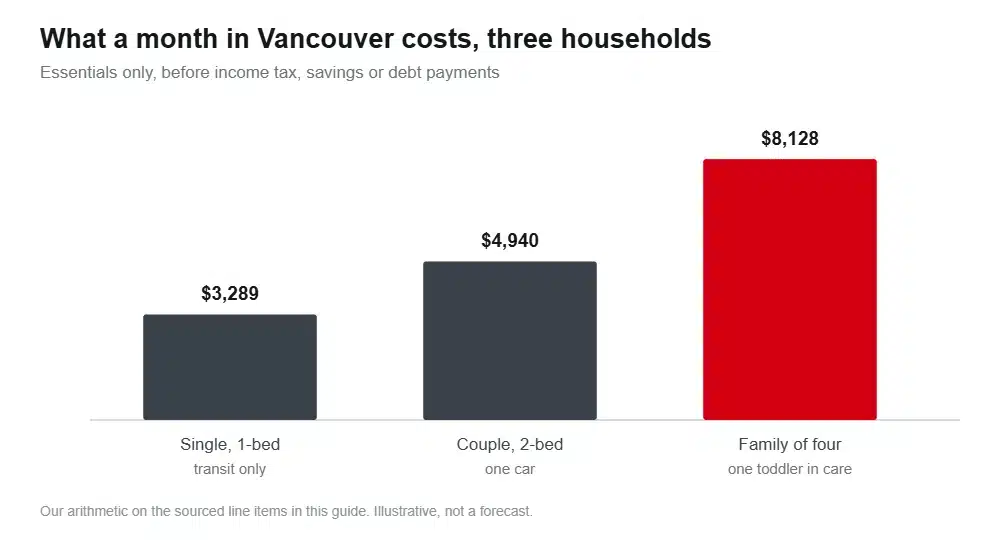
The family column is the one that stops people. Rent plus childcare alone comes to $5,288 a month before a single grocery run.
What you actually need to earn
Living Wage BC calculated a Metro Vancouver living wage of $27.85 an hour for 2025, the rate at which two working parents can cover essentials for a family of four. It sits $9.60 above the provincial minimum wage. The calculation deliberately excludes debt repayment, savings and home ownership, so it describes staying afloat rather than getting ahead.
For context on how that lands: the City of Vancouver’s median household income was about $82,000 in the 2021 census, reporting 2020 incomes. That figure is now six years old and predates most of the price rises on this page, so treat it as a floor rather than a current reading.
Where Vancouver is cheaper than you expect
Three things genuinely cost less here.
Heating comes first. Mild winters mean a Vancouver household burns far less energy than an equivalent home in Calgary or Winnipeg, and the tiered hydro rate rewards a small dwelling.
Second, car insurance. Seven years without a basic rate increase has quietly made ICBC one of the more stable lines in a Vancouver budget.
Third, the car itself. A city where 54.5 per cent of households rent, most of them in apartments near transit, is one of the few places in Canada where going without a vehicle is straightforwardly practical. Dropping a car removes roughly $500 to $700 a month, which is most of the gap between Vancouver rent and Calgary rent.
Frequently asked questions
Is Vancouver the most expensive city in Canada?
For housing, yes. Vancouver’s two-bedroom asking rent of $3,100 in Q1 2026 was 44 per cent above the national composite and 17 per cent above Toronto’s $2,660. Home prices tell the same story: a Greater Vancouver composite benchmark of $1,081,900 against $934,600 for the Toronto region and $569,200 for Calgary. On food, fuel and services the gap narrows considerably.
How much do I need to earn to live in Vancouver?
A single person renting a one-bedroom needs roughly $3,300 a month for essentials before tax, implying gross income somewhere around $60,000 to $65,000 depending on circumstances. Living Wage BC puts the Metro Vancouver figure at $27.85 an hour per working parent for a family of four.
Are rents in Vancouver going down?
Listed rents are, and have been for over a year. Rents paid by tenants who stay put are still edging up, capped at 2.3 per cent for 2026. Vacancy at 3.7 per cent is the highest in three decades, which is what has given renters some room.
What is the average rent for a one-bedroom in Vancouver?
Around $2,377 a month as of July 2026 on asking-rent data, down 4.8 per cent year over year. Older purpose-built buildings average less, and downtown condos more.
Is it cheaper to live in the suburbs?
On rent, usually. Asking rents fell hardest in 2026 outside the city core: Abbotsford down 12.4 per cent, Langley 7.6 per cent, Coquitlam 7.3 per cent, New Westminster 6.6 per cent. Weigh that against transit passes at $156.70 or $211.65 for two or three zones and, for most suburban households, a car. Surrey is the usual comparison, and we have priced that one out too.
How we put this together
Every figure is sourced to the organisation that publishes it, linked where it appears. Where several credible measures of the same thing disagree, we have shown you all of them and explained the difference rather than picking one.
Three cautions. CMHC rent figures cover the Vancouver census metropolitan area, meaning all of Metro Vancouver, and are pulled down by Surrey, Delta and Langley; only the zone table is City of Vancouver. BC Hydro rates quoted here took effect in April 2025 and are reset each April, so confirm the current schedule before budgeting from them. And the household budgets are our own arithmetic on sourced line items, offered as a sanity check rather than a forecast.
Sources
- CMHC, 2025 Rental Market Report
- Statistics Canada, Quarterly rent statistics, first quarter 2026
- BC Residential Tenancy Branch, rent increases
- CREA, Greater Vancouver MLS Home Price Index
- Province of BC, property transfer tax
- Province of BC, first-time home buyers’ exemption
- City of Vancouver, 2026 budget approved with 0% property tax increase
- City of Vancouver, residential property tax rates
- TransLink, pricing and fare zones
- Province of BC, motor fuel tax and carbon tax rates
- BC Government, ICBC basic rates held to spring 2027
- Canada’s Food Price Report 2026
- Statistics Canada, Consumer Price Index, July 2026
- BC Government, minimum wage increase, June 2026
- Living Wage BC, 2025 living wage rates
- CCPA, child care fees in Canada, 2026
Thinking about the North Shore instead? We have priced North Vancouver out the same way, City and District separately.
Where you land inside the city moves this number as much as anything else on the list. We went through all 22 neighbourhoods separately, with what each one costs you in rent and what it gives back in commute. If you have already settled on one, we have movers who know the buildings in downtown, East Van, south Vancouver and Kitsilano.
Budgeting a move as well as a month? Our read on what the city’s crime numbers actually say covers the other question most people ask before they sign, and the provincial picture is worth a look if Vancouver is only one of your options. When you are ready, tell us both addresses.
