

Last updated: August 2026
Abbotsford is the cheapest major city in the Lower Mainland, and it isn’t close. That’s the short version. The longer version is more interesting, because “cheap” is doing a lot of work in that sentence: a detached house here still costs over a million dollars, and the gap between Abbotsford and Vancouver has been narrowing for twenty years.
Here’s what it actually costs, with real numbers and where they came from.
Abbotsford at a glance
| Population | 175,360 (BC Stats estimate, July 2025); 153,524 at the 2021 census |
|---|---|
| Growth | +2.0% in the year to July 2025 — one of BC’s faster-growing cities |
| Where it is | Eastern Fraser Valley, on the US border, between Langley and Chilliwack |
| Size rank | Fifth-largest municipality in British Columbia |
| Average rent, all units | $1,470/month (CMHC survey, October 2025) |
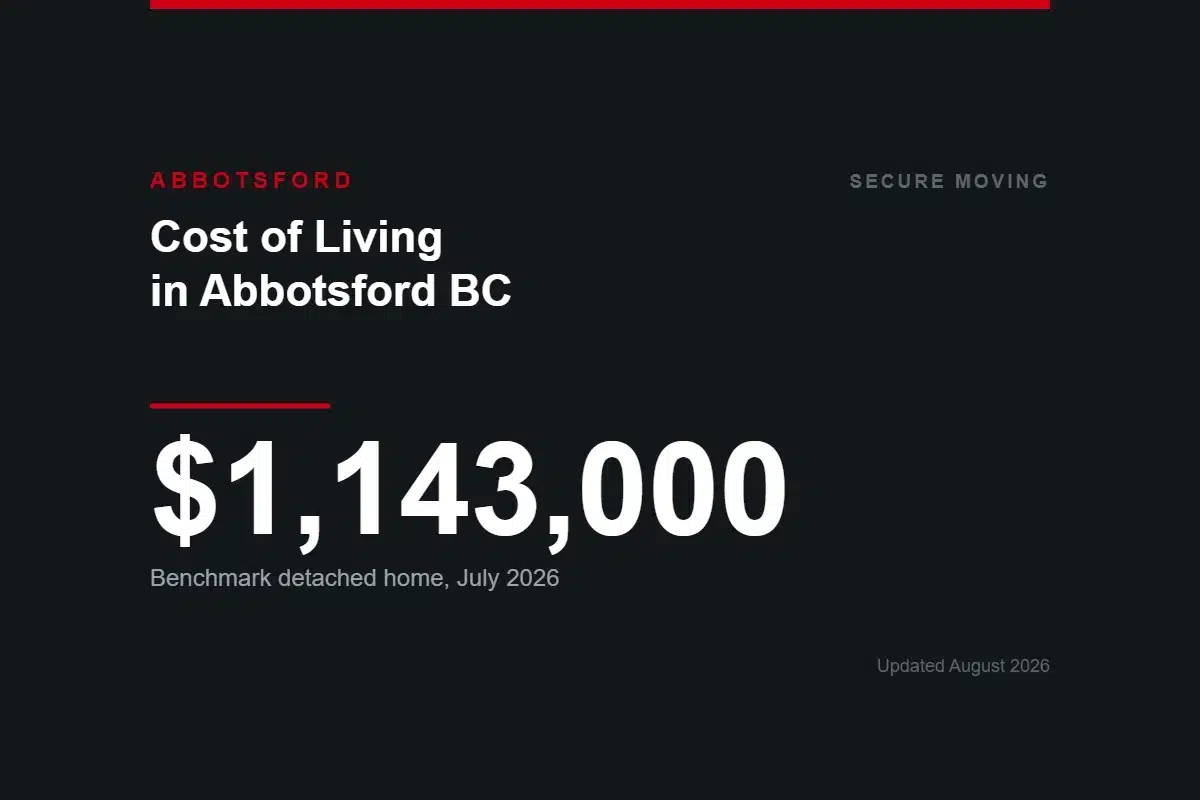
| Benchmark detached home | $1,143,000 (Fraser Valley Real Estate Board, July 2026) |
| Living wage | $24.25/hour for the Fraser Valley (Living Wage BC, 2025) |
| Transit | BC Transit, not TransLink — see the transit section, it matters |
What rent actually costs in Abbotsford
There are two ways to measure rent and they give you different answers, so it’s worth knowing which one you’re looking at.
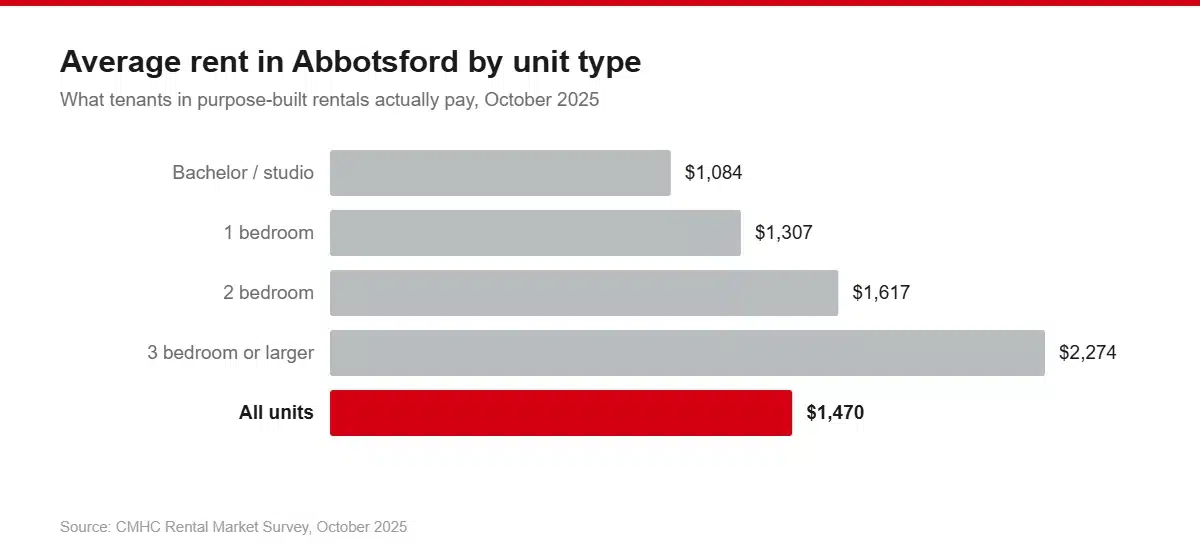
CMHC survey rents are what people currently living in purpose-built rental buildings actually pay. They include long-term tenants whose rent has only gone up a few percent a year. From the October 2025 survey, City of Abbotsford:
| Unit | Average rent |
|---|---|
| Bachelor / studio | $1,084 |
| 1 bedroom | $1,307 |
| 2 bedroom | $1,617 |
| 3 bedroom or larger | $2,274 |
| All units | $1,470 |
Asking rents are what’s advertised right now, which is almost always higher because it’s what a new tenant pays. Zumper had Abbotsford’s median asking rent at $1,700/month across all unit types as of late August 2026, with one-bedrooms at $1,620 and two-bedrooms at $2,025.
If you’re moving here, budget closer to the asking rents. If you’re already here and wondering whether you’re overpaying, the CMHC numbers are the fairer benchmark.
The genuinely good news: Abbotsford’s asking rents fell 12.4% in the year to July 2026, according to Rentals.ca, one of the largest declines in the country. Vacancy also loosened up considerably, from 1.3% in October 2024 to 2.8% a year later. A 2.8% vacancy rate isn’t generous, but it’s the difference between “there is nothing available” and “you have a choice.”
Worth knowing: studio vacancy was 0.0% in that October 2025 survey. Bachelor suites in Abbotsford are effectively unavailable through the formal rental market. Everyone chasing them is chasing the same handful of units.
Buying a home
Benchmark prices for Abbotsford, July 2026 (Fraser Valley Real Estate Board):
| Type | Benchmark price | Change over 12 months |
|---|---|---|
| Detached | $1,143,000 | −7.6% |
| Townhouse | $602,000 | −8.7% |
| Apartment | $380,900 | −9.9% |
Prices have been falling for a year, and the board itself described July 2026 as a buyer’s market: active listings were 32% above the ten-year average and the sales-to-active-listings ratio sat at 11%. Homes took about 40 days to sell.
BC Assessment’s 2026 roll, a different measure valued as of 1 July 2025, put a typical Abbotsford single-family home at $1,082,000, down 5% from the previous roll, and a typical condo or townhouse at $470,000, down 3%.
Two measures, two dates, same direction. Don’t treat assessed value and market benchmark as interchangeable; they’re calculated differently and about six months apart.
How that compares
Same board, same month (July 2026), so this is a fair comparison:
| Detached | Townhouse | Apartment | |
|---|---|---|---|
| Abbotsford | $1,143,000 | $602,000 | $380,900 |
| Mission | $934,800 | $630,500 | $425,800 |
| Surrey | $1,412,000 | $772,700 | $456,100 |
| Langley | $1,500,900 | $811,400 | $534,200 |
| Metro Vancouver* | $1,822,900 | $1,030,400 | $688,000 |
* Greater Vancouver Realtors, July 2026, a different board with a different index basket, so treat it as directional rather than exact.
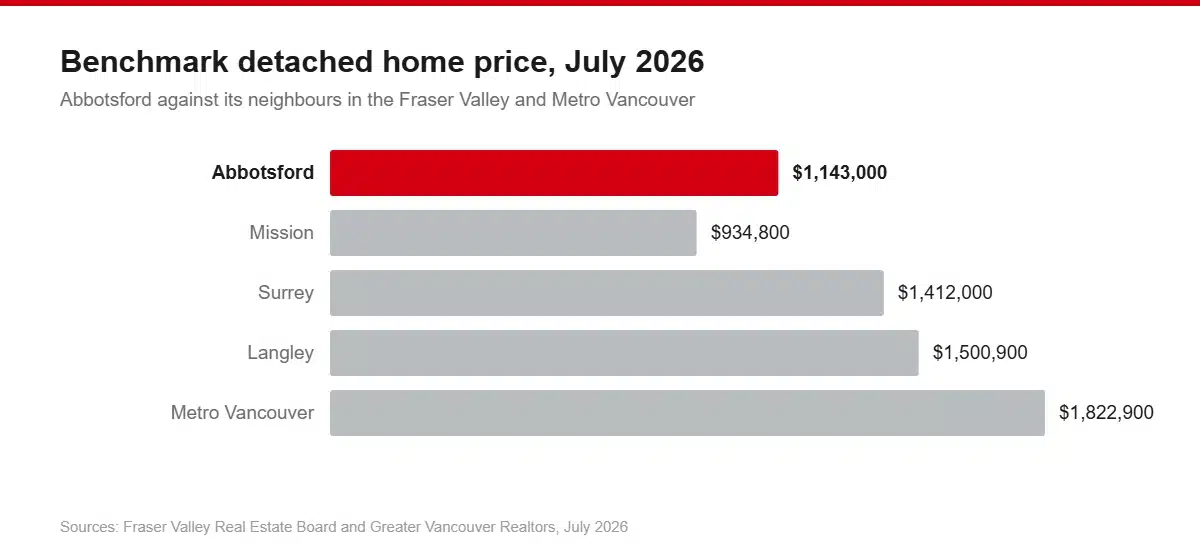
An Abbotsford apartment costs roughly 55% of a Metro Vancouver one. A detached house costs about 63%. That’s the whole argument for living out here, in two numbers.
Utilities
Electricity is BC Hydro, on a two-step tiered rate: a lower rate for the first 22.19 kWh a day and a higher one above that, plus a daily basic charge. BC Hydro says the average residential customer’s bill runs around $100/month. Rates rose 3.75% in April 2025, with a further 3.75% approved for April 2026. Check bchydro.com for the current cents-per-kWh figure before you budget from it, because the published rate pages and the regulator’s summary didn’t agree when we checked.
Natural gas is FortisBC. As of 1 July 2026: $1.660/GJ for the gas itself plus $2.472/GJ storage and transport, on top of a delivery charge. FortisBC uses 7.5 GJ/month as its typical residential household and put the July 2026 change at about $1.57 more per month.
Water and sewer are billed by the City, effective 1 March 2026: water at $1.46/m³ and sewer at $1.35/m³, with sewer charged on 90% of your metered water. Pay early and you get a 5% discount, which drops those to $1.39 and $1.28. Council put both up 4% in January 2026.
Garbage is a flat $420.00 a year for curbside collection.
Property tax
Abbotsford’s total 2026 residential rate is 4.52071 per $1,000 of assessed value, which includes the municipal levy, the regional district, the regional hospital district, the library, storm drainage and the provincially-set school tax.
Council approved a 4.94% increase for 2026, made up of 4.44% in tax revenue plus a 0.50% infrastructure levy.
On a home assessed at $1,082,000, the total bill works out to roughly $4,890 a year before any home owner grant. Apply the grant and most owner-occupiers pay meaningfully less.
Getting around, and the thing nobody tells you
Here’s the single most important structural fact about living in Abbotsford: it is not in Metro Vancouver, and it is not on TransLink.
Abbotsford is served by BC Transit’s Central Fraser Valley system. Local fares as of 6 September 2026: $2.75 a ride, $5.50 for a day pass, $59 for a 30-day adult pass. Kids 12 and under ride free.
To get into Metro Vancouver on transit you take the Fraser Valley Express, Route 66, from the McCallum Park & Ride to Lougheed SkyTrain station in Burnaby, a scheduled 38 minutes on a weekday morning. FVX fares are separate: $5.00 a ride or $100 for a 30-day pass.
And then you’re on TransLink, which is a third fare system. From Lougheed, a Compass stored-value adult fare is $2.85 for one zone, $4.20 for two, $5.40 for three, as of 1 July 2026.
So a daily Abbotsford-to-downtown commuter is paying two separate transit systems. Budget for that properly before you decide the mortgage savings pay for themselves.
The flip side: about two-thirds of Abbotsford residents both live and work in Abbotsford, and the City puts the average local commute at roughly ten minutes. If you can find work here, the transport maths flips entirely in your favour.
Car insurance is ICBC. BC has public auto insurance, so basic coverage comes from one place. The BC-wide average was $1,358 per policy in fiscal 2024/25, and Basic rates are frozen through spring 2027. ICBC doesn’t publish city-level averages, so get an actual quote rather than trusting any “typical Abbotsford premium” you read online.
Groceries and everything else
There is no Abbotsford grocery price index. Anyone quoting one is making it up. What exists:
- BC food prices rose 3.3% in the year to July 2026 (BC Stats CPI). All-items BC inflation was 2.9%.
- Canada’s Food Price Report 2026 forecasts a 4–6% rise nationally and expects BC to come in below the national average, though it doesn’t give a BC figure.
- The Fraser Valley living wage is $24.25/hour (2025), against $27.85 for Metro Vancouver. That $3.60/hour gap is probably the most honest single summary of the cost difference between here and the city.
Childcare
BC’s Child Care Fee Reduction Initiative caps what participating providers can charge after the provincial reduction. For 2026–27: up to $900/month off group care for under-3s, $545/month for ages 3 to kindergarten, $115/month for school-age group care. Fees can’t be reduced below $200/month full-time.
No published survey covers Abbotsford specifically, since the national fee survey skips it. So call providers directly rather than budgeting from a number you found online.
Three sample monthly budgets
Built from the verified figures above. Rent uses current asking rents, since that’s what a new arrival pays. These exclude debt payments, savings, travel and anything discretionary.
Single person, one-bedroom apartment
| Item | Monthly |
|---|---|
| Rent (asking, 1BR) | $1,620 |
| Hydro | $70 |
| Internet and phone | budget your own — no reliable published BC average |
| Transit pass (local) | $59 |
| Groceries | budget your own |
| ICBC (if you drive) | get a quote |
| Fixed housing + hydro + transit | ~$1,749 |
Couple, two-bedroom apartment
| Item | Monthly |
|---|---|
| Rent (asking, 2BR) | $2,025 |
| Hydro | $100 |
| Transit, two passes | $118 |
| Fixed housing + hydro + transit | ~$2,243 |
Family of four, owning a detached home
| Item | Monthly |
|---|---|
| Property tax (assessed $1,082,000, before grant) | ~$408 |
| Hydro | $130 |
| Gas (7.5 GJ typical) | see FortisBC — full bill build-up isn’t published |
| Water, sewer, garbage | ~$35 garbage + metered water/sewer |
| Mortgage | depends entirely on your down payment and rate |
I’ve deliberately left blanks where no credible published figure exists. A budget with an invented grocery number in it is worse than one with a gap.
So is Abbotsford actually affordable?
Compared to Metro Vancouver, clearly yes: roughly 40% off a detached house, 45% off an apartment, and a living wage $3.60/hour lower.
Compared to what Abbotsford cost ten years ago, no. The City’s own census profile shows the average house value went from $516,858 in 2016 to $873,000 in 2021. Median household income rose about 17% over the same period. Those two numbers moving that differently is the whole affordability story of the Fraser Valley.
Compared to Chilliwack or Mission, Abbotsford is more expensive. If price is your only variable, keep driving east.
What Abbotsford buys you for the money is a real city, with a hospital, a university, an airport, 175,000 people, and a genuine local job market, at Fraser Valley prices. That’s a different proposition from a commuter town, and it’s why the population keeps climbing.
Frequently asked questions
Is Abbotsford cheaper than Surrey?
Yes, on every housing measure. In July 2026 a benchmark detached home in Abbotsford was $1,143,000 against $1,412,000 in Surrey, and an apartment was $380,900 against $456,100. Rent is lower too, at $1,470 average across all units in Abbotsford (CMHC, October 2025) against $1,728 in Surrey.
What’s the average rent in Abbotsford?
$1,470/month across all unit types in the October 2025 CMHC survey, which measures what current tenants pay. Advertised rents run higher: Zumper’s median asking rent was $1,700/month in August 2026.
Is Abbotsford in Metro Vancouver?
No. Abbotsford is in the Fraser Valley Regional District. That’s why it’s on BC Transit rather than TransLink, and why its living wage, property taxes and housing costs are calculated separately from Metro Vancouver’s.
How long does it take to get to Vancouver from Abbotsford?
On transit, the Fraser Valley Express runs Abbotsford to Lougheed SkyTrain station in a scheduled 38 minutes, then you’re on SkyTrain. Driving times vary enormously with Highway 1 traffic and construction, and we’re not going to quote a number nobody official publishes.
Are Abbotsford house prices going up or down?
Down, through 2026. Benchmark prices fell 7.6% for detached, 8.7% for townhouses and 9.9% for apartments in the year to July 2026, and the Fraser Valley Real Estate Board described the market as favouring buyers.
The provincial cost guide covers the bills that follow you to any BC address.
One cost this article hasn’t covered is the move itself. If Abbotsford is where you’re landing, here’s how we price a move to Abbotsford.
