

Last updated: August 2026
Abbotsford gets described two ways. Either it’s an affordable, family-friendly city with a real job market, or it’s where you end up when you can’t afford Langley.
The truth is that it’s a working city of 175,000 people that happens to be surrounded by farmland, and whether that suits you depends on some fairly specific things about your life.
Abbotsford in ten facts
| Population | 175,360 (July 2025 estimate) — fifth-largest in BC |
|---|---|
| Growth | +2.0% in the year to July 2025 |
| Projected | Close to 250,000 by 2050 |
| Median age | 39.2 (2021 census) |
| Diversity | 40.2% of residents belong to a visible minority group |
| Largest immigrant origin | India, at 55% of the immigrant population |
| Home ownership | 85% owner-occupied |
| Hospital | Abbotsford Regional Hospital and Cancer Centre |
| University | University of the Fraser Valley, ~15,000 students |
| Airport | Abbotsford International, over 1 million passengers in 2025 |
The case for Abbotsford
It’s a real city, not a commuter suburb
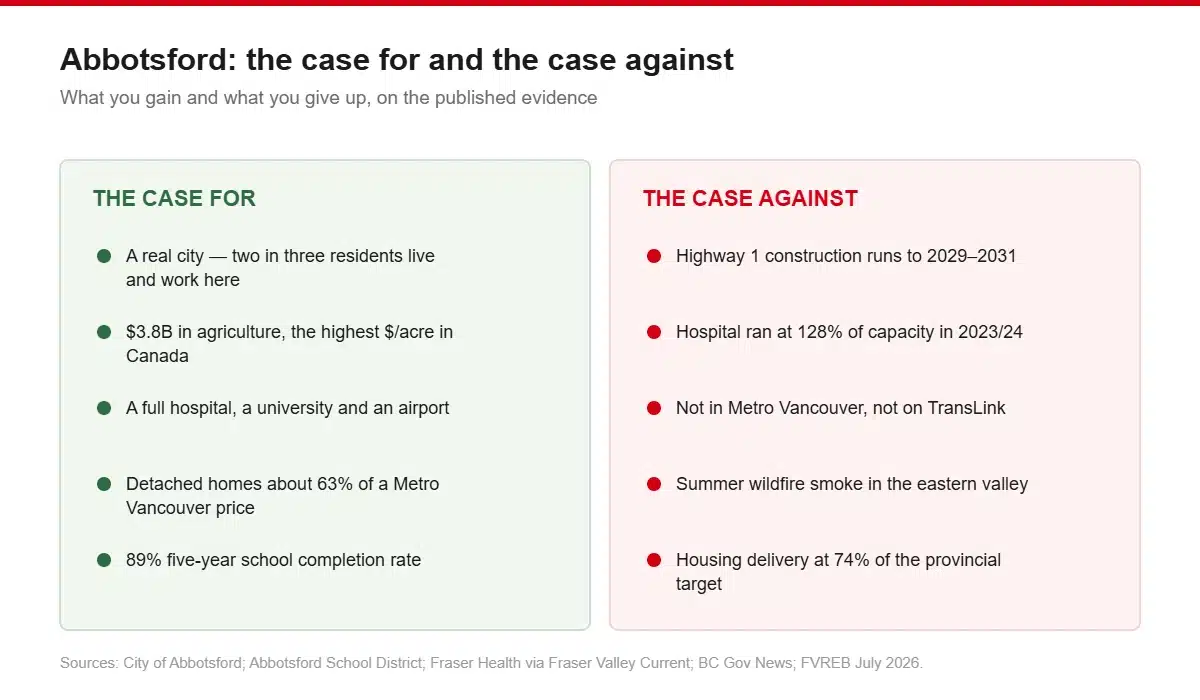
This is the thing people underestimate. About two-thirds of Abbotsford residents both live and work in Abbotsford, with an average commute of roughly ten minutes.
That’s not true of most Fraser Valley communities, and it changes the entire experience of living here. You are not necessarily buying a house at the far end of a two-hour daily round trip.
The employment base is unusually spread out. The top sectors by share of jobs at the 2021 census were retail (11.6%), health care and social assistance (11.5%), manufacturing (9.3%) and transportation and warehousing (8.9%), with no single industry dominating. The Conference Board of Canada has described Abbotsford’s economy as one of the most diverse in the country.
Agriculture isn’t decoration here
Abbotsford earns the highest dollar per acre of agricultural land in Canada, ahead of the Niagara Region. Agricultural sales grew from $635 million in 2010 to nearly a billion by 2021, and the sector accounts for $3.8 billion in economic activity. The city produces close to half of all chicken eggs and dairy milk in British Columbia.
Practically, that means berry fields at the end of residential streets, farm stands in summer, and a permanent green edge to the city because most of that land is in the Agricultural Land Reserve and isn’t going anywhere.
The institutions are actually here
University of the Fraser Valley runs about 15,000 students a year across campuses in Abbotsford, Chilliwack, Mission and Hope, plus an Aerospace Centre at the airport and a campus in Chandigarh, India. It’s a full public university, not a satellite.
Abbotsford Regional Hospital and Cancer Centre is a full acute-care hospital with a BC Cancer centre attached: emergency, ICU, surgery, maternity with neonatal intensive care, paediatrics, dialysis, cardiac, imaging, and cancer treatment including radiation. Most cities this size don’t have that.
Abbotsford International Airport handled 1,025,655 passengers in 2025, its second-busiest year ever and its third straight above a million. Flair and WestJet fly out of it, and for a lot of residents it’s the difference between a fifteen-minute drive and a trek to YVR.
Schools
The Abbotsford School District serves 21,160 students across 47 public schools, with 8 independents in the catchment. The five-year completion rate is 89%. The district serves families speaking close to 100 languages and describes itself as one of the most diverse in Canada.
On the Fraser Institute’s 2025 elementary report card, the highest-rated Abbotsford schools were Mennonite Educational Institute (7.7) and Abbotsford Christian (7.3) among independents, with Prince Charles (7.3) and McMillan (7.2) leading the public schools. Treat those with the usual caution. It’s an advocacy organisation’s ranking built on standardised test data, not a full picture of a school.
The price
A benchmark detached home in Abbotsford was $1,143,000 in July 2026, against $1,500,900 in Langley and $1,822,900 in Metro Vancouver. An apartment was $380,900 against $688,000 in Metro Vancouver.
The Fraser Valley living wage is $24.25/hour against Metro Vancouver’s $27.85. That gap is the practical version of the same point.
The case against
Highway 1 is the daily tax
More than 80,000 vehicles a day use Highway 1 between Langley and Abbotsford. If you work in Metro Vancouver, this road is your life.
It’s being widened, $2.34 billion for 264th Street to Mount Lehman, and another $2.65 billion for Mount Lehman to Highway 11, adding HOV lanes and bus-on-shoulder sections. But Phase 3A doesn’t finish until 2029 and Phase 3B until 2031, and in the meantime you’re driving through the construction.
Transit to Vancouver means the Fraser Valley Express to Lougheed station, a scheduled 38 minutes, and then TransLink, which is a separate fare system on top of BC Transit’s. Abbotsford is not in Metro Vancouver and not on the TransLink network, which surprises a lot of newcomers.
The hospital is chronically over capacity
This is the most serious mark against Abbotsford and it deserves to be stated plainly.
Abbotsford Regional Hospital ran at 128% of capacity in fiscal 2023/24, reported as the worst of any major BC hospital in the previous decade. In 2022/23 it was running with roughly 60 more inpatients than it had beds. It was already at about 115% in 2019. Fraser Health added 25 beds, which did not resolve it. Physicians there have publicly described the hospital as bursting at the seams.
There has been recent investment: a modernised interventional radiology suite in September 2025, new precision imaging capability in March 2025, and a long-term care home announced for the city. But if you have ongoing health needs, go into this with your eyes open.
Summer smoke
The Fraser Valley catches wildfire smoke. In August 2026, Metro Vancouver upgraded its air quality warning to orange for the eastern Fraser Valley and the Air Quality Health Index hit the maximum “10+” band, with warnings still in effect on 25 August. There were comparable advisories in 2023 and 2025.
Abbotsford sits at the western end of that airshed and generally gets it less badly than Chilliwack, Agassiz and Hope. But “less badly” still means some late-summer weeks where you keep the windows shut.
Sumas Prairie floods
The November 2021 flood was a genuine disaster. Roughly $220 million has gone into recovery and mitigation since, including $76.6 million for the Barrowtown pump station and $62 million for water treatment. Canada and the US signed a transboundary flood initiative in October 2023.
There was still further flooding in December 2025. If you’re buying on the prairie, this is a live consideration, not a historical one.
Homelessness has risen sharply
Abbotsford’s 2023 point-in-time count found 406 people experiencing homelessness, up from 333 in 2020 and 274 in 2017, a 247% rise since 2011. The regional report noted the increase “continues to outpace the increase in emergency shelter beds.”
For context, Abbotsford was 37% of the regional count while holding 52% of the region’s population, so it’s not an outlier in the Fraser Valley. But it’s visible, particularly in the city centre.
Housing isn’t keeping up
Abbotsford needs 7,240 new units by late 2028 under its provincial housing target. In 2025 it delivered 866 net new units, 74% of its year-two target. The City’s own needs assessment projects 37,185 new units required by 2041.
Prices are falling right now, which helps. Supply is not being built at the rate the population is growing, which doesn’t.
The weather
Environment Canada’s 1991–2020 normals for Abbotsford International Airport: annual mean temperature 10.7 °C, July mean 18.5 °C, January mean 3.7 °C, annual precipitation 1,504.6 mm with 56.4 cm of snow.
Translation: wet winters, warm dry summers, a bit more snow than Vancouver and noticeably more sun. It is not a Vancouver climate. It’s a Fraser Valley one, which means hotter Julys and colder Januarys than the coast.
Who Abbotsford actually suits
It works well if you:
- can work in Abbotsford, or in the eastern Fraser Valley generally
- want a detached house and a yard at a price that exists
- have kids and value a settled school district
- want farmland, trails and Mount Baker out the window
- fly often enough that a local airport matters
It works badly if you:
- commute daily into Vancouver or Burnaby
- want frequent, useful transit
- need a walkable, dense neighbourhood with things open late
- have health needs that make hospital capacity a real concern
- are sensitive to summer air quality
The honest summary
Abbotsford is a good place to live if your life fits inside the Fraser Valley. It’s a mediocre place to live if your job is downtown.
The city has the things a place needs to function on its own: a hospital, a university, an airport, a diverse job base, real agriculture, and enough people that it isn’t a suburb of anywhere. What it doesn’t have is a fast connection to the rest of Metro Vancouver, and the road that’s supposed to fix that won’t be finished until 2031.
Weigh those two facts against each other and you have your answer.
Frequently asked questions
Is Abbotsford a good place to raise a family?
It’s one of the stronger arguments for the city. The school district serves 21,160 students with an 89% five-year completion rate, home ownership sits at 85%, detached houses cost about 63% of a Metro Vancouver equivalent, and most residents have a ten-minute commute. The counterweights are hospital capacity and housing supply.
Is Abbotsford boring?
It’s a city of 175,000 surrounded by farmland, with a university, an airport, a downtown that’s still finding its feet, and Vancouver an hour away in decent traffic. If your baseline is Vancouver’s density and nightlife, yes, you’ll notice. If it’s a smaller Fraser Valley town, Abbotsford will feel like a step up.
What is Abbotsford known for?
Agriculture, primarily: the highest dollar per acre of farmland in Canada and roughly half of BC’s egg and dairy milk production. Also the Abbotsford International Airshow, the University of the Fraser Valley and its airport.
Is Abbotsford growing?
Yes. It grew 2.0% in the year to July 2025 and is projected to approach 250,000 residents by 2050, about a 47% increase on 2021.
Should I move to Abbotsford if I work in Vancouver?
Only with your eyes open. Transit means the Fraser Valley Express to Lougheed station, a scheduled 38 minutes, then TransLink, on a separate fare. Driving means Highway 1, which carries over 80,000 vehicles a day between Langley and Abbotsford and is under construction until 2029–2031.
Our wider BC comparison is worth a look if Abbotsford is one of several places on your list.
If you’ve decided the answer is yes, we can get you moved to Abbotsford, locally or from the other side of the country.
