

Here is the single best argument for living in New Westminster, and it is one that most guides get wrong. The city has five SkyTrain stations, all of them on the Expo Line, and both Expo branches run through to Waterfront. Nobody here changes trains to reach downtown Vancouver.
That has been true since October 2016, when the network was reorganised and the Millennium Line stopped serving Sapperton and Braid. Plenty of writing about the city still says otherwise. Platform to platform, downtown is 27 to 36 minutes depending on which station you use.
Now the argument against, which is the same fact seen from the other end. Metro Vancouver’s own projections put New Westminster at 0.397 jobs per resident in 2024, against 0.489 for the region. Despite a major hospital, the largest college in the province and a courthouse, this is a city that exports workers. Which is precisely why the trains matter so much.
The short version
- Five stations in 15.6 square kilometres, no transfer to downtown, 27 to 36 minutes in the train.
- Fewer jobs per resident than the region, and the projections say that holds through 2051.
- Royal Columbian is one of two Level One trauma centres in British Columbia and its new acute care tower opened in May 2026.
- Douglas College’s main campus is downtown, on a station, with about 25,000 students a year.
- The school district beats the province on every Grade 4 and Grade 7 measure and trails it on both Grade 10 ones.
- Four freight railways run through the city and only five of its 24 level crossings have won whistle cessation.
The commute
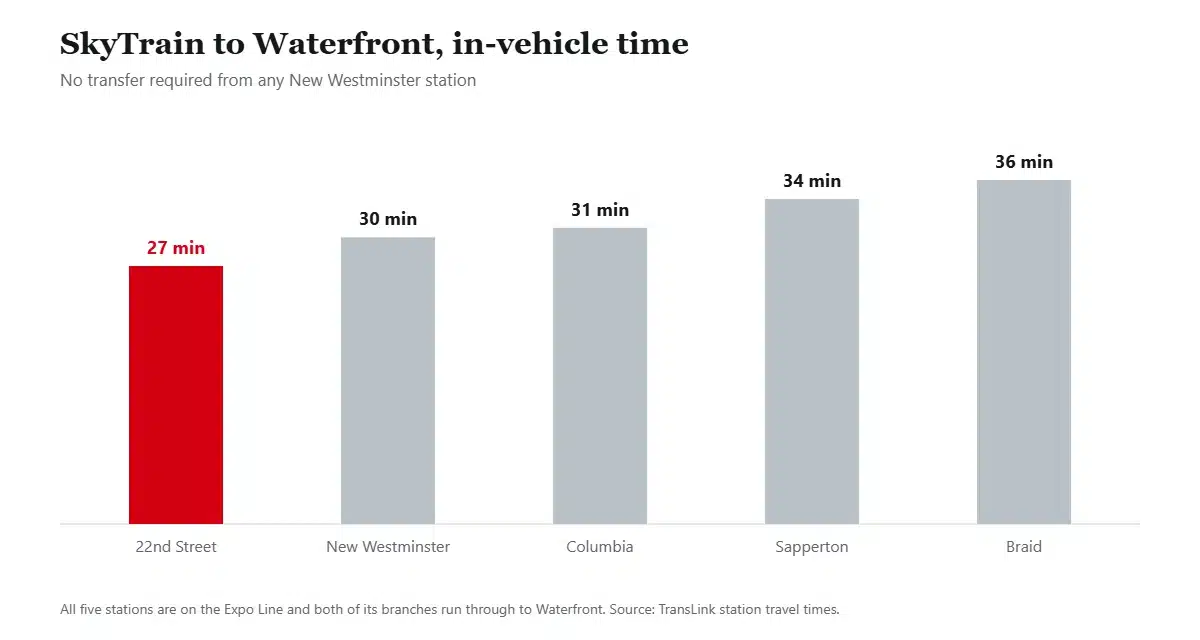
Those are platform-to-platform figures and they are not a commute. Add the walk or bus to the station, half a headway of waiting, and the walk from Waterfront to wherever you work. Realistically most residents should budget 40 to 55 minutes each way, which is our estimate rather than a TransLink number, because TransLink does not publish a door-to-door figure.
Still, the city’s own claim in its transportation plan holds up: it has the highest number of SkyTrain stations per resident in Metro Vancouver. What is no longer true is the second half of that sentence, which says two lines. Today it is one line with two branches.
Fares are a two-zone trip into Vancouver on a weekday daytime, at $4.20 on stored value or $156.70 for a monthly pass. Everything after 6:30pm on weekdays, all weekend and every statutory holiday is a one-zone fare, and buses are one zone at all times.
Two things this city does not have. The West Coast Express does not stop here, despite what some guides claim. And no RapidBus route serves New Westminster. What it does have is ten day bus routes, nine of which terminate at a SkyTrain station, plus two NightBus routes covering the hours after the trains stop.
The jobs gap
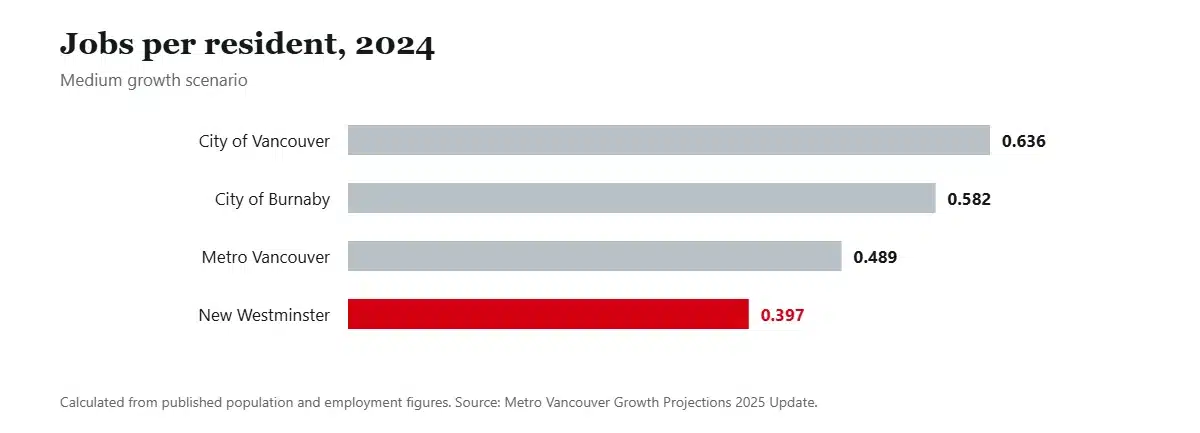
You would expect a city with a provincial referral hospital, a college main campus, a courthouse and a school district to import workers. It does not. At 0.397 jobs per resident it sits closer to the Tri-Cities than to the regional average, and Metro Vancouver projects it will still be at 0.410 in 2051.
The explanation is arithmetic rather than mystery. The institutions are real, but they are a few thousand jobs against a base of 36,690 in a city of 92,433. One hospital does not turn a municipality into an employment centre. And population is projected to grow 48 per cent by 2051 while employment grows 53, which moves the ratio barely at all.
This is not bad news for a resident. What it undercuts is any pitch that says you can work where you live. Read the two facts together and the city makes sense: most people here commute out, and the reason it works is that the commute is short and does not involve a change of train.
Royal Columbian
The hospital is the amenity that genuinely sets New Westminster apart, and it has just had the biggest year in its history.
Fraser Health calls it the only hospital in British Columbia with trauma, cardiac care, neurosurgery, high-risk obstetrics, neonatal intensive care and acute mental health care all on one site, and says more than a third of British Columbians rely on it for critical care. One of two Level One trauma centres in the province, and the oldest hospital in British Columbia.
The Jim Pattison Acute Care Tower opened its first stage on 31 May 2026: 388 beds over ten storeys, an emergency department with 75 treatment spaces, a 47-bed intensive care unit and a 17-bed cardiac intensive care unit. The second stage follows in autumn 2026 with obstetrics, paediatrics, the neonatal intensive care unit, 17 operating rooms and the interventional suites. A third phase upgrading the older buildings runs to 2029.
One honest note on the money. In 2018 the province put the whole three-phase redevelopment at $1.35 billion. The 2026 opening release describes phases two and three alone as costing nearly $2 billion.
And one honest note for anyone buying nearby: it is a construction site until 2029, on an active hospital campus next to residential Sapperton, and Fraser Health has published noise notices to that effect.
On family doctors, New Westminster sits in Fraser Health, which had the second lowest primary care waitlist rate of British Columbia’s five health authorities in July 2025, at 49 people per 1,000. Read that carefully. It measures people who signed up for the waitlist, not people without a doctor, and registration habits differ by region.
Douglas College
The largest college in British Columbia has its main campus here, downtown, next to a SkyTrain station. It serves close to 25,000 students a year, 11,686 of them full-time equivalents, employs around 2,000 people and awarded 2,052 credentials in 2024/25 including 520 bachelor’s degrees across twelve applied baccalaureate programmes.
Its published performance measures are strong. Student satisfaction runs above 90 per cent, quality of instruction above 93, and unemployment among baccalaureate graduates was 2.1 per cent. One target was missed: 76.1 per cent of diploma and certificate graduates rated their skills useful, against a 90 per cent target. That belongs here alongside the good numbers.
Very few Metro Vancouver municipalities outside Vancouver, Burnaby and Richmond host a degree-granting main campus at all, and none of them puts it on a station in the middle of downtown.
Schools
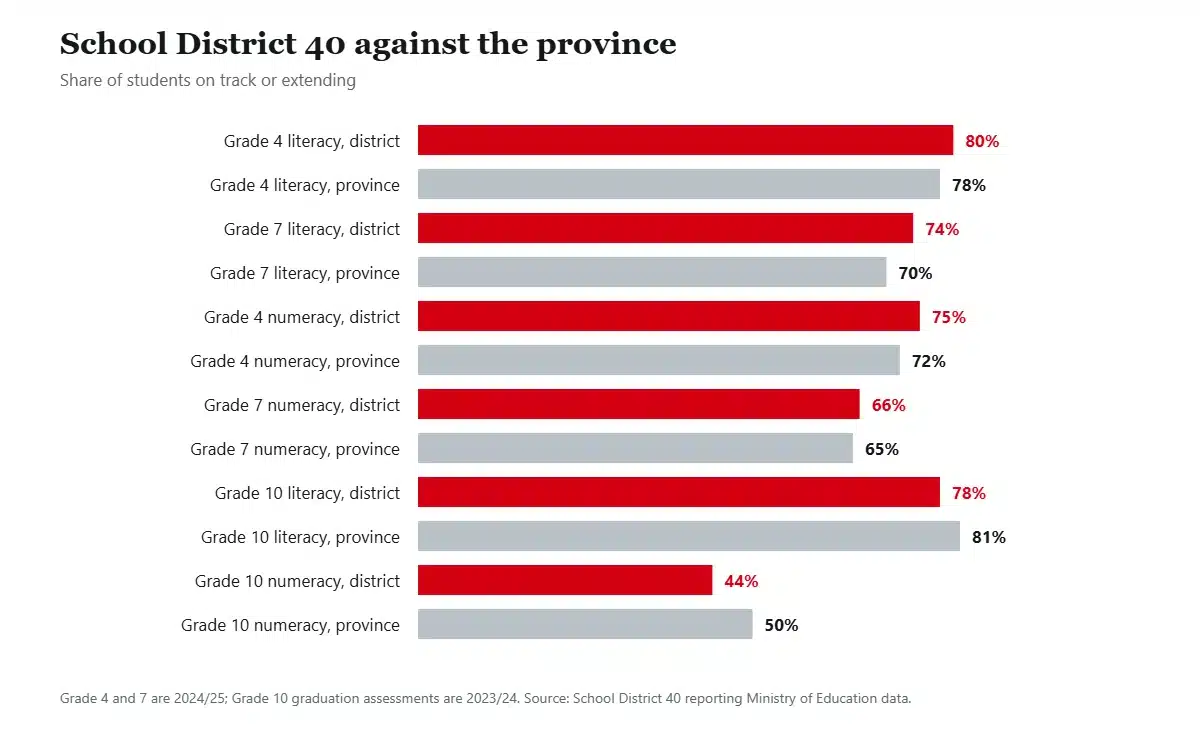
School District 40 runs 8,396 school-age students across seventeen sites, which makes it small by Metro Vancouver standards. At the elementary and middle school level it beats the province on all four measures, by two to four points.
Then the picture inverts. On the Grade 10 graduation literacy assessment the district ran 78 per cent against a provincial 81, and on numeracy 44 against 50. The five-year completion rate for students with a designation fell to 48 per cent in 2023/24, down from 63 two years earlier, which is the district’s weakest trend line and one it publishes itself.
New Westminster Secondary, which every student in the city eventually attends, was replaced in January 2021 at a cost of $106.5 million for 1,900 seats, replacing a building that had been in service since 1949. The province called it one of the largest school capital projects in the province’s history.
What there is to do
The headline facility is new. təməsew̓txʷ Aquatic and Community Centre opened in 2024, the largest capital project the city has ever built at 10,644 square metres, replacing the old Canada Games Pool and Centennial Community Centre. Its name is the hən̓q̓əmin̓əm̓ word for sea otter house. Inside are an eight-lane 50-metre pool with an adjustable floor, a dive tank with a five-metre platform, a leisure pool with a lazy river, two gymnasiums, four pickleball courts and a fitness centre. The building is LEED Gold, accessibility certified gold, and Canada’s first completed all-electric facility to reach the Green Building Council’s zero carbon design standard.
The usage numbers are the striking part. Council recorded 518,076 drop-in recreation participations in 2024 in a municipality of about 92,000 people, plus 25,679 registered programme participants and 295,129 library visits.
Queen’s Park has been the flagship since 1887 and covers 75 acres, with an arena, a sportsplex, a 2,000-seat lit stadium, a bike skills park, a rose garden and a bandshell currently closed for construction. Westminster Pier Park on the river opened in 2012, built half on land and half on 3,600 pilings, with a 325-metre boardwalk. It burned for more than ten days in September 2020 and reopened in April 2021. Together with the Waterfront Esplanade it forms what the city describes as a 2.5 kilometre linear waterfront park.
Growth
The 2021 census counted 78,915 residents. BC Stats put the 2024 estimate at 92,433, and Metro Vancouver projects 137,118 by 2051, a 48 per cent increase over 27 years.
The building is not keeping pace with that on a regional view. CMHC recorded 587 housing starts in the New Westminster zone in 2025, of which 519 were apartments. That is 2.16 per cent of the region’s starts from a city holding 2.96 per cent of its people, or about three-quarters of a proportional share. One year in an apartment-dominated market swings hard on whether a tower happened to break ground, so do not read too much into a single figure, but the direction is the opposite of the Tri-Cities, which build well above their share.
The weather, and a gap worth admitting
Environment and Climate Change Canada publishes no climate normals for New Westminster. There is no station here in either the current or the previous normals period, so any figure you see labelled as New Westminster’s rainfall has been borrowed from somewhere else.
What can be said geographically is that the city sits in the Fraser lowland between the airport at the coast and the higher, wetter Burnaby and Coquitlam slopes, so it is wetter than the airport and drier than the hills. For scale, the Burnaby Capitol Hill station at 183 metres of elevation averaged 1,946.2 mm a year over 1981 to 2010, with November at 308.1 mm and July at 62.4. That is the pattern: mild, wet winters and dry summers.
The honest downsides
Freight rail first, because it is the best documented and the least discussed. Four railways run through the city, along with VIA and Amtrak passenger services. There are 24 level crossings, and only five have achieved train whistle cessation. Nineteen have not, several with no scheduled date at all, and a freight whistle is required to reach 96 decibels measured 30 metres away. If you are buying near a crossing, look up its status before you sign.
Then the traffic, which follows from geography. New Westminster is where the region’s road network crosses the Fraser, and the city has been complaining about it in its own documents for years. Its truck route review put it bluntly: the great majority of goods movement through the city no longer has an origin or destination in it. When the Port Mann Bridge was tolled, heavy truck volumes on Royal Avenue rose 86 per cent in a year as drivers rerouted. Its transportation plan recorded East Columbia and Brunette at 45,000 vehicles a day and Stewardson Way at 35,000.
Those figures are a decade old and two things have changed since: the Port Mann tolls came off in 2017, and the Pattullo has been replaced. Take them as documented history rather than today’s counts.
As for the bridge, the disruption is ending rather than starting. The stal̕əw̓asəm Bridge opened all four lanes on 14 February 2026 and demolition of the 1937 Pattullo is now under way, which takes about two years and keeps the Columbia Street ramps and path connections unfinished until then.
Flooding is a real constraint on part of the city rather than all of it. About five of the city’s twelve square kilometres sit inside the mapped floodplain, taking in Queensborough and stretches of the mainland waterfront. Queensborough is behind a dyke built in the 1960s; the downtown waterfront is not diked at all.
And homelessness. The 2025 point-in-time count found 217 people in New Westminster, up from 203 in 2023. That rise of 6.9 per cent is smaller than the region’s 8.5, and two-thirds of those counted were sheltered. But the city carries 4.2 per cent of the region’s homeless population on about three per cent of its residents, which is what happens when a small city hosts a disproportionate share of the region’s shelter and social service capacity.
So who is it for
It suits anyone whose work is downtown and who wants a shorter, simpler commute than the Tri-Cities or the Fraser Valley offer, at prices below both Vancouver and Burnaby.
It suits people who want to live without a car, because five stations in a small city and a bus network built to feed them is about as good as Metro Vancouver gets outside Vancouver itself.
It suits families who value being ten minutes from a Level One trauma centre and want a small district where the elementary results are above average.
It suits you less if you want to work where you live, if you need a big detached house, if a train whistle at three in the morning would end you, or if you want somewhere that will look the same in 2051. That last one the region’s own projections settle for you.
Frequently asked questions
How long is the commute from New Westminster to downtown Vancouver?
Between 27 and 36 minutes in the train depending on the station, with no transfer, because all five stations are on the Expo Line and both of its branches run to Waterfront. Door to door, budget 40 to 55 minutes.
Is New Westminster a good place to raise a family?
On the published measures it is decent. The school district beats the province on all four Grade 4 and Grade 7 assessments, recreation facilities are unusually good for a city this size, and Royal Columbian is a few minutes away. The Grade 10 results run below the province, and the district publishes that itself.
Does the West Coast Express stop in New Westminster?
No. Its eight stations run from Mission City to Waterfront via the Tri-Cities and Maple Ridge, and none of them is in New Westminster. The city’s rail service is SkyTrain, which runs all day in both directions and is the better deal.
Is the train noise in New Westminster bad?
It depends entirely on the street. Four railways cross the city and only five of 24 level crossings have whistle cessation in place, with a required minimum whistle volume of 96 decibels at 30 metres. The city publishes the status crossing by crossing, so check the one nearest the address you are considering.
Is New Westminster growing?
Quickly. From 78,915 at the 2021 census to a 2024 estimate of 92,433, with Metro Vancouver projecting 137,118 by 2051. The city is building at about three-quarters of its proportional share of the region’s new homes, almost all of it apartments.
How we put this together
Transit figures come from TransLink, the jobs and population projections from Metro Vancouver, hospital information from Fraser Health and provincial news releases, college figures from Douglas College’s accountability report to the province, school results from School District 40’s own reporting of Ministry of Education data, recreation and traffic figures from the City of New Westminster’s annual report and transportation documents, housing starts from CMHC, and the homeless count from the Homelessness Services Association of BC.
Three things we left out on purpose. There is no New Westminster rainfall figure here, because Environment and Climate Change Canada has no station in the city. We give no total bed count for Royal Columbian, because Fraser Health does not publish one and the 388 figure covers the new tower only. And we have not given the district’s provincial comparators for graduation completion rates, because those particular figures could not be read reliably from the source.
Sources
- TransLink, SkyTrain station travel times
- TransLink, SkyTrain operating pattern from October 2016
- TransLink, pricing and fare zones
- Metro Vancouver, Growth Projections 2025 Update
- Fraser Health, Royal Columbian Hospital redevelopment
- Province of British Columbia, opening the Jim Pattison Acute Care Tower
- Douglas College, institutional accountability plan and report 2024/25
- School District 40, enhancing student learning report
- Province of British Columbia, New Westminster Secondary School opening
- City of New Westminster, təməsew̓txʷ Aquatic and Community Centre
- City of New Westminster, annual report 2024
- City of New Westminster, railways and whistle cessation
- City of New Westminster, flood management
- Province of British Columbia, stal̕əw̓asəm Bridge opening
- 2025 point-in-time homeless count for Greater Vancouver
- Environment and Climate Change Canada, climate normals
Made your mind up? Our area guide covers which part of the city suits which household, the cost breakdown prices out tax, utilities and the commute, and the crime numbers deal with the question most people ask next. When you have an address, tell us where you are moving from.
