

Surrey is not one place, and choosing between its parts is less about ranking them than about working out which trade you want to make. Cheapest housing and the worst transit? Best transit and the lowest incomes? A SkyTrain station arriving in 2029, or one that never came at all?
This guide walks all six of Surrey’s communities using the City’s own census profiles and current benchmark prices, and it says plainly who each one suits.
One piece of housekeeping first, because it trips people up. Six communities appear on the City’s website: City Centre, Guildford, Fleetwood, Newton, Cloverdale and South Surrey. Its draft Surrey 2050 official community plan, released in February 2026, uses eight, splitting Clayton out of Cloverdale and Grandview and Semiahmoo out of South Surrey. In the plan’s language a town centre is the commercial core inside a community rather than the community itself. So if a realtor tells you Clayton is its own thing, they are reading the newer document.
The quick comparison
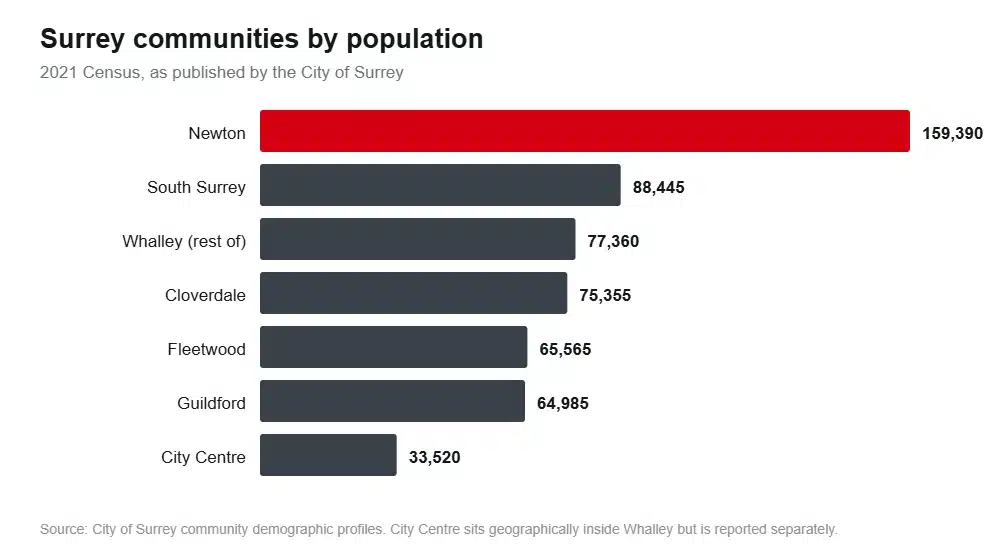
| Community | Population | Growth 2016–21 | Avg age | Avg household income | Owners | Transit to work |
|---|---|---|---|---|---|---|
| City Centre | 33,520 | +24% | 38 | $77,200 | 45% | 32% |
| Whalley (rest of) | 77,360 | +2% | 38 | $111,900 | 59% | 20% |
| Guildford | 64,985 | +7% | 40 | $109,800 | 69% | — |
| Fleetwood | 65,565 | +5% | 40 | $124,000 | 77% | — |
| Newton | 159,390 | +7% | 38 | $116,100 | 67% | 13% |
| Cloverdale | 75,355 | +12% | 37 | $124,400 | 78% | 5% |
| South Surrey | 88,445 | +15% | 44 | $132,400 | 80% | 4% |
2021 Census, as published in the City of Surrey’s community profiles. Household income is for 2020. Whalley and City Centre are reported separately by the City, though City Centre sits geographically inside Whalley.
What things cost
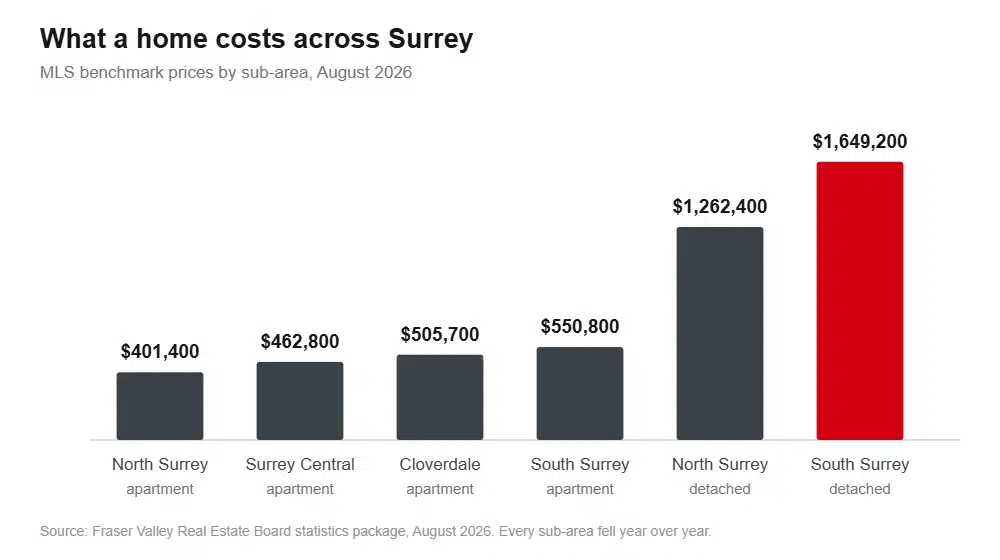
Surrey sits in the Fraser Valley Real Estate Board, not the Vancouver board, and it reports four Surrey sub-areas. These are August 2026 benchmark prices, which describe a typical property rather than averaging sales.
| Sub-area | Detached | Townhouse | Apartment | Detached, year on year |
|---|---|---|---|---|
| North Surrey | $1,262,400 | $681,400 | $401,400 | −11.5% |
| Surrey Central | $1,322,800 | $748,000 | $462,800 | −8.8% |
| Cloverdale | $1,339,700 | $757,200 | $505,700 | −6.2% |
| South Surrey & White Rock | $1,649,200 | $820,300 | $550,800 | −7.5% |
Source: Fraser Valley Real Estate Board statistics package, August 2026. Every Surrey sub-area and property type fell year over year; the board described a sales-to-active-listings ratio of 10 per cent as a deepening buyer’s market.
A North Surrey apartment at $401,400 against a South Surrey detached house at $1,649,200 is a four-fold spread inside one municipality. Rent shows the same pattern more gently: the average asking rent for a Surrey one-bedroom was $1,794 in July 2026, against $2,377 in Vancouver.
Surrey City Centre and Whalley
Suits: renters, first-time condo buyers, students, hospital and university staff, anyone without a car.
Towers dominate only in City Centre: 45 per cent of its homes are high-rise apartments, against 0.2 per cent in Newton. It grew 24 per cent between 2016 and 2021, faster than anywhere else in the city, and it is the only Surrey community where renters outnumber owners.
The City calls it the region’s emerging second downtown, and the ~680-hectare plan area is comparable in size to Vancouver’s downtown peninsula. Surrey Central and King George stations both sit inside it, 39 and 40 minutes from Waterfront. Nearly a third of residents commute by transit, a share nothing else in Surrey approaches.
Here is the counterweight, and it belongs in any honest guide: City Centre has the lowest average household income of any Surrey community at $77,200, an unemployment rate of 10.4 per cent in 2021, and 15 per cent of residents in low income. Whalley outside the City Centre boundary is a different animal, with an average household income of $111,900 and mostly ground-oriented housing.
What is actually there: City Hall and Civic Plaza, the flagship City Centre Library, SFU Surrey, KPU Civic Plaza, Surrey Memorial Hospital, Holland Park, Chuck Bailey Recreation Centre, and Green Timbers Urban Forest on the eastern edge. Council endorsed an entertainment district here in October 2025.
Guildford
Suits: Highway 1 commuters, Fraser Heights buyers wanting a larger detached home, people who like everything in one place.
Two communities live under one name. Around the mall you get mature, mixed neighbourhoods; up the slope towards the Fraser River you get Fraser Heights, larger lots and a well-regarded school catchment. Guildford has Surrey’s highest immigrant share at 52 per cent, and the widest language mix of the six: English at home for 63 per cent, then Mandarin, Tagalog, Korean and Punjabi.
Guildford Town Centre is roughly 1.2 million square feet with more than 200 retailers, and ranks among Canada’s most productive shopping centres by sales per square foot. Tynehead and Surrey Bend regional parks are both here, and the Port Mann Bridge is minutes away.
The transit story is the one to understand before buying. The 2023 Guildford Plan was originally built around light rail along 104 Avenue linking Guildford to City Centre and Newton. That project was cancelled in November 2018 after the civic election, and the plan was approved without it. Guildford is the one Surrey town centre whose rapid transit was cancelled and never replaced. Today the link is the R1 RapidBus to Surrey Central, and that is the plan for the foreseeable future.
Fleetwood
Suits: families buying ahead of infrastructure, and anyone who can trade current transit for a 2029 upgrade.
Fleetwood is the clearest bet-on-the-future play in Surrey. It has no rapid transit today. Three stations are about to arrive: Green Timbers at 140 Street, 152 Street, and Fleetwood at 160 Street, with Bakerview at 166 Street on its eastern edge.
The Fleetwood Plan rezones for that arrival, allowing up to 36 storeys and a floor area ratio of 4.5 in the core, stepping down through high-rise, mid-rise and townhouse bands, with new parks and public space planned across about 20 per cent of the plan area. The area currently reads as detached and townhouse suburbia, and it will not in fifteen years.
Ownership here is the second-highest of the six at 77 per cent, on an average household income of $124,000. Nineteen per cent of residents speak Punjabi at home. Housing cost burden runs slightly below the city average: 29 per cent of renters and 21 per cent of owners spend 30 per cent or more of income on housing, against 31 and 24 citywide.
The caution is simple. Late 2029 is the current in-service estimate for the SkyTrain extension, not a promise, and you would be paying for it now.
Newton
Suits: buyers who want the most house per dollar, South Asian families wanting community and food infrastructure close by, people working in Surrey’s industrial economy.
Newton is by far Surrey’s largest community at 159,390 people, 28 per cent of the city, and it has the lowest average dwelling value of the six at $1,082,000 in 2021. Punjabi is spoken at home by 38 per cent of residents; the City describes Newton as the region’s largest South Asian community. The Vaisakhi parade here draws over 400,000 people.
The community also holds Surrey’s largest inventory of serviced industrial and mixed employment land, and the jobs that come with it in food and beverage manufacturing, metal fabrication, wood and furniture. KPU’s main Surrey campus is here, along with the Bell Performing Arts Centre, Bear Creek Park and Unwin Park, described by the City as the region’s largest fully accessible playground.
Two honest drawbacks. 82.6 per cent of working residents drive and 13.2 per cent take transit, and the Newton Town Centre Plan was written around a King George Boulevard rapid transit line that was suspended in 2018. Newton Exchange is the terminus of two RapidBus routes, R1 and R6, and R6 gets you to Scott Road Station, 34 minutes from Waterfront. No SkyTrain station serves Newton and none is planned.
Cloverdale
Suits: young families, people who want a walkable historic main street, buyers positioning for both SkyTrain and the new hospital.
Cloverdale has the youngest average age of the six at 37 and the second-highest ownership rate at 78 per cent. It also has the lowest immigrant share at 30 per cent and the highest Indigenous population at 3.5 per cent, so it feels demographically different from the rest of north Surrey.
Two large things are arriving at once. Three Surrey Langley SkyTrain stations serve the Clayton and Cloverdale side, at Hillcrest-184 Street, Clayton and Willowbrook just over the boundary. And the new Surrey hospital and BC Cancer Centre is under construction here, which is why the City reopened the Cloverdale Town Centre Plan in 2023 and expanded its scope again in 2024. That plan update runs into 2027.
Cloverdale is where Surrey keeps its history: the Museum of Surrey and Surrey Archives in the 1912 municipal hall, the Cloverdale Rodeo running since 1945, and what the City calls the largest Canada Day celebration in western Canada. Clayton Community Centre combines arts, recreation and a library under one roof. KPU Tech is here too.
The current drawback is transit. Only 4.9 per cent of Cloverdale residents commute by transit today, the second-lowest of the six.
South Surrey
Suits: downsizers, retirees, higher-income families, cross-border commuters.
This is the largest community by land area, running from the ocean to Langley and from 48 Avenue to the US border, and it contains a set of quite distinct places: Crescent Beach, Ocean Park, Grandview Heights, Rosemary Heights, Darts Hill, Campbell Heights and Semiahmoo Town Centre.
South Surrey is the oldest, wealthiest and most car-dependent part of Surrey, and the data says all three at once. Average age 44, with 22 per cent of residents aged 65 or over. Average household income $132,400, the highest. Average dwelling value $1,322,000, also the highest. Home ownership 80 per cent. Transit commuting 4.3 per cent, the lowest. Nearly half its homes are detached houses.
Growth ran 15 per cent between 2016 and 2021, faster than any other Surrey community except City Centre, and Semiahmoo Town Centre has a plan approved in 2022 to add compact, transit-supportive density across 136 hectares.
None is planned here either. The committed answer is the King George Boulevard bus rapid transit line: TransLink puts it at 19 kilometres and 12 stations with five-minute peak frequency, cutting the Surrey City Centre to Semiahmoo trip to roughly 40 minutes. Surrey Council moved it into full design in May 2026, and TransLink estimates roughly three years of construction once it is funded. Funding is not fully secured.
What you get: Grandview Heights Aquatic Centre, South Surrey Athletic Park, Redwood Park, Elgin Heritage Park, Sunnyside Acres Urban Forest, Crescent Beach and Blackie Spit, and two US land border crossings.
The SkyTrain question, answered once
The Surrey Langley SkyTrain is 16 kilometres of raised track running along Fraser Highway from King George Station to 203 Street in Langley City, budgeted at $5.996 billion, with eight new stations and an anticipated in-service date of late 2029.
| New station | Serves |
|---|---|
| Green Timbers (140 St) | Fleetwood, west edge |
| 152 Street | Fleetwood |
| Fleetwood (160 St) | Fleetwood town centre |
| Bakerview-166 Street | Fleetwood, east edge |
| Hillcrest-184 Street | Clayton / Cloverdale |
| Clayton | Clayton |
| Willowbrook | Langley, Cloverdale edge |
| Langley City Centre | Langley City |
Source: Surrey Langley SkyTrain, Province of British Columbia.
Read that list against the map and the picture is stark. Fleetwood and the Clayton/Cloverdale side get stations. Guildford, Newton and South Surrey do not, and for Guildford and Newton the projects that would have served them were cancelled in 2018. If rapid transit matters to you, that single fact should carry more weight than any neighbourhood ranking.
Surrey’s existing Expo Line stations, timed from Waterfront: Scott Road 34 minutes, Gateway 37, Surrey Central 39, King George 40. Those are in-vehicle times, so add walking, waiting and transfers.
Choosing between them
Best transit today: City Centre, by a distance. Two SkyTrain stations, and a third of residents commute without a car.
Best transit in five years: Fleetwood, with three stations arriving.
Cheapest entry: North Surrey apartments at a $401,400 benchmark, or Newton for detached space per dollar.
Quietest: Cloverdale and South Surrey, which also report the fewest crimes against persons in the city.
Family buying a house: Cloverdale for the age profile and the incoming hospital, Fleetwood if you can wait for the train.
Most established: South Surrey, at the highest price in the city.
Frequently asked questions
Which part of Surrey is best to live in?
Depends entirely on whether you need transit. City Centre is the only part with SkyTrain access today and the only one where a car is genuinely optional; it is also the lowest-income community in the city. South Surrey is the most established and most expensive. Transit is about to improve in Fleetwood and Cloverdale, and nowhere else.
Is Clayton part of Cloverdale?
On the City’s current community list, yes. The draft 2050 official community plan treats Clayton as one of eight distinct communities in its own right, so you will see it both ways depending on which document you are reading.
Where is the cheapest place to live in Surrey?
North Surrey on the buying side: an apartment benchmark of $401,400 in August 2026, roughly $150,000 below South Surrey. Newton has the lowest average dwelling value among the six communities in the 2021 census.
Which Surrey neighbourhoods are getting SkyTrain?
Fleetwood gets three stations and Clayton/Cloverdale get two, plus Willowbrook on the Langley boundary. Nothing is planned for Guildford, Newton or South Surrey. The line is due to open in late 2029.
Is South Surrey worth the extra money?
It buys you the oldest and highest-income community in the city, near the ocean, with the largest lots, and it costs roughly $330,000 more for a detached house than North Surrey. The one thing it does not buy is transit: 4.3 per cent of residents commute by transit and the bus rapid transit line that would improve that is not yet funded.
How we put this together
Demographic figures come from the City of Surrey’s own 2021 census community profiles, prices from the Fraser Valley Real Estate Board’s August 2026 statistics package, and transit facts from TransLink and the provincial Surrey Langley SkyTrain project.
Two things we have deliberately left out. Surrey’s census profiles use a “row/townhouse” category that appears to absorb duplexes and suited houses, so we have not quoted townhouse percentages. And there is no official population figure for each community more recent than 2021, so the shares above will have shifted, particularly in City Centre and Cloverdale.
Sources
- City of Surrey, community demographic profiles
- City of Surrey, Our Communities
- City of Surrey, draft Official Community Plan: Surrey 2050
- Fraser Valley Real Estate Board, August 2026 statistics package
- Surrey Langley SkyTrain project overview
- TransLink, Bus Rapid Transit program
- TransLink, SkyTrain station travel times
- City of Surrey, bus rapid transit
Narrowed it down? Read our look at what Surrey’s crime numbers actually say, then the wider case for living here if you are still deciding between cities. When you are ready, tell us where from and where to.
