

Surrey gets described two ways and neither is accurate. One version is a crime-ridden suburb people escape from. The other is Canada’s fastest-growing boomtown about to overtake Vancouver.
Here is what the records actually show: Surrey added more people in a year than any other municipality in British Columbia, has a lower crime rate than Vancouver, Burnaby or Richmond, and is roughly $300,000 cheaper for a detached house. It is also short 6,500 school seats, has 353 portable classrooms, and does not have enough jobs for its own residents.
Below is the case for and against, with the numbers behind both.
The size of the place
BC Stats put Surrey at 703,531 people in July 2025, up 13,377 in a year. That was the largest absolute annual gain of any municipality in the province. The City’s own estimate, published in December 2025, is 733,760.
Worth correcting two things you will read elsewhere. The city is not the fastest-growing municipality in BC by rate; Langford and Squamish both grew 3.6 per cent against Surrey’s 1.9 per cent. And Surrey is not about to overtake Vancouver. Metro Vancouver’s forecast, revised in summer 2025, puts the crossover at 2038, with Surrey passing one million residents around 2051.
Twelve years out is a planning horizon, not a headline. That does explain why so much of Surrey is currently a construction site.
What Surrey genuinely gets right
Housing costs less, by a lot
| Benchmark, July 2026 | Detached | Townhouse | Apartment |
|---|---|---|---|
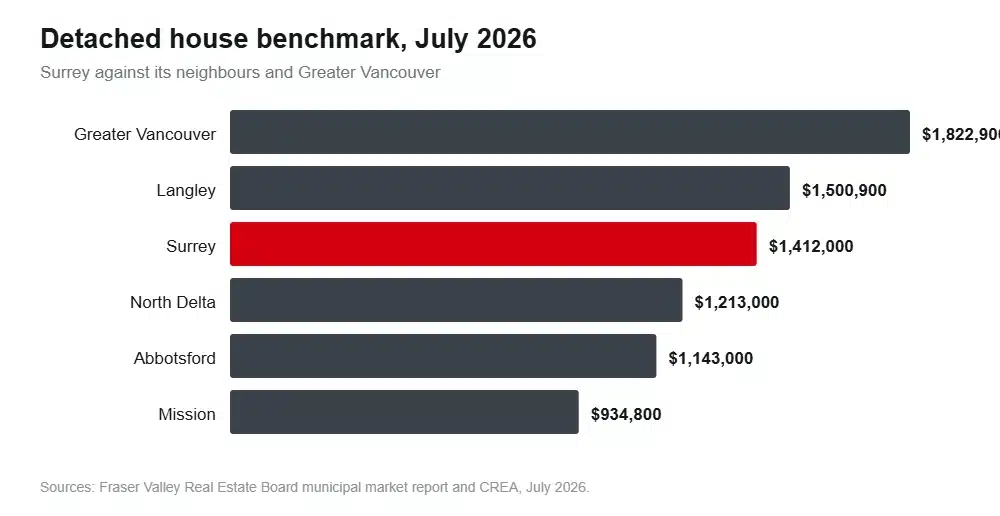
| Surrey | $1,412,000 | $772,700 | $456,100 |
| Langley | $1,500,900 | $811,400 | $534,200 |
| North Delta | $1,213,000 | $848,900 | $496,100 |
| Abbotsford | $1,143,000 | $602,000 | $380,900 |
| Mission | $934,800 | $630,500 | $425,800 |
Source: Fraser Valley Real Estate Board municipal market report, July 2026.
Set that against Greater Vancouver’s July 2026 benchmarks of $1,822,900 detached and $688,000 apartment and the gap is roughly $410,000 on a house and $230,000 on a condo. Rent tells a similar story: a Surrey one-bedroom averaged $1,794 in asking-rent data for July 2026, against $2,377 in Vancouver.
The crime reputation does not match the crime record
Surrey recorded 52.5 Criminal Code offences per 1,000 residents in 2024, below Vancouver at 60.4, New Westminster at 60.8, Burnaby at 57.2, Richmond at 56.8 and Abbotsford at 55.1. Its Crime Severity Index has sat below both the provincial figure and Vancouver’s every year since 2021, and its property crime rate has halved since 2016.
Violence rose in 2025 and again in 2026, driven substantially by an extortion campaign targeting South Asian businesses. We have covered all of this properly in a separate look at Surrey’s crime numbers, including what the police force transition does to the year-over-year comparisons.
Space, parks and an actual economy
Surrey holds roughly 2,700 hectares of parkland across around 250 parks, and the City plans to keep providing 4.2 hectares per 1,000 residents as it grows. Green Timbers Urban Forest, Bear Creek Park, Tynehead, Crescent Beach and Blackie Spit are all inside the municipal boundary.
This is not a bedroom-community economy. More than 20,000 businesses operate here, added roughly 3,000 in 2023 alone, and has grown its business count 23 per cent since 2017. It holds 22 per cent of Metro Vancouver’s industrial land. Some $12 billion of new construction has gone up since 2017. Fraser Health, School District 36, the RCMP, the City itself, KPU, Coast Capital, ICBC and FortisBC are among the largest employers.
Roughly 28,000 students attend SFU Surrey and KPU campuses in the city, and three of KPU’s five campuses are here.
Genuinely, structurally diverse
About 45 per cent of Surrey residents are immigrants, and the school district reports students speaking more than 195 languages. That plays out differently in each community: Punjabi is spoken at home by 38 per cent of Newton residents, Mandarin by 12 per cent in South Surrey, and Guildford runs the widest mix in the city.
Where it falls down
The schools problem is real and it is documented
This is the complaint you will hear most, and unlike most complaints it comes with numbers from the district itself.
- The district has the largest student enrolment in British Columbia, with the district describing 83,000-plus students across 130 schools.
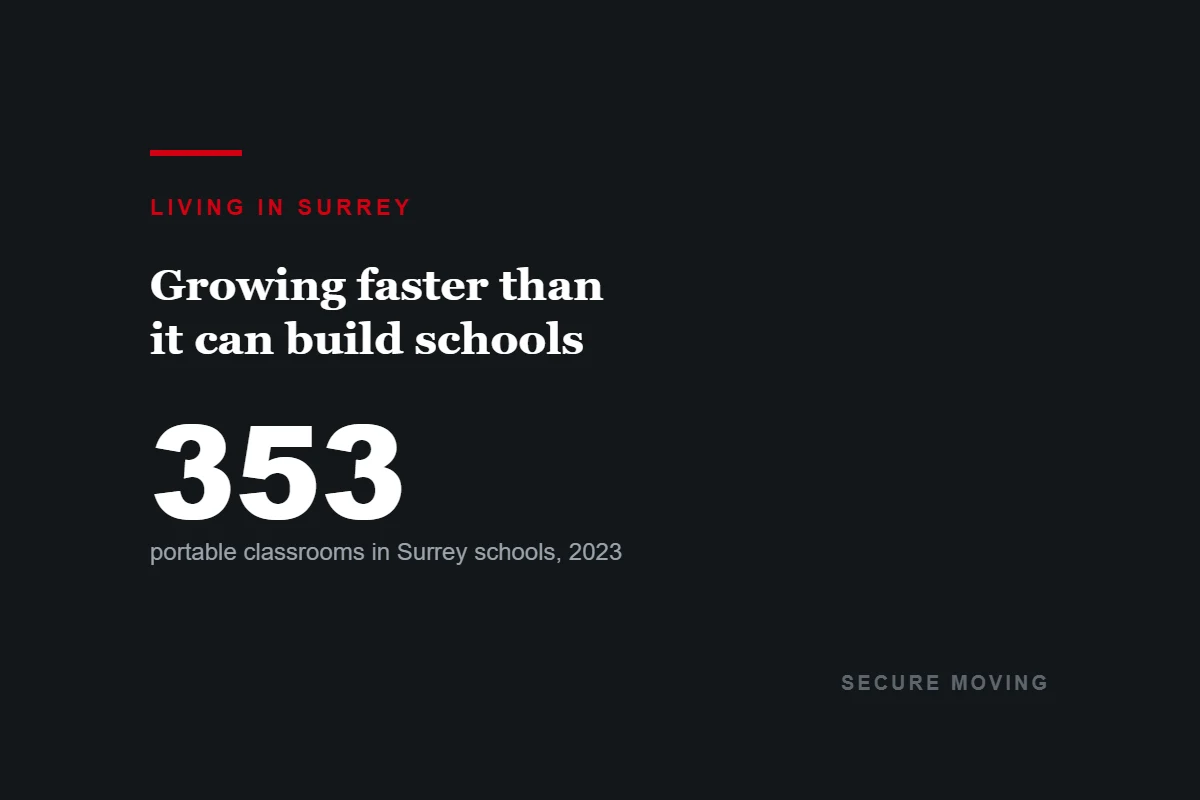
- Portable classrooms went from 236 in 2000 to 353 in 2023. Since 2016/17 the portable count has grown by 106 despite six new schools opening.
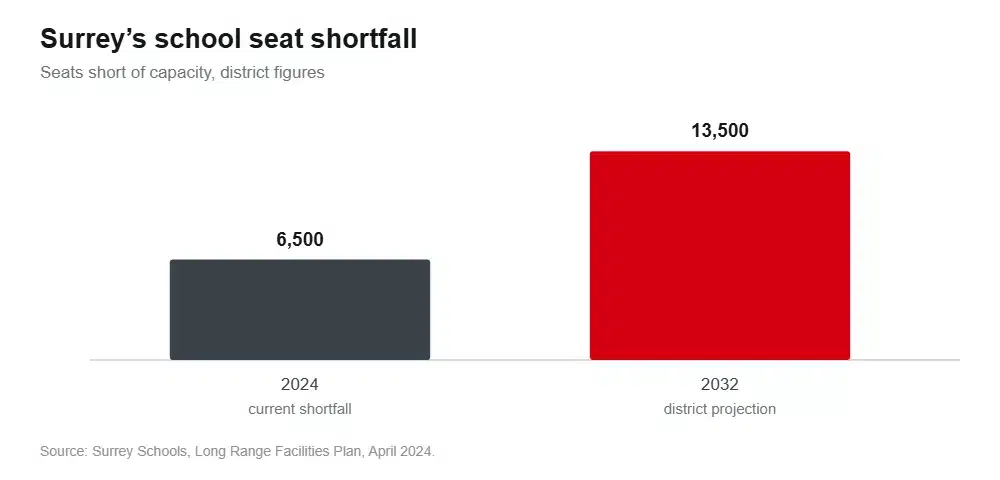
- Surrey Schools is short over 6,500 seats, and projects that shortfall to roughly double to over 13,500 by 2032.
- In its own framing, the current deficit equals a 1,500-student secondary school plus ten 500-student elementary schools.
The funding gap explains why. Surrey’s 2027/28 five-year capital submission asked the province for 48 projects worth $5.41 billion. In the one year the district documents the outcome, it requested ten new schools, seventeen additions and fourteen site acquisitions, and in March 2024 the province supported one new elementary school, one secondary addition and one site acquisition.
As of June 2026, every Surrey school project actually under construction is an addition to an existing school. One new school, Redwood Park Elementary, sits in planning awaiting approval.
One caveat we will not hide: the district’s own 2026/27 budget projects enrolment falling by roughly 2,900 full-time-equivalent students. There is no published explanation, and it may be conservative budgeting rather than a forecast. It sits oddly against the overcrowding story, and we would rather flag it than pretend it does not exist.
Healthcare is expanding, and the wait-time data is missing
Surrey Memorial is the second-largest hospital in the province and, according to Fraser Health, has British Columbia’s busiest emergency department. The Surrey Hospitals Foundation puts 2025 volume at over 182,500 visits and calls it the busiest in the country. Around 6,000 babies are born there each year.
Capacity has been going in. Cardiac catheterisation suites opened in December 2025, the first south of the Fraser. Interventional radiology opened in January 2026 at roughly triple the previous capacity. Internal medicine beds went from 30 to 90. Dialysis stations rose to 60, a 55 per cent increase. And a new hospital with a BC Cancer Centre is under construction in Cloverdale, with an emergency department of 55 treatment spaces, five operating rooms and four procedure rooms.
Now the honest part. Fraser Health does not publish emergency wait times for Surrey Memorial. The public wait-time site covers Vancouver, Richmond and the North Shore but not Surrey, and Fraser Health’s own hospital report cards cover eleven hospitals without including Surrey Memorial. If someone quotes you a Surrey ER wait in hours, that figure did not come from a published dataset.
On family doctors, the City has started funding clinics itself. The first, in City Centre, opened with ten doctors each committing to attach at least 1,250 Surrey residents, with a second due in Newton in autumn 2026 and up to ten planned. A city funding medical clinics is not a sign of a well-served population.
Not enough jobs, and not enough transit to reach them
Surrey has 0.75 jobs for every resident worker: three jobs in the city for every four employed residents. Reaching a million people, by the City’s own economic strategy, would require 309,000 more jobs than exist here today.
The transit position is uneven in a way that matters enormously depending on where you land. City Centre has two SkyTrain stations and a third of residents commuting by transit. Cloverdale and South Surrey sit at around 5 and 4 per cent. Fleetwood and Clayton get SkyTrain stations in late 2029; Guildford and Newton had their rapid transit projects cancelled in 2018 and have nothing scheduled to replace them.
One thing that cuts the other way, and it surprised us: between 2016 and 2021 Surrey commutes over 60 minutes fell 4.9 per cent, jobs within 30 minutes of home rose 4.3 per cent, and commuting within Surrey rose about 3 per cent. The traffic complaint is real, but the trend was moving the right way.
Renting here is hard
Surrey’s purpose-built rental vacancy rate was 1.7 per cent in 2024, and it has been below the healthy 3 to 5 per cent range every year since 2014. Average rent doubled from $850 in 2014 to $1,700 in 2024. A renter on Surrey’s median individual income of $38,312 could afford $958 a month; the actual cost of a one-bedroom was $2,145. Around 28 per cent of Surrey renter households were in core housing need in 2021.
Asking rents have eased across BC since, but the underlying shortage has not gone away, and CMHC expects Surrey vacancies to rise partly because new studios and one-bedrooms are the wrong stock for the households that need housing here.
Flooding is a genuine long-term issue
The coastal floodplain covers 20 per cent of Surrey’s land area. The Serpentine and Nicomekl catchment runs to 334 square kilometres, of which 59 are lowland floodplain, and the area has been dyked since the 1910s. Federal funding of $76.6 million supports the City’s coastal flood adaptation strategy. If you are buying in the lowlands, this belongs on your diligence list.
What it costs to be here
Surrey’s 2026 property tax increase was 2.6 per cent, about $75 for an average assessed single-family home, with no increase to the roads and traffic safety levy. The total 2026 residential rate is $3.42731 per $1,000 of assessed value, though only part of that is the City’s: school tax accounts for $1.13480 and TransLink for $0.35860. A $300 capital parcel tax is collected alongside.
For comparison, Vancouver’s 2026 total residential rate is $3.36394 per $1,000, on a much higher assessment base.
So is it a good place to live?
Yes, if you want space and a yard for a price that no longer exists closer in, you work in Surrey or somewhere reachable from it, and you are choosing a community deliberately rather than buying whatever comes up. Surrey rewards people who do their homework on which part they land in more than almost any city in the region.
Be careful if your children are entering the school system in a growth area, you depend on transit and are not looking at City Centre, Fleetwood or Clayton, or you need frequent specialist healthcare and want predictability about access.
Probably not, if you want walkable urban life outside City Centre, or you are renting on a modest income and have options elsewhere in the region.
Frequently asked questions
Is it a nice place to live?
For most residents, yes. Housing runs roughly $410,000 cheaper than Vancouver on a detached house, the crime rate is lower than Vancouver, Burnaby and Richmond, and there are around 2,700 hectares of parkland. The pressure points are schools, transit outside a few areas, and rental affordability.
Is Surrey growing too fast?
The infrastructure evidence says the growth is outrunning the funding rather than the planning. School capacity is the clearest case: 353 portables and a 6,500-seat shortfall against a capital request the province funds a fraction of. The city itself added 13,377 people in the year to July 2025, more than any other BC municipality in absolute terms.
Will Surrey be bigger than Vancouver?
On Metro Vancouver’s current forecast, in 2038. Surrey is projected to reach about one million residents by 2051 against Vancouver’s 953,000.
Is it cheaper than Vancouver?
Substantially, on housing. A Surrey detached benchmark of $1,412,000 against $1,822,900 for Greater Vancouver in July 2026, and a one-bedroom asking rent of $1,794 against $2,377. Property tax rates are close, but Surrey’s assessments are lower. We priced the Vancouver side out line by line in a separate guide.
What is the downside of living in Surrey?
School overcrowding, uneven transit, a jobs deficit of roughly one job per four residents, no published emergency wait times for the province’s busiest ER, and a rental market that has been below healthy vacancy every year since 2014.
How we put this together
Figures come from the City of Surrey, Surrey School District 36, Fraser Health, BC Stats, the Province of British Columbia, Metro Vancouver and the Fraser Valley Real Estate Board, linked where they appear.
Three gaps we ran into and would rather name. Surrey’s most recent published portable count is 353 for 2023; no district, provincial or union source publishes a 2025 or 2026 figure, so any current number you see elsewhere is not from a primary source. Surrey Memorial’s bed count and the new Cloverdale hospital’s budget, bed count and opening date are not published by Fraser Health. And every Environment Canada weather station named for Surrey stopped recording by 2011, so there is no Surrey station in the current climate normals and no sound basis for claiming Surrey’s weather differs from Vancouver’s.
Sources
- BC Stats, sub-provincial population estimates
- City of Surrey, population estimates and projections
- Surrey Schools, Long Range Facilities Plan, April 2024
- Surrey Schools, capital project progress chart
- Fraser Health, Surrey Memorial Hospital
- Fraser Health, new Surrey hospital and BC Cancer Centre
- City of Surrey, first city-supported medical clinic
- City of Surrey, Economic Strategy 2024
- City of Surrey, Housing Needs Report 2025
- City of Surrey, 2026 property tax rates
- City of Surrey, coastal flood adaptation strategy
- Fraser Valley Real Estate Board, municipal market report
- Police Resources in British Columbia, 2024
Still weighing it up? Our guide to Surrey’s six communities goes area by area on price, transit and who each one suits, and the crime numbers are worth reading before you rule any part of the city out. When the decision is made, we can quote your move.
