

Last updated: August 2026 · Every figure below is dated and attributed to its source
Mission gets described two ways, and both are lazy. Either it is the affordable Fraser Valley town with a train to Vancouver, or it is where you end up when Abbotsford got too expensive.
What it actually is: a town of roughly 48,000 on the wrong side of a big river, with a working forest behind it, a monastery on the hill, a commuter train that runs five times a day in one direction, and a hospital whose emergency department has closed overnight repeatedly.
Whether that suits you comes down to some specific things about your life. Here they are.
Mission in ten facts
| Population | 41,519 at the 2021 census; the City’s 2025 Housing Needs Report says about 48,000 |
|---|---|
| Where it is | North bank of the Fraser, across the river from Abbotsford, ~65 km east of Vancouver |
| Area | About 225 km², roughly half of it working forest |
| Regional district | Fraser Valley — not Metro Vancouver |
| Commuter rail | West Coast Express to Waterfront Station, 75 minutes, weekdays only |
| Benchmark detached home | $934,800 — the cheapest in the Fraser Valley board’s area (July 2026) |
| Schools | School District 75 — 6,577 students, 19 sites, one mainstream secondary school |
| Hospital | Mission Memorial — 24/7 emergency, with a history of overnight closures |
| Crime rate | 97 Criminal Code offences per 1,000 (2024), against a BC average of 74.0 |
| Municipal forest | Tree Farm Licence 26, about 10,900 hectares, held since 1958 |
The case for Mission
It is the cheapest detached housing in the Fraser Valley
Not “one of the cheapest.” The cheapest. A benchmark detached home in Mission was $934,800 in July 2026, the only municipality in the Fraser Valley Real Estate Board’s territory under a million dollars.
Against Abbotsford ($1,143,000), that is about $208,000. Against Langley ($1,500,900), about $566,000. For the same product, in the same region, twenty minutes apart.
It has a train to downtown Vancouver
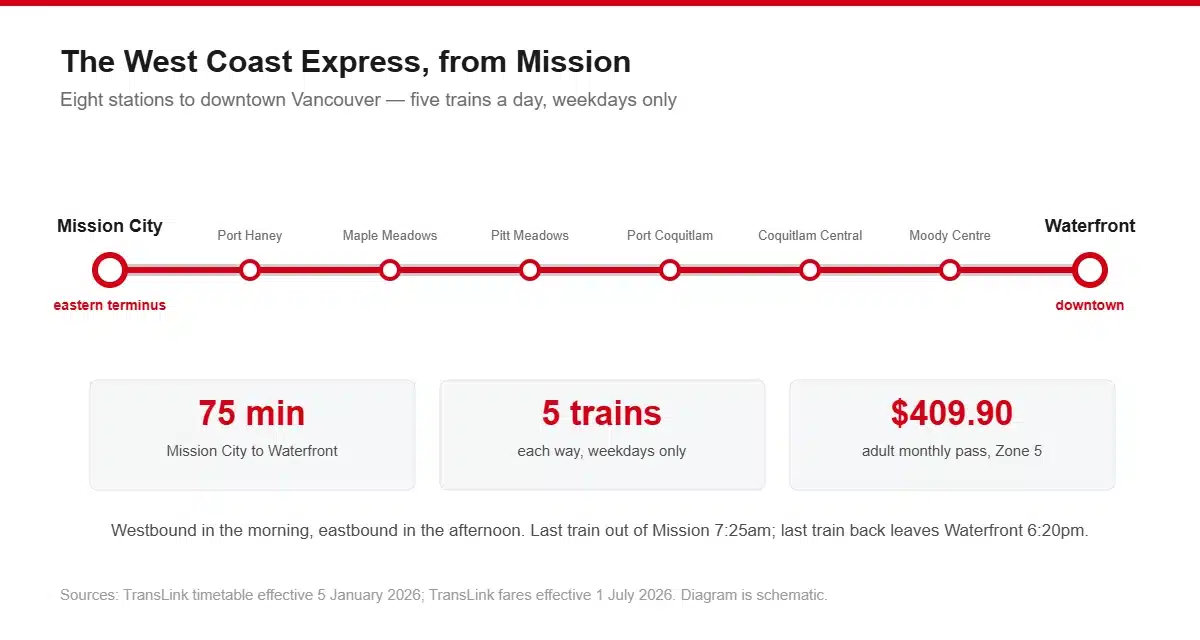
Mission City is the eastern terminus of the West Coast Express, and no other Fraser Valley community has commuter rail at all. Seventy-five minutes to Waterfront Station, sitting down, without touching Highway 1.
For the right person, a downtown office worker on a fixed weekday schedule, this is genuinely transformative, and it is the single strongest argument for living here rather than in Abbotsford. See the case against for why “the right person” is doing a lot of work in that sentence.
Half the municipality is forest, and it is staying that way
Mission has held Tree Farm Licence 26 since 1958, about 10,900 hectares across Bear Mountain, Red Mountain and Steelhead, running north of Stave Falls along Stave Lake. The annual allowable cut is 60,000 m³, roughly 0.7% of the forest a year, and the revenue funds a community reserve.
What that means day to day: Hayward Lake with a 16 km trail circuit and a developed beach, Rolley Lake Provincial Park with 64 campsites, the Stave Falls Powerhouse (a National Historic Site with a visitor centre) and a northern half of the municipality that will not become subdivisions.
Another 1,539 hectares is Agricultural Land Reserve. Mission has a hard green edge in two directions.
Housing is actually getting built
Mission’s provincial housing target is 1,798 net new units by 2029. In year one it delivered 314 units against a target of 211, or 149% of target.
That is a genuinely better record than most Lower Mainland municipalities managed. Cedar Valley is heading toward 18,000–22,000 residents, and Silverdale’s adopted Central Neighbourhood plan alone provides for 10,470 homes.
It has a character most commuter towns don’t
Westminster Abbey, a working Benedictine monastery founded as a priory in 1939 and raised to abbey status in 1953, home to around 30 monks, with a church completed in 1982 and a seminary attached. It sits on the hill above town and it is the reason Mission’s skyline is a bell tower rather than a big-box roofline.
Add the Mission Folk Music Festival (its 39th year in July 2026, at Fraser River Heritage Park) and Mission Raceway Park, with an NHRA-sanctioned quarter-mile dragstrip, a road course and a motocross track. For a town of 48,000 that is an unusual amount of actual identity.
The case against
It is a commuter town, and the commute is the whole problem
The most recent figures anyone has published on this are old (from the 2006 census, via the Fraser Valley Regional District), but they are stark: only 36% of Mission residents worked within Mission; 64% commuted out. Abbotsford’s split at the same time was 62% local, 38% out.
The 2021 census shows what that looks like now: 86% of Mission commuters drive, another 7.3% ride as passengers, and just 2.4% use public transit, of which only 0.9% is the commuter rail.
The West Coast Express is Mission’s best feature and it carries under 1% of Mission’s commuters. Almost everyone here drives.
And look closely at the train before you build a life around it:
- Five trains a day, weekdays only. No weekends, no statutory holidays.
- One direction at a time. Westbound in the morning, eastbound in the afternoon. The last train out of Mission leaves at 7:25am; the last one back leaves Waterfront at 6:20pm.
- $409.90 a month for an adult pass, plus $60 for station parking.
Work a late shift, work weekends, work anywhere other than central Vancouver, or need to leave early for a sick kid, and the train is useless to you. Then you are driving Highway 7 or crossing the Mission Bridge onto Highway 11.
Mission is not in Metro Vancouver, and it costs you
Mission is in the Fraser Valley Regional District, outside TransLink’s transportation service region. TransLink serves it under a provision of the enabling act that lets the authority operate beyond its own boundary.
The practical consequences: Mission has no seat on the Mayors’ Council that sets regional transport priorities, and pays no TransLink levy, which sounds like a saving until you notice it also means no vote on the network Mission depends on. Local buses are BC Transit’s Central Fraser Valley system, an entirely separate operation with separate fares.
The hospital’s emergency department keeps closing overnight
This is the most serious mark against Mission and it deserves to be stated plainly.
Mission Memorial Hospital has a 24/7 emergency department on paper. In practice it closed overnight six times in 2025 because of physician staffing shortages: 15–16 February, 29–30 and 30–31 March, 3–4 August, 31 October–1 November and 9–10 November. Fraser Health announced a return to full hours in January 2026, and then further closures or reduced hours followed in April, May, June and August 2026.
During closures, emergency-trained nurses stay on site to provide basic care and arrange transfers.
There is real investment underway: an $18 million emergency department expansion is under construction, increasing the department’s size by 35% and taking it from 17 to 41 care spaces, with completion projected for spring 2027. Four new emergency physicians were recruited over the past year.
But the hospital is small: a 25-bed medical inpatient unit, a 20-bed transition unit and a 10-bed hospice. Paediatrics and obstetrics are not here. For those you cross the river to Abbotsford Regional Hospital. If you are planning a family or managing a chronic condition, factor that in properly.
One secondary school, and a shrinking district
School District 75 has one mainstream public secondary school: École Mission Secondary. Wherever in Mission you buy, that is where your teenager goes.
Enrolment is 6,577 for 2025/26, down 51 students year over year, and the Ministry projects continued decline to a low of about 6,504 in 2032, a shrinking district in a growing town, which is an unusual combination and one worth asking the district about.
On the Fraser Institute’s 2025 elementary report card, Hillside Traditional Academy rated 6.8 out of 10 and the other rated Mission schools came in at 3.8, 2.6 and 2.6. That is an advocacy organisation’s ranking built on standardised tests and it measures a narrow slice of what a school does, but it is not a flattering set of numbers.
Crime runs above the provincial average
Mission recorded 97 Criminal Code offences per 1,000 residents in 2024 against a BC average of 74.0 in 2023, and the rate has been broadly flat for a decade. Mission RCMP reported police files up 7% from 2024 to 2025, with shoplifting up 37% and residential break-ins up 15%.
Homelessness counted 175 people in the 2023 point-in-time count, up from 63 in 2017.
Parts of it are floodplain
Mission sits on the Fraser. The City’s own flood plan names Silvermere Lake foreshore, Ruskin Trailer Park and Silverdale Industrial Park as undiked, and Hatzic Estates and Triple Creek Estates as low-lying. The Silverdale dike is built to a lesser agricultural standard than the main Mission dike.
This is manageable: check the City’s floodplain mapping for any address you are serious about. But it is a live consideration, not a historical one.
Taxes went up sharply this year
7.43% on the municipal portion for 2026, or 10.27% for households that also receive water, sewer and curbside waste collection. For comparison, Abbotsford’s 2026 increase was 4.94% and Surrey’s was 2.6%.
The weather
Honest answer: there is no Environment and Climate Change Canada climate normals station in Mission. The nearest station meeting World Meteorological Organization standards is Abbotsford International Airport, about 12.5 km south-southwest across the river.
Rather than quote figures from an aggregator and label them Mission’s, the fair statement is that Mission has a Fraser Valley climate: wet winters, warm dry summers, more snow than Vancouver and more sun. If you want numbers, use the Abbotsford Airport normals and understand they are a proxy from the other side of the river and a couple of hundred metres lower.
Who Mission actually suits
It works well if you:
- want a detached house and a yard at the lowest price in the Fraser Valley
- work a standard weekday schedule in downtown Vancouver and will use the train
- work in Abbotsford, which is one bridge away
- want lakes, trails and working forest at the end of your street
- are buying land or acreage inside a municipality rather than an electoral area
It works badly if you:
- work shifts, weekends, or anywhere the West Coast Express doesn’t go
- want an apartment, since Abbotsford’s are cheaper and there are more of them
- have health needs that make a reliably open emergency department non-negotiable
- want school choice at the secondary level
- need frequent local transit, since 86% of people here drive for a reason
The honest summary
Mission is a good place to live if your working life fits its one narrow channel: a weekday job in downtown Vancouver reachable by a train that runs five times each morning, or a job in Abbotsford across the bridge, or a job in Mission itself.
Outside that, the arithmetic gets harder. You are buying the cheapest detached house in the Fraser Valley, and paying for it with a river crossing, a hospital that has trouble staying open at night, one high school, and a 64% chance you’ll be commuting out.
What makes Mission genuinely different from a commuter suburb is the land: 10,900 hectares of municipal forest, the lakes, the abbey on the hill. That is not marketing; it is a real and permanent feature of the place, and it is why people who like Mission tend to like it a great deal.
Go and stand in Cedar Valley on a Tuesday morning, then drive to Hayward Lake, then look at the West Coast Express timetable next to your own working hours. You will know fairly quickly.
Frequently asked questions
Is Mission BC a good place to raise a family?
Mixed. In favour: the cheapest detached housing in the Fraser Valley, a strong outdoor setting and a genuinely community-scaled town. Against: one mainstream secondary school, a shrinking school district, weak Fraser Institute elementary ratings, and no paediatrics or obstetrics at the local hospital.
Is Mission BC a commuter town?
Yes, and openly so. The most recent published split found 64% of residents commuting out of Mission for work, against 38% in Abbotsford. In the 2021 census, 86% of Mission commuters drove and only 2.4% used transit.
How far is Mission from Vancouver?
About 65 km east. The West Coast Express covers Mission City to Waterfront Station in a scheduled 75 minutes, five times each weekday morning, returning in the afternoon. We are not going to quote a driving time, because no official source publishes one.
Is Mission cheaper than Abbotsford?
For a detached house, clearly: $934,800 against $1,143,000 in July 2026. For an apartment, no: Mission’s benchmark was $425,800 against Abbotsford’s $380,900.
Does Mission have a hospital?
Yes. Mission Memorial Hospital, with a 24-hour emergency department, a 25-bed medical unit, a 20-bed transition unit and a 10-bed hospice. It has closed overnight repeatedly due to physician shortages, and an $18 million expansion taking it from 17 to 41 care spaces is due to complete in spring 2027. Paediatrics and obstetrics are in Abbotsford.
What is Mission BC known for?
Westminster Abbey, the Benedictine monastery above the town; its municipal forest, held under Tree Farm Licence 26 since 1958; the Mission Folk Music Festival; and being the eastern end of the West Coast Express.
Sources
- Fraser Valley Real Estate Board — July 2026 statistics package
- City of Mission — Housing Needs Report 2025
- City of Mission — Provincial housing targets and progress
- TransLink — West Coast Express schedules
- TransLink — West Coast Express fares
- BC Transit — Central Fraser Valley fares
- Fraser Health — Mission Memorial Hospital
- Fraser Health — $18M emergency department expansion (February 2026)
- School District 75 — schools
- Fraser Institute — BC elementary schools report card 2025
- BC Ministry of Public Safety — Police Resources in British Columbia, 2024
- City of Mission — Municipal Forest
Our comparison of BC communities sets Mission against the rest of the province on jobs, safety and climate.
Comparing along the valley? Our honest read on Maple Ridge weighs Golden Ears against the commute.
Decided Mission is the one? We can get you moved to Mission, locally or from the other side of the country.
