

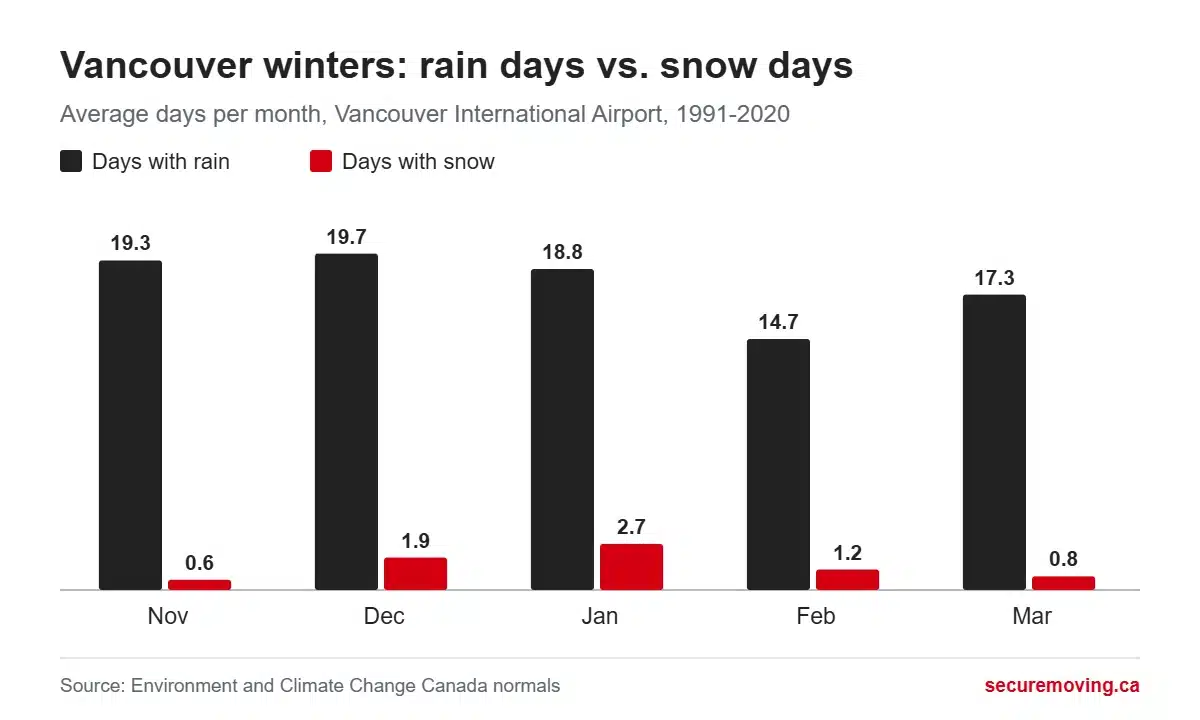
Moving in winter in Metro Vancouver is mostly a rain problem. Vancouver airport averages about 19 or 20 days with rain in December and only around two days with snow. The real challenges are wet floors, soggy cardboard, short days and, if you are heading east, the mountain passes. And this year there is something new: BC has stopped changing its clocks, so winter mornings will be darker than anyone here is used to.
Here is what a winter move actually looks like in the Lower Mainland and the Fraser Valley, why it can be a smart time to move, and how to keep your things dry and your day on schedule.
Moving between November and March?
Secure Moving works right through the winter across Metro Vancouver and the Fraser Valley, and winter dates are far easier to get than summer ones. Ask us about floor protection and mattress bags when you book. Rates and typical totals are on our residential moving page.
Is winter a good time to move?
For a lot of people, yes. Summer is peak season for movers, landlords and buyers alike, and winter is the quiet stretch. Greater Vancouver Realtors’ ten-year averages show it clearly: about 1,602 home sales in a typical January against about 2,930 in a typical May. Fewer moves means more open dates, more flexibility on the day of the week, and less competition for the rental or home you want.
Nobody publishes reliable data proving moving companies charge less in winter, so be wary of any article that promises a specific discount. What you can count on is choice. A mid-week, mid-month date in January is far easier to book than a Saturday at the end of June.
The trade-offs are real too: rain on most days, short daylight, the holidays, and highways that need winter tires once you leave the coast. None of them is a reason not to move. They are reasons to plan differently.
What winter weather here really looks like
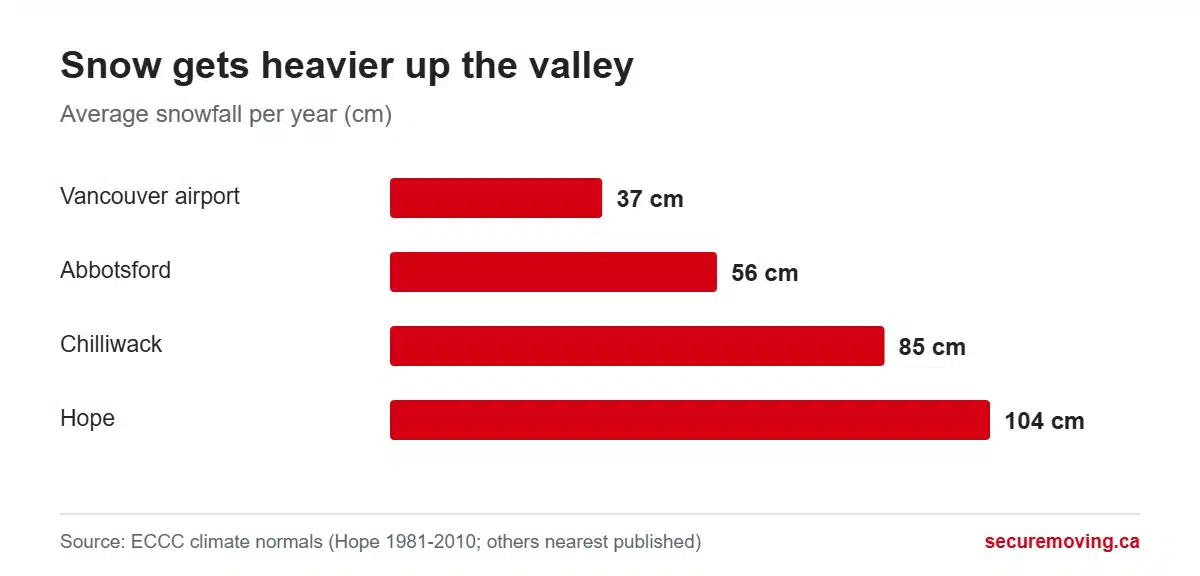
Environment Canada’s 1991 to 2020 climate normals for Vancouver International Airport tell the story. From November to January the airport averages 19 to 20 rain days a month, and between one and three days with any snow at all. Total snowfall for a whole year averages about 37 cm.
Head up the valley and that changes fast. Annual snowfall averages roughly 56 cm at Abbotsford airport, about 85 cm at Chilliwack and more than a metre at Hope. A move from Burnaby to Chilliwack in January can start in drizzle and finish in slush.
The wildcard is arctic outflow. A few times each winter, on average one to three, cold air from the Interior drains down the Fraser Valley to the coast. It brings hard frost, strong east winds, and occasionally the kind of snowfall that shuts schools. These spells can last a week. If your date lands in one, the right call is often to shift the move by a day or two rather than fight it.
Darker mornings: the first winter without a clock change
BC adopted permanent daylight time in 2026. The province’s last clock change was 8 March, and clocks did not fall back on 1 November. That moves winter daylight an hour later: on the shortest day of the year, sunrise in Vancouver is now around 9:05 a.m. and sunset around 5:15 p.m.
| Date (Vancouver) | Sunrise | Sunset | Daylight |
|---|---|---|---|
| 15 November | 8:23 a.m. | 5:30 p.m. | 9 h 6 min |
| 21 December | 9:05 a.m. | 5:15 p.m. | 8 h 10 min |
| 15 January | 9:02 a.m. | 5:41 p.m. | 8 h 39 min |
| 15 February | 8:21 a.m. | 6:32 p.m. | 10 h 11 min |
Most crews start at 8 a.m., which from late November to late January now means loading in the dark for the first hour. In practice:
- Turn on every porch, hallway and garage light before the crew arrives, and replace burnt-out bulbs on the route to the truck.
- Do the walk-through of the new place the day before, in daylight, so you know where the steps and the parking are.
- If the drop-off end has an awkward path or steep driveway, ask your mover whether a slightly later start would land that part of the job in daylight.
- The upside: you now have usable light until after 5 p.m., so a long day is less likely to end with unloading in the dark.
Keeping a rainy move dry
Water is what damages things on a winter move here, not cold. Cardboard softens, wet shoes mark floors, and a sofa that sits on a driveway for ten minutes in a downpour can stain. Some simple habits make a big difference:
- Use plastic where it counts. Mattress bags, plastic-wrapped upholstered furniture, and bins instead of boxes for anything you would hate to see wet: books, papers, photos and linens.
- Protect the floors at both ends. Ask your mover for floor runners and door-jamb protectors, and put down old towels and a heavy mat at each door. Hardwood and carpet are where rainy-day damage happens.
- Stage under cover. With a garage, carport or covered entry, gather everything there before the truck is loaded. Never leave boxes sitting on wet ground or on the lawn.
- Tape boxes properly. Damp cardboard loses strength, so tape the bottom seams twice and do not overload them. Small boxes for heavy things.
- Have a dry set of clothes and towels handy. For you, the kids and the dog.
Electronics need a bit of patience. When a cold TV, monitor or laptop comes into a warm room, moisture can condense inside it. Let it reach room temperature before you switch it on; Samsung, for example, tells owners of some TV models to leave them unplugged for at least two hours after moving them from cold to warm. Apple rates its laptops for use at 10 to 35 °C and says not to leave them in a parked car.
Pianos react to the jump from a cold truck to a heated house. Tuners usually suggest waiting a few weeks after a move before tuning, so the instrument settles into its new room first. Our piano movers can advise on timing.
If it snows on moving day
It does not happen often on the coast, but when it does, the first job is a safe path. Most Metro Vancouver cities require property owners and occupants to clear their sidewalks by 10 a.m.
- Vancouver: clear the full width of the sidewalk by 10 a.m. every day it snows, with fines of $250, rising to $750 if the snow stays more than 24 hours.
- Burnaby: clear by 10 a.m. daily, holidays included. Fines start at $100 for a single- or two-family home and $250 for a multi-family building. Do not shovel snow onto the road.
Beyond the sidewalk, clear and salt the path from the door to wherever the truck will park, and shovel out the parking spot itself. A truck that cannot get close means a longer carry, which on an hourly move costs you time. Phone your mover early in the morning if conditions look bad. Rescheduling a day is usually far cheaper than a slip on icy stairs, and hills in places like Burnaby Mountain, North Vancouver or the upper parts of Abbotsford can be impassable for a heavy truck for a day or two.
Heading over the mountains
Lower Mainland city streets do not require winter tires. Leave the coast, though, and from 1 October to 30 April most BC highways do, including the Sea to Sky and the routes into the Interior. Tires need the M+S or three-peak mountain snowflake symbol and at least 3.5 mm of tread, and the fine for not having them is $121. Rental vehicles must have at least M+S tires, so check a rental truck before you sign for it.
Commercial moving trucks have their own rules, and bigger trucks must carry steel chains on most major highways outside Greater Vancouver. That is one reason winter delivery windows on long-distance moves run wider than summer ones. Check DriveBC before you leave, and build in a spare day. Our long-distance moving tips cover the rest of the planning for a move out of province.
Heat, hydro and frozen pipes
Moving into a cold, empty house in January is miserable, so get the utilities sorted early:
- BC Hydro charges $13.50 plus GST to open or move an account and asks you to arrange it well before your move-in date.
- FortisBC gas transfers can be requested online. Do it early enough that the furnace or fireplace works on day one.
- Heat the new place before moving day if you can, so boxes, furniture and people are not coming into a fridge.
For the home you are leaving, and any house that sits empty during a cold snap, the Province’s emergency management advice is to keep the thermostat no lower than 12 °C, shut off outdoor taps and remove hoses, insulate pipes in unheated spaces, and know where the main water shut-off is.
Holidays, buildings and the month-end crunch
Winter adds a few calendar traps. BC’s statutory holidays over the season are Remembrance Day (Wednesday 11 November 2026), Christmas Day (Friday 25 December), New Year’s Day (Friday 1 January 2027) and Family Day (Monday 15 February 2027). Boxing Day is not a statutory holiday in BC, but many strata managers and building offices close over the holidays, so book elevators and move-in times early and get confirmation in writing.
Tenancy rules do not change with the season. Under BC’s Residential Tenancy Act, tenants must be out by 1 p.m. on the last day of the tenancy unless they agree otherwise in writing, and a month-to-month tenant must give a full month’s written notice before the day rent is due. So even in a quiet January, the last and first days of the month still fill up first. Where possible, move mid-month.
Pick a winter date with room to spare
Mid-week, mid-month winter dates are the easiest to book. Call 604-500-3003 or get a free quote for your move.
Your winter moving checklist
- Book a mid-week, mid-month date if your tenancy allows it.
- Pack books, papers and linens in plastic bins, and buy mattress bags.
- Book elevators at both ends and confirm holiday office hours.
- Set up BC Hydro and FortisBC at the new place at least a week ahead.
- Check the forecast three days out and again the night before. Call your mover early if snow or ice is coming.
- Light the route, lay mats and towels, and clear the truck’s parking spot.
- Let electronics warm up before you plug them in.
- For long-distance moves, check DriveBC and build in a spare day.
Frequently asked questions
Is it cheaper to move in winter in Vancouver?
There is no reliable data showing winter rates are lower, but winter is the quiet season, so you get more choice of dates. Hourly moves can also run faster when there is less traffic and fewer building bookings competing with yours. The biggest saving usually comes from booking mid-week and mid-month.
Do movers work in the rain and snow?
Yes, in rain it is business as usual here. In heavy snow or ice, a good mover will call you to talk about safety and may suggest moving the date by a day, especially on steep streets.
What is the best winter month to move in BC?
February tends to be the easiest. Days are noticeably longer than in December, it has fewer rain days at the coast than the months before it, and it avoids the holiday closures. Watch for Family Day on the third Monday.
Do I need winter tires to drive a rental moving truck in BC?
Not on Lower Mainland city streets. On most BC highways outside the Lower Mainland, including the Coquihalla and the Sea to Sky, yes, from 1 October to 30 April, and any rental needs at least M+S tires.
Does BC still change the clocks?
No. BC moved to permanent daylight time in 2026, so clocks did not fall back in November. Winter sunrises are about an hour later than they used to be, and sunsets about an hour later too.
How we put this together
Climate figures are Environment and Climate Change Canada normals for Vancouver International and Abbotsford airports (1991 to 2020), with Chilliwack and Hope figures from the nearest published station normals; treat the valley numbers as approximate. Sunrise and sunset times are calculated for downtown Vancouver at UTC−7 and rounded to the minute. Clock-change, highway, holiday and tenancy rules come from the Province of BC; snow bylaws from the cities of Vancouver and Burnaby; utility details from BC Hydro and FortisBC; sales seasonality from Greater Vancouver Realtors; and device guidance from Samsung and Apple.
Sources
- Province of BC, permanent daylight time, March 2026
- Environment and Climate Change Canada, Canadian Climate Normals 1991–2020
- Climate of Vancouver (ECCC normal tables and arctic outflow)
- Province of BC, winter driving
- Province of BC, winter driving for commercial vehicles
- TranBC, winter tire FAQ
- City of Vancouver, snow removal
- City of Burnaby, your role in snow and ice control
- BC Hydro, moving in or out
- Province of BC, prevent your pipes from freezing
- Province of BC, statutory holidays
- Residential Tenancy Branch, ending a tenancy
- Greater Vancouver Realtors, January 2026 market report
- Apple, Mac laptop operating temperatures
Still weighing up dates? Our guide to the best time to move in Canada compares every season, and the BC moving checklist has the tenancy deadlines. For a winter date with us, use the quote form.
