

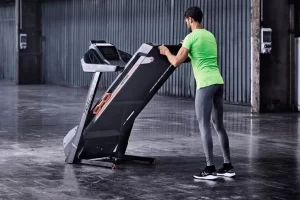
We went looking for the facts this page should be built on and came back with almost nothing, so we are going to tell you that first.
We tried to find published weights, transport instructions, warranty language and doorway requirements from NordicTrack and iFIT, Peloton, Sole, Precor, Life Fitness and Horizon. We obtained nothing publishable from any of them. Some sites block automated access, some manual libraries returned errors, and everything else that came back was a retailer listing or a content farm.
More usefully, here is a claim we specifically went looking to verify and could not: the idea that laying a treadmill on its side makes the belt lubricant migrate and damage the machine. It appears on essentially every treadmill-moving page online. We found no manufacturer statement supporting it. We are not saying it is wrong. What we are saying is that nobody who made a treadmill appears to have written it down, and we are not going to be the next page to repeat it as fact.
So this guide does the one thing that genuinely works, and then covers what we can actually source.
Find your model’s manual. It is the whole job.
A treadmill is the item in your house with the widest variation between models. Folding and non-folding, motor at the front or under the deck, transport wheels or none, shipping brackets or none, a deck lock or nothing. Generic advice cannot accommodate that, and the manufacturer’s manual for your exact model can.
Where to find it:
- The model number is on a sticker, usually on the frame near the motor cover, on the rear crossmember, or under the front of the deck. Photograph it.
- Search the manufacturer’s own support site for that number, not a generic model family. Manuals are typically PDFs.
- What you are looking for, in this order: any section headed relocation, moving or transport; whether the deck has a lock or a transport bracket; whether the machine may be laid down and on which face; the folding mechanism’s lock; and the warranty section’s language about relocation and self-service.
- If the manual has no relocation section, that is information too. It means the manufacturer has not restricted anything, and the decision is a mechanical judgment rather than a rule.
That step takes ten minutes and replaces every generic instruction on this page, including ours.
The two numbers that decide whether it fits
These we can source, and they are the ones that actually stop a treadmill move.
Doorways. The narrowest doorway the BC Building Code permits inside a dwelling is 610 mm, about 24 inches, covering bathrooms, walk-in closets and rooms off a 710 mm hallway. Other rooms are 760 mm and required entrances 810 mm, about 31.9 inches. A treadmill is typically 32 to 38 inches wide across the handrails, so an unfolded treadmill is at or over the width of a code-minimum front door, and comfortably over an interior one.
Folding it, if it folds, usually reduces the length rather than the width. Which means the width across the handrails is the number to measure, and if it exceeds your narrowest opening, something has to come off or the machine goes on its side.
Stairs. Required exit and public stairs in residential buildings are not less than 900 mm wide; stairs serving a single dwelling unit not less than 860 mm; headroom not less than 2,050 mm, or 1,950 mm within a dwelling unit. Vancouver’s own by-law matches those. A treadmill going down a basement stair in a Vancouver special is the standard version of this job, and 860 mm with a turn at the bottom is why it is a two-person planned carry.
Measure in this order: machine width across the handrails, machine length folded and unfolded, then every doorway on the route at its narrowest, the stair width, and the headroom at the turn.
Weight, and how to find yours
We cannot give you a sourced figure, so here is the method instead.
The weight is in your manual, in the specifications section, usually as a shipping weight and sometimes as a net weight. The shipping weight includes packaging and is the higher number.
If you cannot find the manual, the practical check is whether two people can tip and hold it. A treadmill is dense and its mass is concentrated in the motor and the deck, which means it is heavier than it looks and unevenly balanced, and the handrails are the tempting handhold and the wrong one.
For equipment context, from published sources: Magliner states all its hand trucks have a 500 lb capacity unless otherwise noted. Forearm Forklift publishes lifting straps up to 800 lb and Shoulder Dolly’s heavy-duty Pro Lift straps up to 1,000 lb. Most home treadmills sit well inside those numbers, so equipment capacity is rarely the constraint on a treadmill. Geometry and stairs are.
There is no legal lifting limit in BC
Worth stating because content in this category routinely cites one. BC’s Occupational Health and Safety Regulation, Part 4, sections 4.46 to 4.53, contains no weight threshold and no numeric trigger. The duty is to identify the factors that expose workers to musculoskeletal injury, assess the risk, and eliminate or minimise it, considering the force required, the work postures, the size and weight distribution of the object, the floor surfaces and the working heights, with controls reviewed at least annually.
For a treadmill, the risk factors the regulation names are exactly the ones that bite: weight distribution, floor surfaces, postures. Not a number.
If two of you are carrying it, do it the documented way
The Canadian Centre for Occupational Health and Safety publishes team-handling guidance, and it is short, specific and almost never followed:
- Select team members of similar height and strength.
- Assign a leader to the team.
- Agree the commands before you start: lift, walk, stop, down.
- Practise the lift and carry together before attempting the task.
- “Remember that the combined strength of the team is less than the sum of individual strength.”
- Walk in step.
- For furniture, use straps with webbing to prevent slipping, dollies or platform trucks, secure the load, and have assistance when loading.
That last-but-one point is the one people get wrong. Two people who can each manage 60 kg cannot reliably manage 120 kg between them, and on a stair the person below is carrying more than half.
Worth noting honestly: we looked for guidance from CCOHS or WorkSafeBC specifically about carrying loads on stairs, or about stair-climbing dollies, and found none. The legal hook for stairs sits inside the risk assessment, in the regulation’s references to floor surfaces and work postures, rather than in a dedicated procedure. So anyone telling you “WorkSafeBC says X about stairs” is on thin ice.
The sequence, in the absence of a manual
With the caveat that your manual overrides all of this:
- Unplug it and coil the cord, taped to the frame so it cannot catch a wheel or a foot.
- If it folds, fold it and engage the lock. A folding deck that releases mid-carry is the main way people get hurt moving one of these.
- If there is a transport or shipping bracket, fit it. This is the item most likely to exist and most likely to be missing from a generic guide, and your manual will name it.
- Wrap the console and the display. They are plastic, they protrude, and they are the expensive part to replace.
- Use the transport wheels for flat ground only. They are designed for repositioning in a room, not for a route with thresholds.
- On stairs, carry it with the heavy end downhill and a spotter below, in step, with agreed commands.
- Load it against the truck wall and strap it at two heights. A treadmill is top-heavy folded.
- At the far end, set it up on a level floor and check the belt tracks straight before the crew leaves. A belt that runs off-centre after a move is a tensioning adjustment, and it is easier to catch on the day.
On lubricant, given what we said at the top: our practice is to keep a treadmill upright or folded rather than laid on its side where the route allows it, because it costs nothing to do and the mechanical reasoning is at least plausible. We are describing our practice, not citing a manufacturer.
When to hand it over
- Any stairway. This is the single most common reason people injure themselves with a treadmill.
- A doorway narrower than the machine across the handrails.
- A non-folding commercial-style machine, which is heavier, longer and has no fold to shorten it.
- A machine still under warranty whose manual restricts relocation or self-service. Read the warranty section before you move it yourself.
How Secure Moving handles a treadmill
We will ask for the model before quoting, so the width and the fold are known rather than discovered. We fold and lock where the machine folds, fit the transport bracket where there is one, wrap the console, and carry it on stairs as a planned two-person job with a spotter. At the far end we set it level and check the belt tracks straight.
If you have the manual, send it with the booking. It is more useful to us than a photograph of the room.
Our team works across the region as a moving company in Vancouver and as a moving company in Burnaby. For the stairway side of the job in more detail, our guide to moving heavy furniture up stairs goes further, and if the treadmill is going into a tight space our guide to moving furniture into a small apartment covers the measuring.
Frequently asked questions
Can you lay a treadmill on its side to move it?
We could not find a manufacturer statement either way, from NordicTrack, iFIT, Peloton, Sole, Precor, Life Fitness or Horizon. The claim that laying one on its side causes lubricant to migrate appears on almost every moving guide online and we found nothing from any manufacturer supporting it. Check your own model’s manual, which is the only authority that applies to your machine. Our practice is to keep it upright or folded where the route allows, because it costs nothing.
How much does a treadmill weigh?
No published weight from any major manufacturer could be sourced, so rather than quote an average: it is in your manual’s specifications section, usually as a shipping weight, which includes packaging and is the higher figure. Magliner publishes a 500 lb capacity for its hand trucks and lifting straps run to 800 or 1,000 lb, so most home treadmills are well inside equipment limits. The real constraint is geometry and stairs.
Will a treadmill fit through a door?
Measure the width across the handrails, because that is the dimension folding does not reduce. Treadmills typically run 32 to 38 inches wide, against a code-minimum BC entrance opening of 810 mm, about 31.9 inches, and interior doorways that can legally be as narrow as 610 mm. So an unfolded treadmill is at or over the width of a minimum front door and over most interior ones.
Do I need to lock the deck before moving a folding treadmill?
Yes, and your manual will name the mechanism. A folding deck that releases mid-carry is the main way people are hurt moving these. Some models also have a transport or shipping bracket that should be refitted for a move, which is exactly the sort of model-specific detail a generic guide cannot tell you and your manual can.
Is there a WorkSafeBC rule about carrying heavy items on stairs?
No dedicated rule that we could find. Part 4 of BC’s Occupational Health and Safety Regulation requires an employer to identify, assess and control the risk of musculoskeletal injury, and names floor surfaces and work postures among the factors to consider, which is where stairs sit. There is no weight limit and no stair-specific procedure, so any page attributing one to WorkSafeBC has invented it. CCOHS does publish team-handling guidance, including the point that a team’s combined strength is less than the sum of the individuals’.
Will moving a treadmill void the warranty?
No warranty language about relocation or self-service could be obtained from any major treadmill manufacturer, so we cannot tell you in general. Read the warranty section of your own manual before you move it yourself, particularly if the machine is recent and expensive. That is the same advice we give for pool tables, where two manufacturers do publish terms that void coverage if anyone other than an authorised agent moves the table.
