

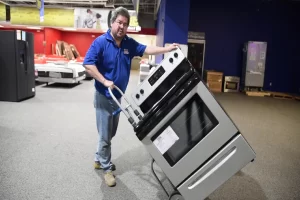
Start with the part that most moving guides skip, because in British Columbia it decides who touches the appliance.
If your stove runs on gas, your moving company cannot legally disconnect it. Not as a favour, not with you watching, not if you ask them to. And unless you live in a fully detached house that you do not rent out any part of, you probably cannot legally disconnect it yourself either.
That is not caution, it is the Safety Standards Act and the Gas Safety Regulation. This page sets out exactly what those say, who can do the work, who issues the permit in your municipality, and what changes if your stove is electric.
General information only, not legal advice. Every provision is named so you can read it yourself.
Why a mover cannot touch your gas line
Four provisions do the work, and they connect like this.
One. Working on a gas appliance is “regulated work.” The Safety Standards Act defines regulated work as the assembly, manufacture, construction, installation, operation, testing, maintenance or repair of a regulated product, and the alteration of one. The Gas Safety Regulation defines “appliance” to include “any valves, controls, fittings and components attached to or connected to it”, so the connector and the shut-off behind your range are part of the regulated appliance, not accessories to it.
Two. Only a closed list of people may do it. Section 4(1) of the Gas Safety Regulation says an individual must not perform regulated work on a gas system or gas equipment unless they hold a certificate of qualification, are authorized to work on gas without one, have completed a recognized training programme, hold another limited-scope gas certificate, are a homeowner acting under section 24, or are permitted under the Safety Standards General Regulation. A moving company is none of those.
Three. Doing it for someone else, unlicensed, is prohibited outright. Section 23(1) of the Act: a person must not do regulated work for another person who is not a licensed contractor unless licensed or authorized. A mover disconnecting your range is doing regulated work for another person.
Four. The homeowner route exists and it is narrow. Section 24(1) lets a homeowner apply for an installation permit to perform gas regulated work in a fully detached dwelling, but only if no person is being paid to do, or assist the owner in doing, the work, and no part of the dwelling is rented to any person. Technical Safety BC adds that owners of a strata, a non-strata duplex, or a home from which a business operates cannot obtain a homeowner permit at all.
That third condition is the one that closes the last door. The workaround people reach for, where the homeowner pulls the permit and the movers do the lifting, does not work, because paid assistance voids the exemption by its own terms.
Who can disconnect it, by type of home
| Your home | Who can disconnect the gas range |
|---|---|
| Detached house you own and do not rent any part of | A licensed gas contractor, or you yourself under a homeowner installation permit, with nobody paid to help |
| Detached house with a rented suite | A licensed gas contractor only |
| Strata condo or townhouse | A licensed gas contractor only |
| Duplex, or a home you run a business from | A licensed gas contractor only |
Class B is enough, and it needs a permit
People are told they need a Class A gas fitter, which overstates it. A Class B certificate covers appliances with an input of 120 kW or less carrying a certification mark, and a domestic gas range is far below that threshold. Class A covers any gas system.
The certificate alone is not enough. Both the Class A and Class B provisions say the holder may perform the work “under an appropriate permit.” Technical Safety BC’s own position is that permits are a legal requirement in BC and are often necessary for home insurance purposes. Its July 2025 information bulletin on alteration permitting treats the removal of gas equipment as an alteration requiring a permit before work begins, and warns that those who have not obtained one may be subject to enforcement action.
Gas certificates expire. Technical Safety BC states that all gas certificates are valid for three years from the date of issue and that performing regulated work with an expired certificate is not permitted. If you are hiring a contractor, that is a fair thing to ask about.
Six BC cities issue their own gas permits
This trips up guides written for the whole province. Technical Safety BC issues gas installation permits across BC except in six jurisdictions, where the municipality issues its own:
| Permitting authority | Where |
|---|---|
| The municipality | Vancouver, Richmond, Burnaby, North Vancouver, Maple Ridge, Kelowna |
| Technical Safety BC | Everywhere else in BC |
Three of those six are in our service area, so for a Vancouver, Richmond or Burnaby move the permit conversation is with the city, not the province.
Reconnecting: no use until it passes inspection
There is no separate reconnection regime. Putting the appliance back is installation or alteration of gas equipment, so the same people and the same permit rule apply. The regulation’s own word for it is “reinstallation.”
Two obligations attach at the far end, and both matter more than people expect:
- You may not use the appliance until it has passed inspection, or until the regulatory authority has waived inspection on conditions it specifies. The permit authorizes the work; it does not authorize firing up the range.
- The permit holder must notify the authority and request an inspection on completion of each phase of the work. For a homeowner permit, Technical Safety BC requires at least one inspection request within 180 days of the permit being issued.
A provincial safety manager may also require a pressure test of a gas installation, conducted by a gas company in the presence of a safety officer. The leak-test procedure itself lives in CSA B149.1-20, which BC adopts by reference as the B.C. Natural Gas and Propane Code. That standard sits behind CSA’s paywall, so anyone quoting a clause number at you should be asked where they read it.
The penalties reach $100,000
Two separate tracks, and they are maximums rather than typical outcomes:
- Administrative penalty. A provincial safety manager may impose a monetary penalty, and the total for a contravention must not exceed $100,000.
- Prosecution. On conviction, an individual faces up to $100,000 or 18 months’ imprisonment, or both; a corporation faces up to $200,000.
There is a quieter cost too. Work done without a permit has no inspection record, which is exactly the document an insurer asks for after a fire.
Electric: plug-in is fine, hard-wired is not
Different regulation, and the dividing line is not the one people assume.
It is not about the voltage. A residential range circuit is 120/240 volt single-phase, which is about 120 volts to ground, and the homeowner electrical permit in section 17 of the Electrical Safety Regulation covers installations up to 200 amps and 150 volts to ground in a fully detached dwelling. So the “240 volts” figure does not put a range outside the homeowner permit. Anyone telling you it does has misread the provision.
It is about whether the appliance is plugged in or wired in. Most BC ranges and dryers are cord-and-plug connected to a receptacle. Pulling a plug out of a receptacle is using the appliance as designed, not electrical work. A hard-wired appliance is the regulated case, and section 18 of the Electrical Safety Regulation, which lists the things you may replace without a permit, is a closed list that does not include disconnecting or reconnecting a hard-wired appliance. So there is no permit-free do-it-yourself route for hard-wired work.
To be straight with you about the sourcing: the plug-versus-hard-wire distinction is the practical reading of sections 4, 17 and 18 taken together. No official page states it in those words. If your range is hard-wired, the safe answer is an electrician.
One more thing worth knowing if a gas contractor is already in the house: a Class A or B gas fitter’s electrical scope is restricted to wiring for fuel-fired heating equipment, and expressly excludes modifying plug-in equipment connections. The gas contractor is not a shortcut to the electrical work.
Measure the narrowest door, not the front one
This is the part a moving company can do, and it is mostly about doorways and weight.
Measure the narrow point, not the front door. The narrowest doorway the BC Building Code permits inside a dwelling is 610 mm, about 24 inches — bathrooms, walk-in closets and rooms off a 710 mm hallway. Required entrances and stair openings are 810 mm and most other rooms 760 mm. A 30-inch range does not pass a 610 mm door, and it is usually a hallway pinch point rather than the entry that decides the route.
Empty it and secure everything that swings. Racks and broiler pans out or taped in place, oven and warming drawers taped shut, the door itself secured. An oven door that swings open on a dolly takes a shin or a door frame with it.
Protect the floor before the appliance leaves the alcove. A range on the move is the single most common cause of scratched hardwood and torn vinyl in a kitchen, because it is heavy, it has feet or rollers, and there is no room to lift it cleanly.
Use an appliance dolly with a strap, not a general-purpose hand truck. Magliner, one of the main manufacturers, publishes a blanket statement that all its hand trucks have a 500 lb capacity unless otherwise noted, which is ample for a domestic range and not ample for much else in a kitchen. Lifting straps are rated higher, with Forearm Forklift publishing up to 800 lb and Shoulder Dolly’s heavy-duty Pro Lift straps up to 1,000 lb. A strap carry on stairs with a range is still a two-person job with a spotter rather than a shortcut.
Anti-tip bracket. Free-standing ranges are supplied with an anti-tip device and the manufacturer’s installation instructions require it to be fitted. It is a bracket screwed to the floor or wall that catches a rear leg, and it exists because a child standing on an open oven door can tip an unbraced range. When a range moves, the bracket stays behind, so it needs refitting at the new address. We are not citing a standard number for this because the standard most often quoted could not be verified and CSA text is paywalled; what we can say is that it is in the manufacturer’s instructions and it is cheap to get right.
How we handle a stove move
We move the appliance. We do not disconnect or reconnect gas, because we are not licensed to and no arrangement makes that legal. What we will do is tell you, at the quote stage, that you need a licensed gas contractor booked before move day and a permit in hand, and which authority issues it in your city, because a range that is still connected at nine in the morning stops the whole move.
For an electric range that is cord-and-plug connected, we unplug it, move it and plug it in. Hard-wired, you need an electrician.
We work across the region as a moving company in Vancouver and as a moving company in Richmond, two of the six jurisdictions that issue their own gas permits.
Frequently asked questions
Can movers disconnect a gas stove in BC?
No. Working on a gas appliance is regulated work under the Safety Standards Act, section 4(1) of the Gas Safety Regulation lists who may perform it and does not include movers, and section 23(1) of the Act prohibits doing regulated work for another person unless licensed. A mover also cannot assist you under your own homeowner permit, because section 24(1) of the regulation requires that nobody be paid to do or assist with the work.
Can I disconnect my own gas stove in BC?
Only in a fully detached dwelling, no part of which is rented, under a homeowner installation permit, with nobody paid to help. Owners of a strata, a non-strata duplex, or a home with a business operating from it cannot obtain a homeowner gas permit and must hire a licensed contractor.
Do I need a permit to move a gas stove?
Yes, for the disconnection and the reconnection. Technical Safety BC treats the removal of gas equipment as an alteration requiring a permit before work begins, and both the Class A and Class B gas fitter provisions say the work is performed “under an appropriate permit.” In Vancouver, Richmond, Burnaby, North Vancouver, Maple Ridge and Kelowna the municipality issues the permit; elsewhere in BC, Technical Safety BC does.
What class of gas fitter do I need for a stove?
Class B is sufficient. A Class B certificate covers appliances with an input of 120 kW or less that carry a certification mark, and a domestic range is well under that. Class A covers any gas system. Either way the certificate must be current — Technical Safety BC states gas certificates are valid for three years from issue.
Can I use the stove as soon as it is reconnected?
No. Under the Gas Safety Regulation the permit authorizes the installation or reinstallation but not testing or use of the appliance until it has passed inspection, or inspection has been waived by the regulatory authority on its own conditions. The permit holder must request an inspection on completion.
Do I need an electrician to move an electric range?
Not if it is cord-and-plug connected to a receptacle, which most are — unplugging it is using the appliance as designed. If it is hard-wired, yes: the list of electrical work you may do without a permit is a closed list in section 18 of the Electrical Safety Regulation and it does not include disconnecting or reconnecting a hard-wired appliance.
Will my stove fit through the door?
Measure the narrowest doorway on the route, not the front door. The BC Building Code permits interior doorways as narrow as 610 mm, about 24 inches, for bathrooms, walk-in closets and rooms off a 710 mm hallway; other rooms are 760 mm and required entrances 810 mm. A standard 30-inch range needs the 760 mm class of opening or better.
