

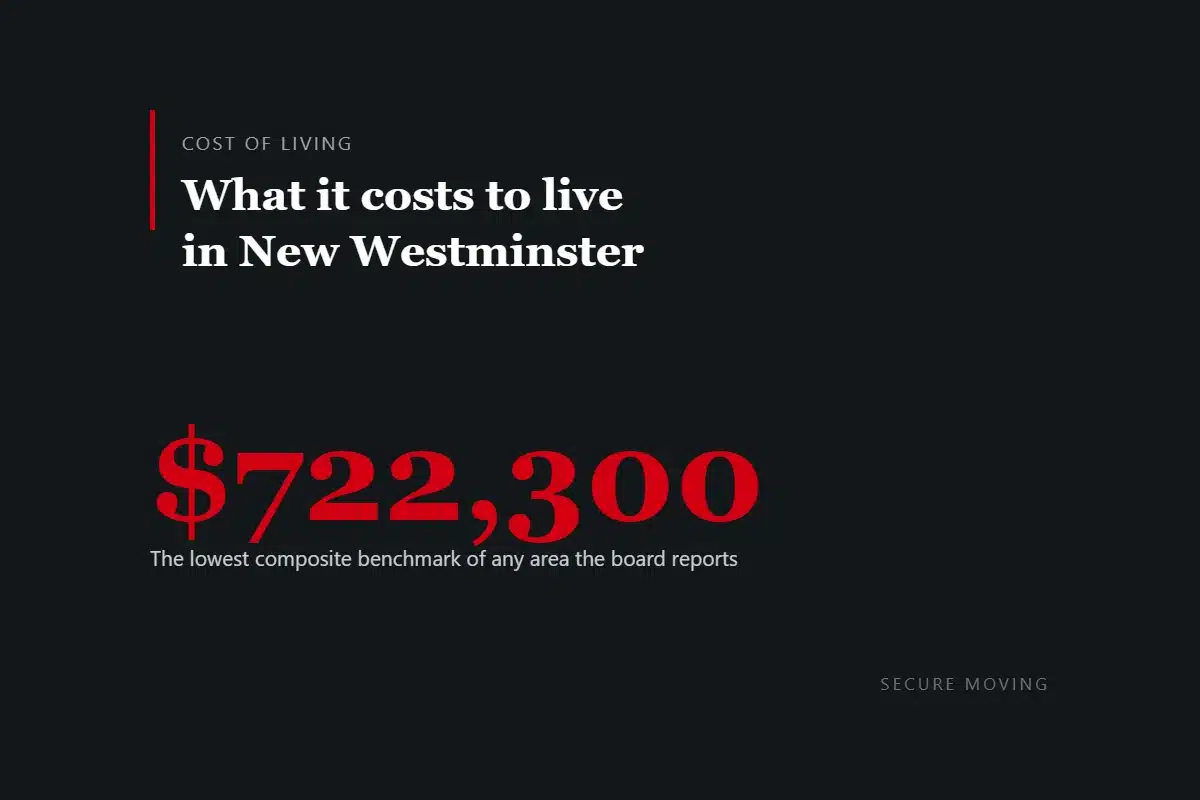
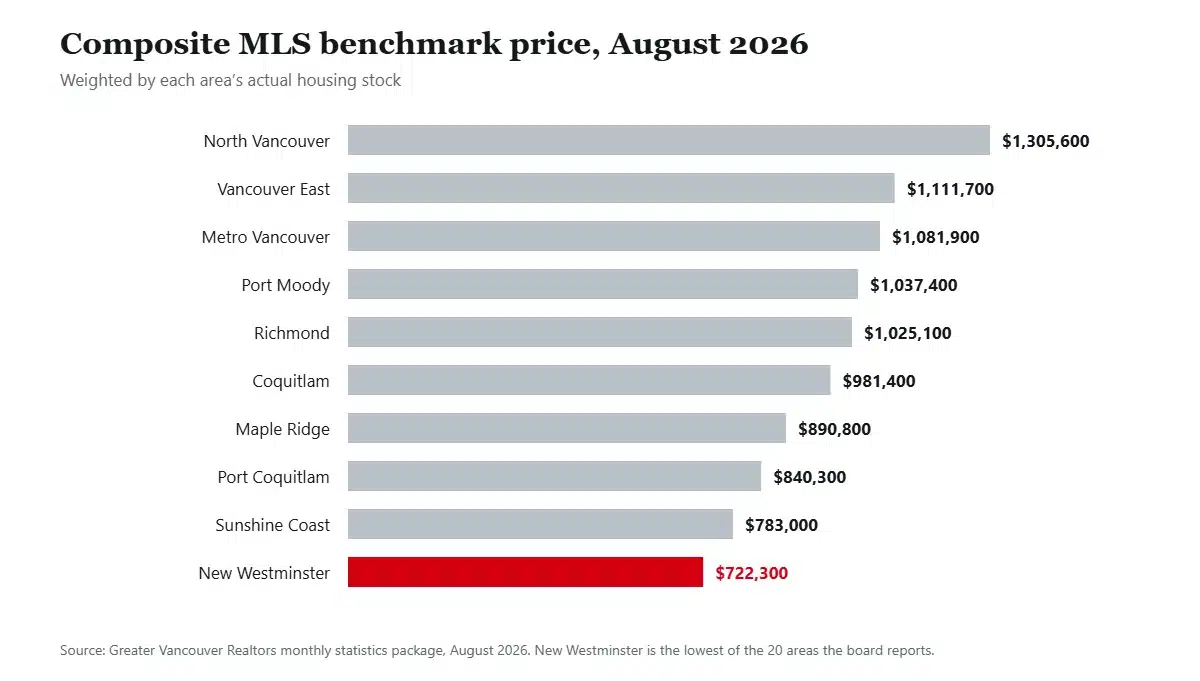
New Westminster has the lowest composite benchmark price of any area Greater Vancouver Realtors reports. In August 2026 it was $722,300, against $1,081,900 for Metro Vancouver as a whole.
Before anyone books a truck on the strength of that, here is what it means and does not mean. The composite is a weighted average of what a place actually contains, and 70 per cent of New Westminster households live in apartments, which is the highest share of any municipality in the region against a regional average of 43. A detached house here is $1,377,600, which is an ordinary Metro Vancouver detached price. This is not a cheap city. It is a city full of apartments, which is a different thing.
The short version
- Composite benchmark $722,300, detached $1,377,600, townhouse $873,400, apartment $576,100 in August 2026.
- Over five years the composite has moved 0.2 per cent. Over ten it is up 31.2 per cent, against 6.7 for the region.
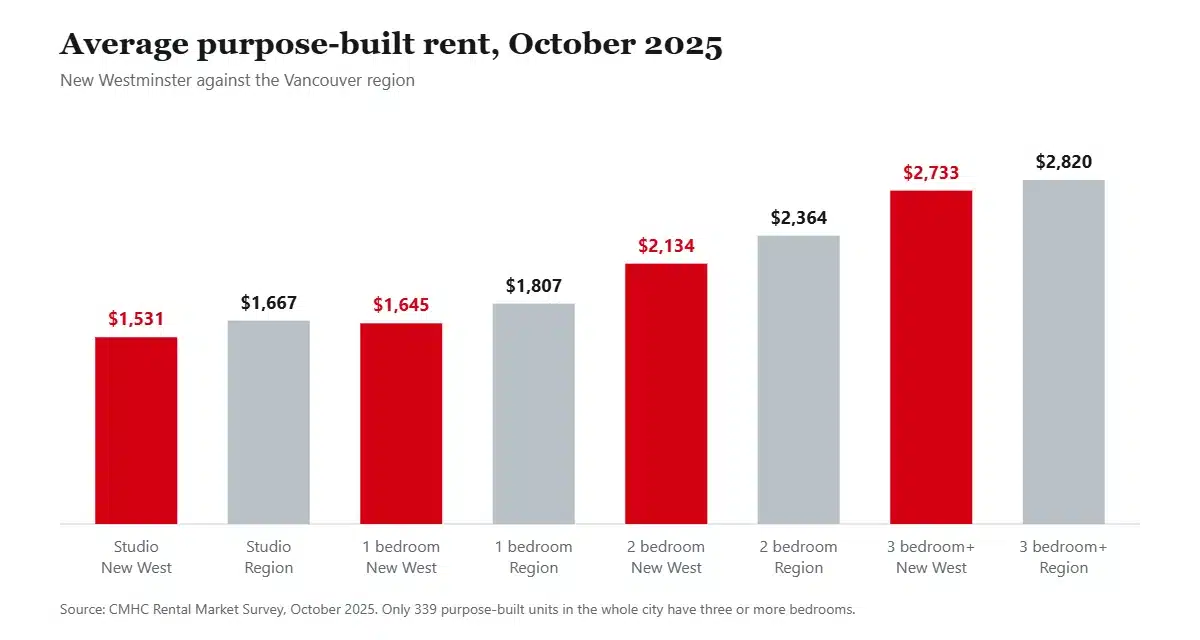
- Average purpose-built rent is $1,794 across all unit types, about nine per cent under the regional average.
- Property tax on a typical single-family home is around $7,477, plus $2,753.73 in water, sewer and waste.
- Residents do not buy electricity from BC Hydro. The city runs its own electrical utility, and its flat rate has no cheap first tier.
- Every SkyTrain station in the city is a one-seat ride to Waterfront in 27 to 36 minutes, on a two-zone fare that drops to one zone after 6:30pm and all weekend.
Buying
| August 2026 | Benchmark | 1 year | 5 years | 10 years |
|---|---|---|---|---|
| Detached | $1,377,600 | −14.6% | +0.1% | +22.9% |
| Townhouse | $873,400 | −4.2% | +11.2% | +61.3% |
| Apartment | $576,100 | −8.9% | +2.6% | +54.3% |
| Composite | $722,300 | −9.6% | +0.2% | +31.2% |
Data: Greater Vancouver Realtors MLS Home Price Index, August 2026.
Two things in that table are worth sitting with. The five-year column is essentially zero, so anyone who bought in 2021 has watched a decade’s worth of headlines and gone nowhere. And the gap between property types is unusually wide this cycle: detached down 14.6 per cent on the year while townhouses gave up 4.2.
Stretch to ten years and the picture flips. New Westminster’s composite is up 31.2 per cent against 6.7 for Metro Vancouver, and townhouses are up 61.3. Almost all of that happened in the first half of the decade.
One number we are not going to give you is a sales-to-active ratio for the city. Greater Vancouver Realtors publishes a sales column and a listings column by municipality, and the listings column is new listings for the month rather than standing inventory, so any ratio built from it is wrong. The region-wide figure for August 2026 was 12.3 per cent.
The housing stock, which explains everything else
New Westminster’s own reading of the 2021 census puts 70 per cent of households in apartments, six per cent in townhomes and 24 per cent in single-family homes and secondary suites. That is the highest apartment share in Metro Vancouver. Renters are 45.3 per cent of households, third highest in the region behind Vancouver and the City of North Vancouver.
Housing here is also old and new at the same time. Nearly one in five units was built in 1960 or earlier, and 1,485 units predate 1920. Meanwhile 11.3 per cent of the stock went up between 2016 and 2021, slightly ahead of the regional 10.5. Old walk-ups and new towers, not much in between, which is why the rental story below looks the way it does.
Incomes sit below the region. Median household income was $82,000 against $90,000 for Metro Vancouver. The number worth holding onto is the one for people living alone or with roommates: $52,000. In a city that is 70 per cent apartments, that is a lot of the market.
Renting
The city gets its own CMHC zone, which is more than its neighbours manage. Coquitlam, Port Coquitlam and Port Moody are pooled into a single Tri-Cities line. Here, one city of 36,000 households is reported on its own.
Rents run about nine per cent under the regional average across all unit types, $1,794 against $1,970. The vacancy rate reads 5.8 per cent against 3.7 for the region, which sounds like a renter’s market, but CMHC flags its own New Westminster vacancy estimate as poor reliability and suppressed the studio, one-bedroom and three-bedroom figures entirely. Take the direction, not the decimal.
The size of that stock is the real finding. This one city holds 10,622 of the region’s 129,351 purpose-built rental apartments, which is 8.2 per cent of Metro Vancouver’s entire purpose-built stock in a city with about 3.5 per cent of its households. Sixty per cent of those units are one-bedrooms. Three hundred and thirty-nine units in the whole city have three bedrooms or more.
So if you are single or a couple, this is one of the easier rental markets in the region to get into. If you are a family of four looking for purpose-built rental, there are 339 doors and you will be competing for all of them.
The renoviction bylaw, and how that story actually ends
New Westminster is famous among renters for its renoviction bylaw, and almost everything written about it stops halfway through.
The city adopted it in May 2019, calling itself the first municipality in British Columbia to tackle renovictions through municipal regulation. It worked through business licensing rather than tenancy law, which is provincial. A landlord company challenged it as beyond municipal jurisdiction. It won at the BC Supreme Court in February 2020, won again at the Court of Appeal in May 2021, and the Supreme Court of Canada dismissed the application for leave with costs on 9 December 2021.
And by then the city had already repealed it. Council voted on 2 November 2021 to strike the relevant part of the bylaw, effective 15 November, because amendments to the provincial Residential Tenancy Act that July had put the same protections in place across British Columbia. The mayor’s own words at the time were that the bylaw was no longer required.
So a tenant in New Westminster today has exactly the protections a tenant anywhere in the province has, and they are decent ones. Ending a tenancy for renovations means getting an order from the Residential Tenancy Branch first rather than simply serving notice, give four months’ notice, pay a month’s rent in compensation, and offer the tenant right of first refusal at market rent afterwards.
Two municipal protections do survive. Rental tenure zoning still restricts a set of properties to rental-only, blocking conversion to owner-occupancy, and a 2015 tenant relocation policy still applies to redevelopment applications.
And one clause in the licensing bylaw is worth knowing about, because almost nowhere else has it. Rental property owners in New Westminster must be able to heat a unit to 22 degrees, and between 1 April and 31 October they must also keep it below 26. A cooling obligation on landlords is unusual in Canada, and in an old apartment stock during a Fraser Valley heat dome it matters.
British Columbia’s rent increase cap for 2026 is 2.3 per cent, and it applies only to sitting tenants. On the average local one-bedroom that is about $38 a month. Move, and you reset to whatever the market asks.
Property tax and utilities
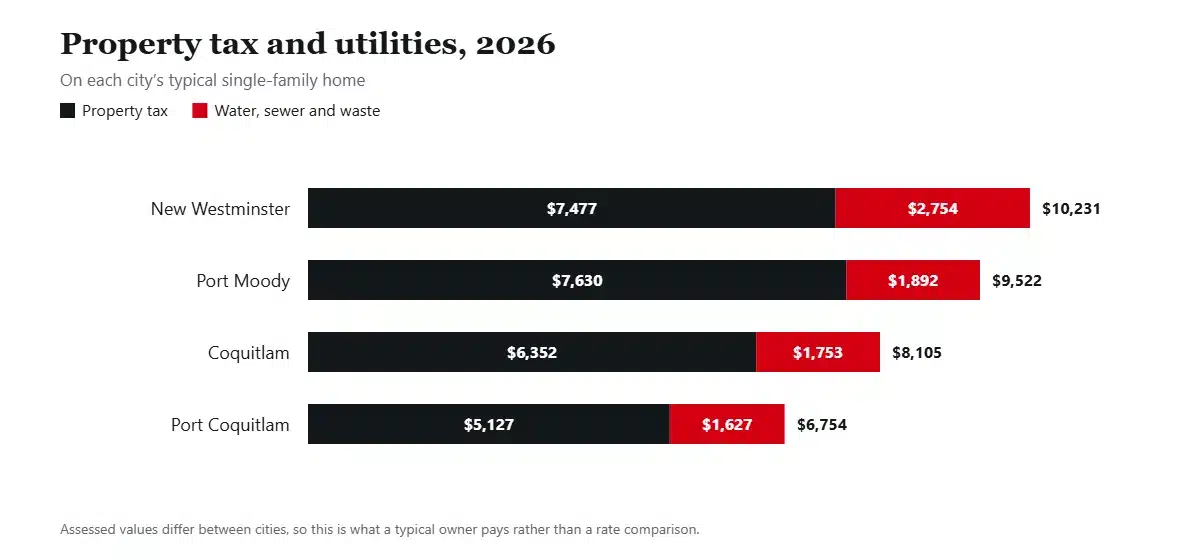
The 2026 residential rate is 4.793122 per $1,000 of assessed value. BC Assessment’s typical New Westminster single-family value for 2026 is $1,560,000, down two per cent, which produces a bill of roughly $7,477 before the Home Owner Grant. A typical strata home at $617,000 pays about $2,957.
Worth knowing where that money goes. New Westminster’s own share is about 65 per cent of a residential bill. The school levy, which the province sets and the city merely collects, is about 26 per cent. TransLink takes about 7.5.
Then utilities, which are rising considerably faster than the tax bill. Water is $881.20 for 2026, up six per cent; sewer $1,364.21, up ten; solid waste $508.32, up twelve. That is $2,753.73 a year on a single-family home, nine per cent more than 2025. A five per cent discount applies if you pay by 4 May, and a 25 per cent waiver is available to eligible seniors, which brings it to $2,174.
There is no separate drainage charge on a residential bill here. Three lines, not four.
The electricity bill, which works differently here
Residents here are not BC Hydro customers. It owns and operates its own electrical utility, and the BC Utilities Commission confirms it: BC Hydro serves the province except for part of southern BC and the cities of New Westminster, Penticton and Nelson. No other municipality in Metro Vancouver does this.
The rate from 1 January 2026 is 13.44 cents a kilowatt hour, flat, with a $16.16 basic charge every two months, plus a 2.5 per cent rate rider and a 3.5 per cent climate action levy. Add those and you are paying about 14.25 cents a kilowatt hour and about $103 a year in basic charges.
The interesting part is the shape rather than the level. BC Hydro’s residential rate, as published by the utilities commission effective 1 April 2025, starts at 11.72 cents for the first 1,376 kilowatt hours in a two-month period and rises to 14.08 above that. There are no steps at all here.
Which means a low-consumption household, and that describes most apartment dwellers in a city that is 70 per cent apartments, pays a noticeably higher rate here than a comparable BC Hydro customer. A heavy user pays about the same. The flat rate removes both the reward for using less and the penalty for using more. Note the two schedules are dated nine months apart and BC Hydro has been raising its rates 3.75 per cent a year, so the real gap is narrower than the raw numbers suggest.
One more precision point, because the wording invites confusion. That 3.5 per cent climate action levy is a city charge set in the city’s own bylaw. It is not the provincial carbon tax, which was eliminated for consumers on 1 April 2025 and no longer appears on anyone’s bill.
On gas, FortisBC’s residential Mainland schedule runs a 40.85 cent daily basic charge plus $11.48 per gigajoule all in. But most households here are not FortisBC customers, because apartment heating in the newer towers is electric. In most of Metro Vancouver the energy story is BC Hydro plus FortisBC. In New Westminster, for the typical household, it is the city and nothing else.
Getting around
This is where New Westminster earns its keep. Five SkyTrain stations sit inside 15.6 square kilometres, all of them on the Expo Line, and every one of them reaches Waterfront without changing trains.
| SkyTrain to Waterfront | Scheduled time |
|---|---|
| 22nd Street | 27 minutes |
| New Westminster | 30 minutes |
| Columbia | 31 minutes |
| Sapperton | 34 minutes |
| Braid | 36 minutes |
Source: TransLink station travel times. 22nd Street, New Westminster and Columbia sit on both Expo Line branches, so they run at roughly double the frequency of Sapperton and Braid.
The city sits in Zone 2, so a weekday daytime trip into Vancouver is a two-zone fare. An adult two-zone monthly pass is $156.70 and a one-zone pass is $117.20. Stored value is $4.20 and $2.85 respectively.
Two rules make that cheaper than it looks. Every trip starting after 6:30pm on weekdays and all weekend travel is charged as one zone, and bus travel is always one zone. For a five-day commuter the pass wins. For someone in the office two or three days a week, stored value usually wins.
Driving costs fuel and insurance and no tolls. Metro Vancouver charges 27 cents a litre in motor fuel tax against 14.5 in the rest of the province, and 18.5 of those cents fund TransLink, so a New Westminster driver pays for the trains whether or not they use them. The new stal̕əw̓asəm Bridge replacing the Pattullo cost $1.637 billion and is toll-free, as is every other crossing in the region.
What you need to earn
Living Wage BC put the Metro Vancouver living wage at $27.85 an hour for 2025, against a general minimum wage of $17.85. A full-time job at the living wage, 35 hours a week for a year, comes to about $50,687 before tax.
The average one-bedroom here is $1,645 a month, or $19,740 a year, which is 39 per cent of that. The average two-bedroom at $2,134 is 51 per cent of it, and about 31 per cent of the city’s $82,000 median household income.
Which is the honest bottom line. One full-time living-wage income does not cover an average local two-bedroom in New Westminster. Two do, comfortably, and that is more than can be said for most of the region.
Frequently asked questions
Is New Westminster cheaper than Vancouver?
On the composite benchmark, considerably: $722,300 against $1,111,700 for Vancouver East and $1,222,000 for Vancouver West in August 2026. On rent the gap is smaller, about nine per cent under the regional average. On a detached house the gap is real but you are still paying $1,377,600.
How much is property tax in New Westminster?
About $7,477 a year on a typical single-family home for 2026, at a rate of 4.793122 per $1,000 of assessed value, plus $2,753.73 in water, sewer and solid waste. A typical strata home pays roughly $2,957 in tax.
Does New Westminster still have a renoviction bylaw?
No. New Westminster repealed it in November 2021, weeks before winning the last court challenge to it, because provincial law had adopted the same protections. Tenants here now rely on the Residential Tenancy Act, which requires a Residential Tenancy Branch order, four months’ notice, a month’s compensation and right of first refusal.
Why is my electricity bill different in New Westminster?
Because the city sells you the electricity, not BC Hydro. It charges one flat rate of 13.44 cents a kilowatt hour with no cheap first tier, plus a rate rider and a city climate action levy. Low-consumption households pay more than they would on BC Hydro’s step one rate; heavy users pay about the same.
How long is the SkyTrain from New Westminster to downtown?
Between 27 and 36 minutes depending on the station, with no transfer, because all five stations are on the Expo Line and both of its branches run through to Waterfront.
How we put this together
Prices come from Greater Vancouver Realtors, rents and vacancy from CMHC, assessments from BC Assessment, tax and utility rates from the City of New Westminster’s own published schedules and bylaws, electricity rates from the city’s electrical utility bylaw and the BC Utilities Commission, gas from FortisBC, fares and fuel tax from TransLink and the province, and the renoviction record from the city’s own releases and the Supreme Court of Canada docket.
Three things we left out on purpose. There is no sales-to-active ratio for New Westminster here, because the board’s municipal listings column is new listings rather than standing inventory. We have not quoted the city’s 2026 tax increase percentage, because the council report is behind a portal that would not open and every figure in circulation is from news coverage. And we have not published a New Westminster figure from Metro Vancouver’s housing and transportation cost burden study, because the per-municipality numbers are published as chart images and two reads of them disagreed.
Sources
- Greater Vancouver Realtors MLS Home Price Index statistics
- CMHC Rental Market Survey, Vancouver zones, October 2025
- BC Assessment, Lower Mainland 2026 property assessments
- City of New Westminster, 2026 tax rates
- City of New Westminster, 2026 utility rates
- City of New Westminster, electrical utility
- BC Utilities Commission, residential energy rates
- City of New Westminster, renovictions and tenant protection
- Supreme Court of Canada, docket 39773
- Province of British Columbia, rent increases
- TransLink, pricing and fare zones
- TransLink, SkyTrain station travel times
- Province of British Columbia, motor fuel and carbon tax rates
- FortisBC residential rate schedule 1
- Living Wage BC, 2025 rates
- Metro Vancouver Housing Data Book, February 2025
Pricing a move as well as a month? Our area guide covers which part of the city suits which budget, the crime numbers answer the other common question, and the wider case for and against weighs the commute properly. When you have an address, tell us where you are moving from.
