

For a local move in Metro Vancouver, most people who tip give each mover $20 to $40 for a half-day job and $40 to $60 for a full day. Another way to land on the same number is about $5 per mover for every hour they worked. On a long-distance move, the crew that loads your truck and the crew that unloads it are often different people, so each one gets its own tip.
That is the short version. Tipping movers in BC is optional, nobody is entitled to it, and a good crew will not treat you differently if you skip it. What follows is the detail most tipping guides leave out: how to do the maths when you are paying by the hour, what BC law says happens to a tip you add on a card, and when it is completely fair to give less.
Still working out what the move itself will cost?
Secure Moving charges by the hour with no add-ons for stairs or elevators, and disassembly is part of the rate. Typical totals by home size are on our residential moving page, so you can budget the move and the tip together.
How much to tip movers: the quick numbers
These ranges are what Canadian moving companies and consumer guides published in 2025 and 2026 broadly agree on. They are per mover, not per crew.
| Type of job | Typical length | Tip per mover |
|---|---|---|
| Small move: studio, a few items, a storage unit | 3 to 4 hours | $15 to $25 |
| Apartment or condo, one or two bedrooms | 4 to 6 hours | $20 to $40 |
| House, three bedrooms or more | 7 to 10 hours | $40 to $60 |
| Hard job: long carries, many flights of stairs, a piano, a hot summer day | Any | Add $10 to $20 |
| Long distance, each crew (loading and delivery) | Full day at each end | $50 to $100 |
If you prefer a percentage, 10 to 15 per cent of the labour part of the bill gets you to roughly the same place on a local job. It starts to overshoot on big, long moves, which is why most people end up thinking in dollars per person instead.
Paying by the hour? Tip by the hour too
Local moves in BC are almost always billed by the hour, and that makes the per-hour method the easiest one to get right. You already know the crew size and roughly how long the job will take, so the tip is simple multiplication.
Take two common Metro Vancouver jobs, using the typical durations on our own price guide:
- Two-bedroom apartment: 2 movers for 5 to 6 hours. At $5 per mover per hour, that is $50 to $60 in total, or $25 to $30 each.
- Three-bedroom house: 3 movers for 7 to 8 hours. The same $5 rate comes to $105 to $120 in total, or $35 to $40 each.
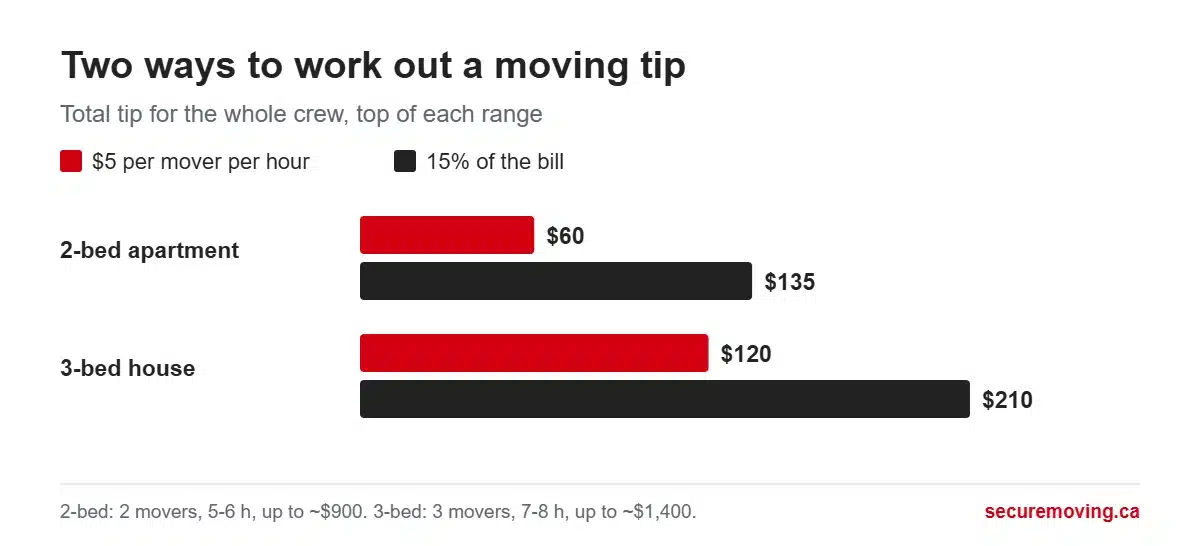
Now compare that with a straight 15 per cent. Take a three-bedroom move totalling around $1,400: 15 per cent is $210, almost double the per-hour figure, for exactly the same work. Neither number is wrong. The per-hour version simply tracks effort rather than the size of the invoice, and effort is the thing you are thanking people for.
For context on what that money means to the person receiving it: WorkBC puts the median wage for furniture and household goods movers in BC at $22.00 an hour, and the provincial minimum wage rose to $18.25 on 1 June 2026. A $5 hourly tip is close to a quarter on top of a typical mover’s pay for that day.
What Canadians think about tipping in 2026
If tipping has started to feel like a chore, you are in good company. An H&R Block Canada survey of 1,545 adults, run by the Angus Reid Forum in February 2026, found that 67 per cent think Canada should get rid of tipping culture altogether. Nine in ten (93 per cent) said they are annoyed by tip prompts for services where they never used to tip, and 89 per cent said the suggested percentages on payment screens are too high.
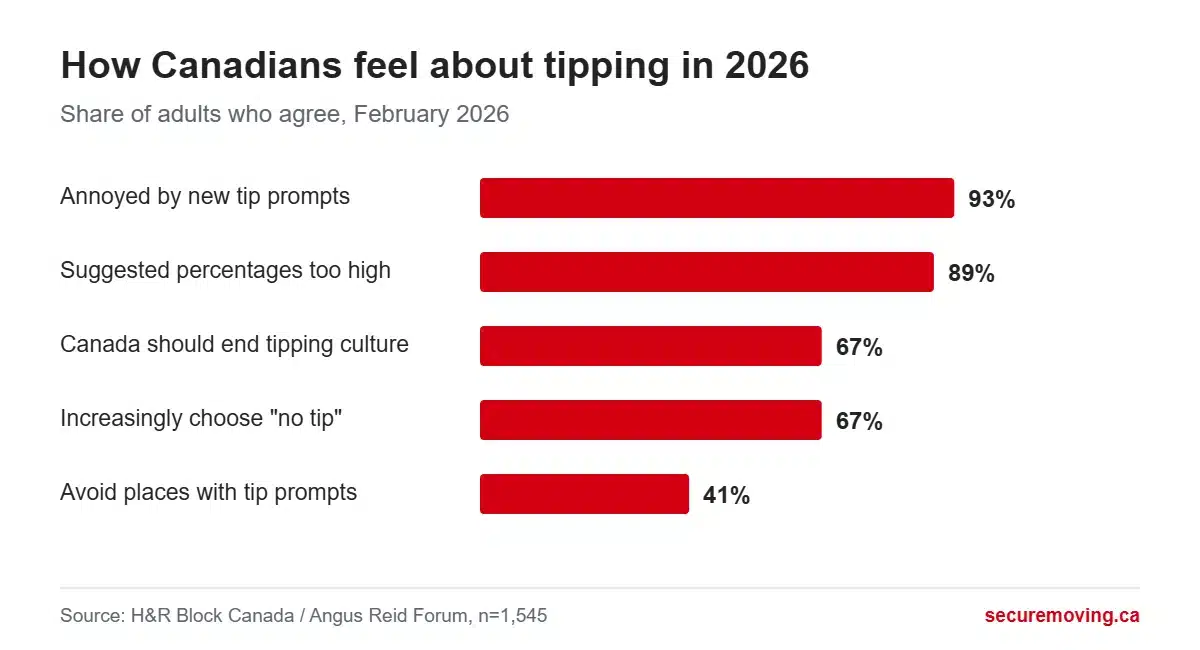
None of those polls asked about movers specifically. Moving sits in a slightly different spot from a coffee counter, though. You are dealing with two or three named people who carry everything you own up and down stairs for a whole day, and you can see the effort directly. It explains why tipping movers has held up better than tipping at a payment screen, and also why it should stay a judgement about the work rather than a reflex.
Cash, e-Transfer or card: where your tip actually goes
This is the part almost nobody explains, and in BC the answer is written into law.
Since amendments to the Employment Standards Act came into force in 2019, a tip belongs to the employees it was meant for. Section 30.3 says an employer cannot withhold a tip, deduct anything from it, or require workers to hand it over. The Act’s definition of a gratuity also covers money paid to the employer when a reasonable person would understand it was meant for the crew, so a tip added to the company’s invoice or card machine still legally belongs to the movers.
Section 30.4 lets an employer pool tips and share them among the crew. Owners, directors and shareholders cannot take a share unless they regularly do the same work as the crew, for example an owner who drives the truck and carries furniture alongside everyone else.
In practice, here is how the options compare:
- Cash, handed to each mover: still the simplest. Each person gets exactly what you meant for them, on the day. Hand it over individually rather than giving one envelope to whoever happens to be nearest.
- Cash or e-Transfer to the crew lead: fine if the crew lead splits it on the spot. Say how many people it is for.
- Added to the card payment or invoice: legally still the crew’s money in BC. Asking the office how card tips are paid out is perfectly reasonable, and a good company will tell you without hesitation.
Two tax details, briefly. A tip you give freely is not subject to GST, according to the Canada Revenue Agency. A mandatory service charge printed on a bill is different: it is part of the price, it is taxable, and it is not a tip. For the movers, tips are taxable income either way, which is their business rather than yours.
Long-distance moves: two crews, two tips
When the move runs from Vancouver to Calgary, Edmonton or Toronto, the people who pack and load your truck are usually not the people who unload it. Sometimes the driver is a third person again. Tip the loading crew when they finish in BC, and set aside a second tip for the delivery crew at the other end.
Long-distance moves are generally priced on weight and distance rather than hours, so the per-hour method does not fit as neatly. Most Canadian guides land on $50 to $100 per person for a full day of loading or unloading, toward the top end if the job involves a lot of stairs or a long carry from the truck. Only meeting the driver at delivery? They do the longest stretch of the job, so it is worth including them.
Not sure who will turn up at the far end? Ask when you book. Our long-distance moving team can tell you whether the same crew travels with the truck on your route, and our long-distance moving tips cover the rest of the planning.
When it is fair to tip less, or not at all
Tips reward good work, so it is reasonable to scale them back when the work was not good. Fair reasons include a crew that arrived very late with no call, careless handling you watched happen, damage they tried to hide, or rudeness to you or your building staff.
Be fair about what was not in their control, though. A strata that double-booked the elevator, a bridge closure, or a parking spot nobody reserved are not the crew’s fault. Neither is a job running long because the boxes were not packed when they arrived.
Damage is a separate issue from tipping. If something breaks, report it to the company in writing and keep the paperwork, because a claim against the mover is how you get compensated. Withholding a tip does not replace that process, and tipping does not waive your claim.
What helps a crew as much as a tip
Movers will tell you the best thing a customer can do costs nothing: be ready. Boxes packed, sealed and labelled, beds stripped, the fridge emptied, the elevator booked and a parking spot held for the truck. On an hourly move, all of that also saves you real money, often more than the tip itself.
Small comforts matter too. Cold water on a hot day, access to a washroom, and somewhere to sit for a lunch break are always appreciated. Pizza or coffee is a kind gesture on top of a tip, not instead of one, and it is worth asking before you order since some crews prefer to eat on their own schedule. Skip the beer: crews are driving a heavy truck afterwards.
Booking a move in Metro Vancouver?
Secure Moving’s crews work by the hour, with no add-ons for stairs or elevators. Call 604-500-3003 or get a free quote, and we will suggest the right crew size for your home.
Frequently asked questions
Do you have to tip movers in BC?
No. Tipping is voluntary, and the price you were quoted is the price for the job. Many people do tip for good work, usually $20 to $60 per mover depending on the length of the day.
How much do you tip movers for a small move?
A short job of three or four hours, such as a studio or a few pieces of furniture, earns $15 to $25 per mover from most people who tip. At the per-hour rate, a two-person crew working three hours works out to about $30 in total.
Should the crew lead get more?
Nobody expects it. Some people give the lead a little extra when they also did the walk-through, the paperwork and the planning, but an even split is the usual default.
Do you tip movers if you paid for packing?
Yes, if you tip at all. A packing day is a separate day of skilled labour, so treat it the same way as the moving day and tip whoever did the packing.
Is it okay to tip by e-Transfer?
Yes. Send it to the crew lead and say how many people it should be split between, or ask the office whether tips can go through the company. Under BC law a tip paid to the employer for the crew still belongs to the crew.
Do you tip a single-item or furniture delivery?
A quick one-item job usually gets $10 to $20 per person, which is a kind gesture, and more if it involved stairs or a tight turn. Our single-item furniture movers handle these small jobs all over Metro Vancouver.
How we put this together
Tip ranges reflect what Canadian moving companies and consumer guides published between 2025 and 2026, cross-checked against each other. The hourly examples use the typical crew sizes and durations from Secure Moving’s own Metro Vancouver price guide. Wage figures come from WorkBC and the Province of BC, the poll figures from H&R Block Canada’s February 2026 survey and Research Co.’s May 2025 survey, the employment rules from the BC Employment Standards Act and the Province’s interpretation guide, and the tax points from the Canada Revenue Agency.
Sources
- Province of BC, Employment Standards Act
- Province of BC, Interpretation Guide, section 30.3 (gratuities)
- Province of BC, Interpretation Guide, section 30.4 (tip pooling)
- Canada Revenue Agency, GST/HST on tips and service charges
- Canada Revenue Agency, tips and gratuities
- WorkBC, Material handlers career profile (includes household goods movers)
- Province of BC, minimum wage increase, June 2026
- H&R Block Canada, tipping survey, March 2026
- Research Co., tipping in Canada, May 2025
Planning the rest of the move? Our guide to choosing a moving company in BC covers what to check before you book, and the BC moving checklist has the deadlines that matter in the weeks before. When you are ready, the quote form takes about a minute.
